
Between school, homework, travel and everything else in the week, VCE revision needs a clear place in your routine. A useful plan tells you what to practise, when to revisit it and how to tell whether you are improving.
This guide turns a few evidence-informed learning principles into a practical weekly routine for Year 11 and Year 12 students. The timings below are examples to adapt around your subjects, school requirements and energy levels, rather than a compulsory study quota.
Start with a small, specific weekly plan
Spend ten minutes at the start of the week checking your school calendar, upcoming SACs and recent feedback. Choose a manageable outcome for each subject. Replace “revise Chemistry” with something you can check, such as “complete six equilibrium questions and explain the errors in my answers”.
Put school commitments, meals, sleep, work and sport into your calendar before adding revision. Leave some spare time for difficult homework or a session that needs to move. A plan that only works on a perfect day will be hard to maintain.
Use retrieval and return to topics later
Retrieval practice means trying to recall something before looking at the answer. Close your notes and explain a concept, sketch a labelled diagram or answer a few short questions. Then check your response and correct the gaps.
The Australian Education Research Organisation (AERO) explains that spacing and retrieval practice can help consolidate learning in long-term memory. Build short returns to earlier topics into your week rather than leaving all revision until the night before a test.
For example, after learning a topic on Monday, try a short closed-notes check on Wednesday and another the following week. These intervals are a practical starting point, not a universal formula. Bring a topic back sooner if you cannot explain it accurately, and continue revisiting older material alongside new work.
Move from a worked example to your own attempt
When a method is unfamiliar, begin with a clear worked example from your teacher or textbook. Explain why each step is needed, then attempt a similar question with the solution covered.
This progression reflects AERO’s guidance on explicit instruction: use worked examples and gradually reduce support as understanding develops. Independent practice matters because following someone else’s reasoning does not show whether you can produce the next step yourself.
In Maths, that might mean explaining how an equation is rearranged before solving a new one. In English, examine how a model paragraph connects evidence to an argument, then write a paragraph responding to a different prompt. If you get stuck, identify the exact step and ask your teacher or tutor about it.
A weekly VCE revision routine you can adapt
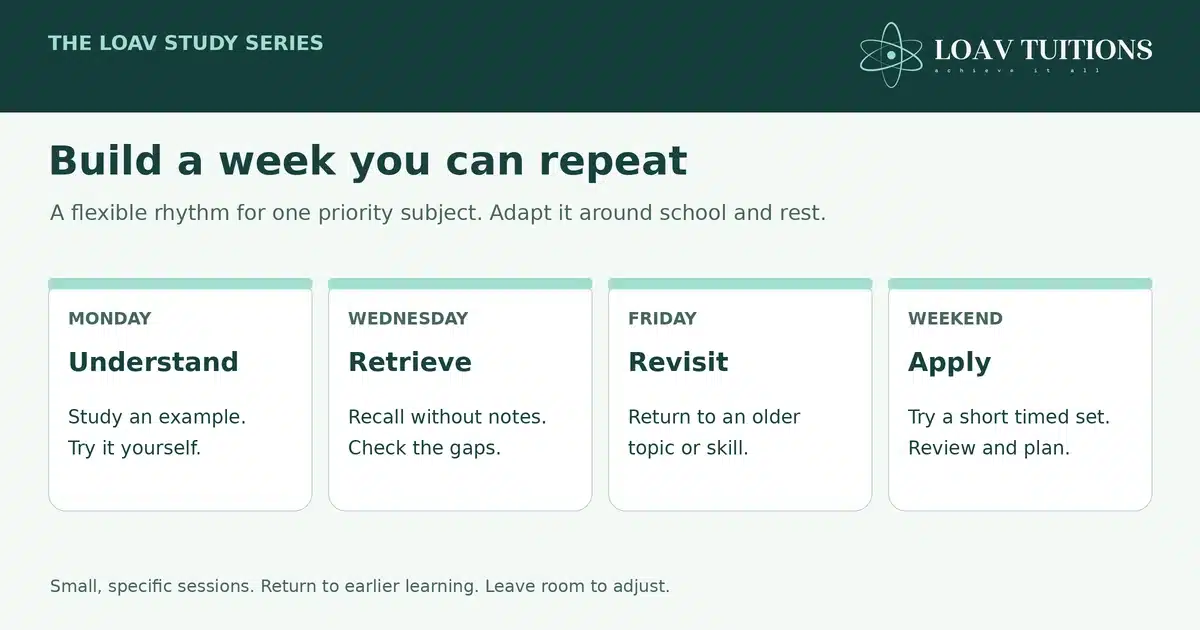
Use this pattern for a priority subject, then distribute your other subjects across the week. It sits alongside required schoolwork; it is not a complete timetable for every VCE subject.
- Monday: understand and practise. Choose one current topic. Review a worked example, then complete a small set of questions independently.
- Wednesday: retrieve and check. Spend 10–15 minutes answering questions from memory. Check your answers and record one point that still needs work.
- Friday: revisit an older topic. Return to something from a previous week. Include a question that asks you to apply it in a different context.
- Weekend: apply and review. Complete a short timed set suited to what you have learned. Mark it, revisit the difficult questions and choose next week’s priorities.
If a SAC is approaching, give its topics more attention while keeping brief review sessions for your other subjects. If the week becomes crowded, reduce the size of a session and move unfinished work into an available slot.
Try this 50-minute study session
- Minutes 0–5: Write the session goal and answer two or three questions from memory.
- Minutes 5–15: Check those answers and work through one example addressing a gap.
- Minutes 15–30: Attempt related questions independently, without checking every step against the solution.
- Minutes 30–35: Take a short break away from the desk.
- Minutes 35–45: Mark your work and redo one incorrect question.
- Minutes 45–50: Add a useful error to your log and schedule the next review.
Adjust the session length and break to suit your needs. Before you begin, put your phone out of reach, open only the resources you need and decide what “finished” looks like.
Keep an error log that leads to another attempt
A simple notebook or document is enough. For each useful mistake, record the question reference, what went wrong, the correction and a date to retry it.
For example: “I differentiated the outside function but missed the inside derivative. Next time, label the inner and outer functions before starting. Retry a similar question on Thursday.” This gives your next session a concrete task. Avoid copying entire solutions into a log that you never revisit.
Separate knowledge gaps from misreading, incomplete explanations and timing problems. Each needs a different response. A recurring conceptual error is a good reason to seek feedback before completing more questions of the same kind.
Add timed practice when the foundations are ready
Start with a short set before attempting a full practice exam. Use the current subject requirements and allowed materials, and reserve time afterwards to review your answers.
The VCAA examination resources include examination specifications, past papers and external assessment reports. Check that questions match your current study design; older papers may cover different content or use a different format. Reports can help you understand common difficulties, but not every report provides a full set of answers. Ask your teacher when the expected response is unclear.
Make the routine sustainable
Set a stopping time, protect time for rest and leave room for life outside school. If you regularly miss sessions, simplify the plan before adding more hours. Parents can help by asking what their child is working towards and what support would make the week easier, rather than checking only how long they have sat at a desk.
At the end of the week, ask: What can I now do independently? Which error keeps returning? What is the next small step? Use those answers to shape the following week.
If you would like help identifying gaps or building a practical revision plan, explore Loav Tuitions’ VCE tutoring or send a tutoring enquiry.
Free weekly and daily VCE study planner
Turn the routine into your own realistic week. Use the weekly page to choose priorities and revisit dates, then use the daily page for a focused session and a quick reflection. Adapt the timings around school requirements, rest and other commitments.
Download the printable study planner (PDF) or download the editable study planner (Word). Free to use, with no email sign-up.
