
A VCAA examiner report can help explain why an answer worked, what a question required and where students struggled. It becomes less useful when you copy a strong response into your notes without working out how it answers that particular question.
The aim is to turn a report into a few decisions you can use in your own writing or problem-solving. Here is a practical way to read one alongside your work, while keeping the original question firmly in view.
Start with the right documents
VCAA calls these documents external assessment reports. Its official examination resources hub explains that they describe student performance and can support exam preparation. Some include answers to examination questions.
Open the report beside the matching examination paper and your own response. Check the subject, year and examination, especially where more than one paper or timetable appears. Use the current examination specifications and study design to establish what applies to your course.
For example, the VCAA English examination page separates current-study-design materials from older examinations and also links assessment criteria and expected qualities. VCAA warns that papers from previous study designs may not guide the current examination. Ask your teacher which older questions remain useful.
Attempt the question before reading its commentary
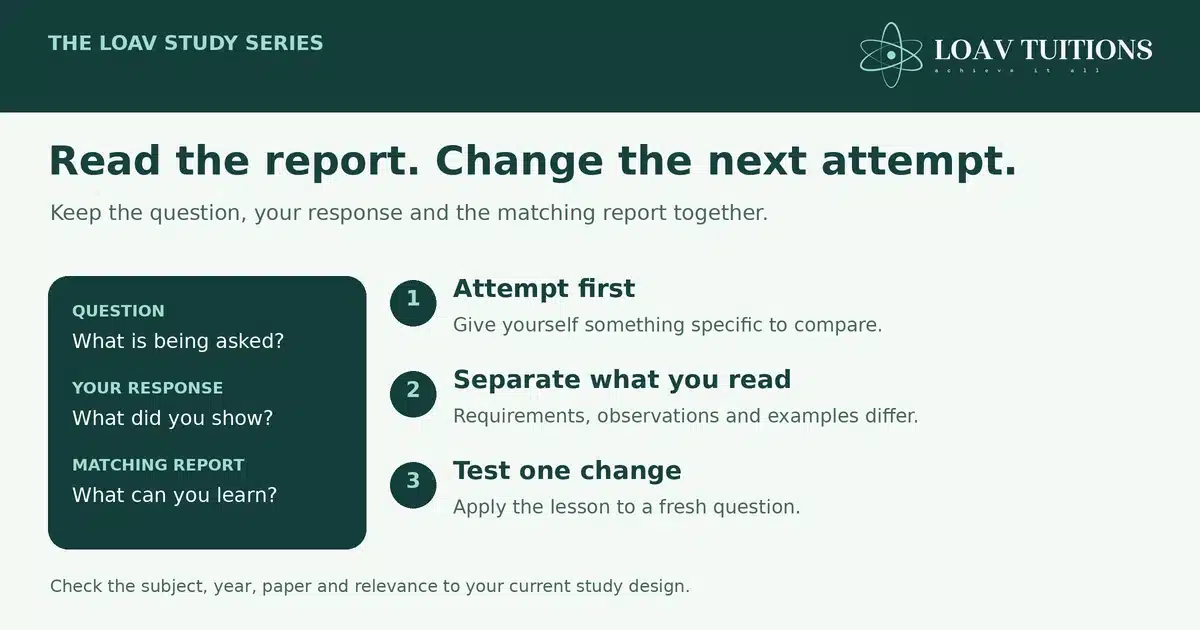
Choose one question you have already tried, or make a short independent attempt before opening that section of the report. For a longer task, an argument plan or partial response can still give you something specific to examine.
Record where you hesitated. Did you understand the instruction? Could you choose evidence? Did you know the content but struggle to connect it to the situation?
Now you have a reason to read. Instead of highlighting everything that sounds important, look for information that explains a decision you made or a gap in your response.
Separate requirements, observations and examples
Read each relevant passage with three questions in mind:
- Requirement: What did this question ask students to demonstrate?
- Observation: What does the report say about the responses students produced?
- Example: How does any supplied answer illustrate a successful approach?
Keep those categories separate in your notes. An observation about what students commonly did is not automatically a rule for every future question. An example that suits one prompt may contain details that would be irrelevant to another.
If the report includes question-level results, use them to add context. A question that many students found difficult can still expose a skill you need to learn. Avoid using past performance figures to predict what will appear next or to decide that a topic is safe to ignore.
Annotate what the answer does
When an example response is provided, describe the job performed by each important part. Depending on the question, that might be identifying the relevant feature, selecting evidence, explaining a relationship, qualifying a claim or reaching a supported conclusion.
Use your own short labels rather than collecting impressive phrases. Beside a sentence, you might write “connects this evidence to the question” or “explains why the first step is valid”. Then check whether your response performs that job.
Keep the actual assessment criteria beside you where available. The labels above are reading aids, not a universal answer formula or a promise of particular marks. Some tasks need a concise calculation; others need sustained reasoning.
Turn one observation into a testable change
Here is an invented example to show the method. Suppose a practice task asks whether a proposal is justified using two pieces of supplied evidence. Your response states an opinion and mentions only one piece of evidence.
A useful note would be: “Before writing, identify all the evidence the question requires and decide how it supports or limits my conclusion.” Copying a polished concluding sentence would leave the missing reasoning unresolved.
Revise your response, explaining how each relevant piece of evidence affects your judgement. Then try a different prompt with different evidence. Check whether you can make the same reasoning decisions without borrowing the first answer’s content.
AERO’s Extend and challenge guide describes using varied tasks to help students apply and deepen their learning. Applying a lesson from a report to a fresh task is one practical way to pursue that aim.
Know when to ask for clarification
A report may not resolve every marking question. If your wording differs from an example, do not assume that either matching words or sounding sophisticated establishes the quality of your answer.
Bring your teacher a precise question: “I made this claim and used this evidence. Which part of the question have I not addressed?” Include the original prompt, your response and the relevant report passage.
Keep each reading session manageable. One question investigated properly can give you a useful next step. You do not have to annotate every report for every subject at once. Parents can support this by asking what changed in the student’s next attempt, rather than how many reports they downloaded.
Your examiner-report checklist
- Match the report to the exact paper and check current-course relevance.
- Attempt the question before reading the commentary.
- Distinguish task requirements from observations and examples.
- Identify what a strong response does, using the relevant criteria.
- Make one concrete change and test it on a fresh task.
- Ask your teacher about unresolved questions.
If you would like support applying feedback to your own responses, explore Loav Tuitions’ VCE tutoring or send a tutoring enquiry.
Free examiner-report reflection worksheet
Use one page to connect the question, your own response and the matching report. Separate requirements from observations and examples, choose one change and test it on a fresh task. This Loav worksheet is an independent learning aid, not a VCAA publication or marking guide.
Download the printable reflection worksheet (PDF) or download the editable reflection worksheet (Word). Free to use, with no email sign-up.
