
You plan to finish a revision set in half an hour. An hour later, you have answered the questions but still need to check the difficult ones. The next task has already lost its place in the afternoon. Before deciding that you need more discipline, check whether your estimate included the whole job.
A small record of predicted and actual study time can help you make your next plan more realistic. The aim is to fit useful learning into the time available, without turning every session into a race.
Start by defining what finished means
“Do Biology” has no clear endpoint. “Attempt four short-answer questions, check them and rewrite one incomplete explanation” does. A useful time estimate belongs to a task with an observable result.
Keep that result consistent when you compare sessions. If yesterday's record includes marking but today's estimate includes only answering, the numbers will mislead you. Likewise, a familiar exercise and an unfamiliar extended problem are different jobs even when both occupy one page.
Write one sentence before starting: “Finished means I have attempted the set independently, checked each response and identified the next correction.” If you need teacher feedback before you can check an answer, record that dependency rather than pretending the work is complete.
Use your own recent evidence
In their 1994 research, Buehler, Griffin and Ross found optimistic completion-time predictions across academic and nonacademic tasks. One experiment reduced the bias when participants connected relevant past experiences to their predictions. This supports looking back at comparable tasks, but does not establish a universal time multiplier or prove that a particular revision log raises VCE results. Read the original study.
The routine below is Loav's practical suggestion. Try it on three comparable sessions, then decide whether it improves your planning. A notebook line is enough; you do not need a tracking app or a record of every minute of your life.
- Name the complete task. Include the question set, checking and one useful correction.
- Estimate before starting. Note the expected working time and the time available in your day.
- Record the actual time afterwards. Separate time spent working from breaks or unavoidable interruptions.
- Explain the main difference. Was a method unfamiliar, were the solutions unclear, or did you forget to allow for marking?
- Adjust the next comparable task. Change its size, the time reserved or the support you need.
A worked example of a better estimate
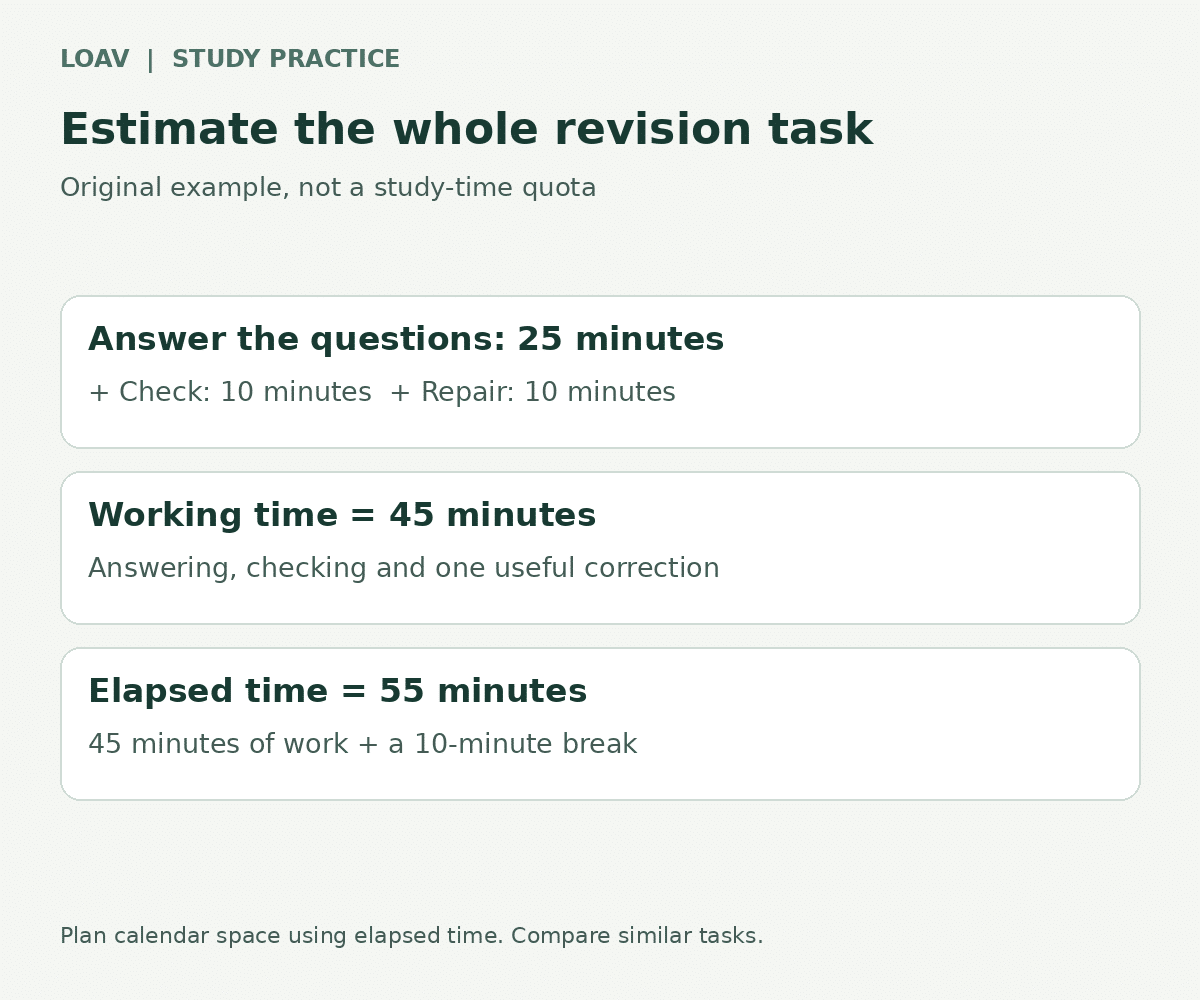
Imagine you predict 30 minutes for six revision questions. Answering takes 25 minutes, checking takes 10 and repairing one mistake takes another 10. You also take a 10-minute break. The task used 45 minutes of working time and 55 minutes from start to finish.
Those numbers tell two different stories. A calendar needs room for the 55-minute span. Your learning plan needs to recognise that checking and correction were substantial parts of the work. Recording only “25 minutes to answer” would leave the same gap in tomorrow's plan.
Suppose three similar complete sets take 45, 50 and 40 working minutes. Use roughly 45 minutes as an initial estimate for another comparable set, then consider its difficulty and any needed breaks. Three observations are limited evidence, not a prediction rule. A new topic or a much harder set may require a different allowance.
When only 30 minutes are available
Keep the appointment, meal, work shift or bedtime that defines your stopping point. Choose a smaller complete task: perhaps three carefully selected questions with checking, rather than six questions with no review. The right number depends on the questions, so treat this as a planning example rather than a fixed conversion.
Choose questions that address a specific uncertainty or recent error. Write down what you will defer. If something essential cannot fit before a real deadline, speak to your teacher or tutor early about priorities. Adding every unfinished task to tomorrow without removing anything simply moves the problem.
Do not confuse learning time with examination time
During learning, you may pause to understand a step or seek feedback. During a realistic timed practice, follow the current paper's conditions and record what you could complete within them. Keep these records separate. Speed on an easy familiar set does not establish readiness for a whole examination.
Use the official VCAA examination timetable and your school's advice to confirm actual examination arrangements. Your personal revision estimate cannot change an official start time or writing period.
Tonight's checklist
- Have I defined a result I can actually check?
- Does my estimate include marking and correction?
- Am I comparing work of similar difficulty?
- Have I allowed for the difference between working time and elapsed time?
- If the task overruns, what will I reduce or defer?
Start with one task today. After three comparable sessions, replace one optimistic estimate in your plan with an evidence-based allowance. You can then use Loav's weekly study routine to place the task in a sustainable week. Judge the change by whether the plan is more usable and the work is checked, not by whether you can make every session faster.
