
You have finished a VCE practice exam, checked the score and found a few disappointing answers. What should you study next? “Do another paper” is one option, but first work out what this paper has revealed.
A useful review ends with a short list of repairs you can test. This guide takes you from a marked paper to that list, without turning every mistake into hours of extra work. The review categories and examples below are practical suggestions, not official VCAA marking rules.
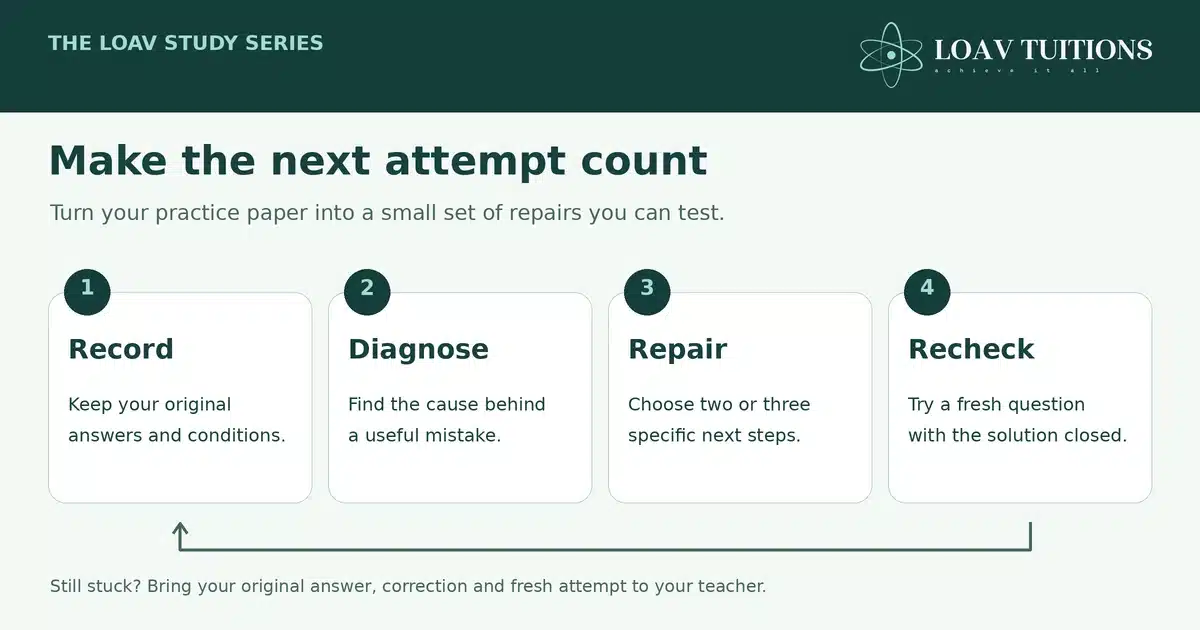
1. Keep an honest record of the attempt
Before changing anything, write down how you completed the paper: timed or untimed, with or without notes, and whether you finished. Note interruptions, unfamiliar content and any questions you had seen before.
Keep your original answers visible. Use another colour or a separate page for corrections so that you can distinguish what you knew independently from what you understood after reading a solution.
If you are exhausted, take a break before reviewing. You can mark the paper in one sitting and investigate the main difficulties in another.
2. Check that your marking reference fits
For official papers, begin with the VCAA examinations and external assessment reports hub. It provides subject-specific examination specifications, past papers and reports. Some reports include answers; do not assume every report is a complete marking guide.
Match the subject, year and paper carefully. If your practice exam came from school or another provider, use its accompanying guidance and ask your teacher about uncertain marks. Check whether older questions still fit your current study design before treating a whole paper as representative.
Mark only what your original response actually shows. For an extended response, record uncertainty rather than awarding yourself a precise score you cannot justify. “Teacher to check whether my evidence supports the argument” is more useful than an optimistic guess.
3. Diagnose the cause behind the lost marks
For each important mistake, ask what stopped you answering successfully. These five categories provide a starting point:
- Knowledge: you could not recall or explain the relevant concept.
- Selection: you knew possible methods but chose one that did not fit.
- Interpretation: you missed a condition, instruction or part of the question.
- Execution: the approach was sensible, but a calculation, unit, label or reasoning step went wrong.
- Completion: time ran out, or you spent too long deciding how to begin.
Allow more than one category. “Careless” is too vague to guide a repair: identify the observable slip. Did you copy a negative sign incorrectly, overlook “using the data”, or answer only the first half of a prompt?
Also review correct guesses and answers you could not explain. A tick does not tell you whether you can repeat the reasoning on a new question.
4. Test your diagnosis with one small task
Consider this invented, subject-neutral example: a question asks you to compare two patterns shown in a graph. Your answer describes only one. The immediate problem may be interpretation rather than a lack of content knowledge.
Try another short comparison question without time pressure. Before answering, identify both items and the feature you will compare. If you can then make a supported comparison, practise recognising the task under modest time pressure. If you cannot interpret the graph itself, ask for help with that skill first.
This is the difference between a useful diagnosis and a label. AERO’s Monitor progress guide emphasises checking what students understand and can apply, then responding with guidance, feedback or further instruction. Here, the small follow-up task helps you and your teacher choose that response.
5. Choose two or three repairs
You do not need to fix every weakness before moving on. Start with recurring errors, gaps that block several questions, and skills your teacher identifies as priorities. Keep less urgent issues on a separate list.
For each priority, record four things:
- Evidence: the question and the specific problem.
- Repair: the explanation, worked example or feedback you need.
- Practice: a small set of relevant questions.
- Check: what you will attempt independently afterwards.
For example: “I omitted units in three numerical answers. I will check the required quantities, correct those responses, then complete a fresh short set and inspect every final answer for the appropriate unit.” This is a bounded task with something observable to check.
6. Recheck before adding another full paper
After correcting a response, explain the change in your own words. Later, attempt a different question that tests the same skill. Keep the solution closed until you have made a genuine attempt.
AERO’s spacing and retrieval practice guide supports returning to learning over time and correcting errors. Your follow-up can be brief; there is no need to make every check another full exam.
If the difficulty remains, bring your original answer, correction and fresh attempt to your teacher or tutor. Those three pieces make a focused question possible. Parents can help by asking which repair the student wants support with, rather than comparing practice scores.
Your post-exam review checklist
- Record the conditions and preserve the original attempt.
- Use the matching reference; flag uncertain marking.
- Investigate recurring mistakes and correct guesses.
- Choose two or three specific repairs.
- Test the repaired skill on a fresh question.
For help working through a difficult paper, explore Loav Tuitions’ VCE tutoring or send an enquiry with your subject and the skill you want to improve.
Free practice-exam review and error log
Record the conditions of your attempt, investigate the most useful mistakes and choose a small number of repairs. Bring uncertain marking to your teacher, then use a fresh question to check what has improved. This is a study aid, not an official marking guide.
Download the printable review and error log (PDF) or download the editable review and error log (Word). Free to use, with no email sign-up.
Download the Excel review and error log (.xlsx) with reflection questions, adjustable column widths, more writing space and easy sorting.
