
When your teenager has been at the desk for an hour and still seems stuck, it is tempting to take over. You might explain every step, rewrite a paragraph or keep asking whether the homework is finished. The immediate task may move forward, but it can become harder to see what your teen can do independently.
For Melbourne families navigating secondary school and VCE, a useful starting point is to agree on your role: help your teen get organised, talk through obstacles and find appropriate support, while leaving the thinking and final work with them.
Ask what kind of help would be useful
Before opening the textbook, ask: “Would you like me to listen, help you work out the next step, or help you find someone to ask?” This gives your teen a say in the support they receive.
If they say “I don't get any of it”, narrow the conversation gently:
- “Which part of the instructions makes sense so far?”
- “Can you show me the first point where you get stuck?”
- “Is the difficulty understanding the idea, choosing a method or explaining your answer?”
You do not need to know the subject to help them describe the problem. “I can substitute numbers into the formula, but I don't know which formula to choose” is a useful question to take to a teacher.
Agree on a small, predictable check-in
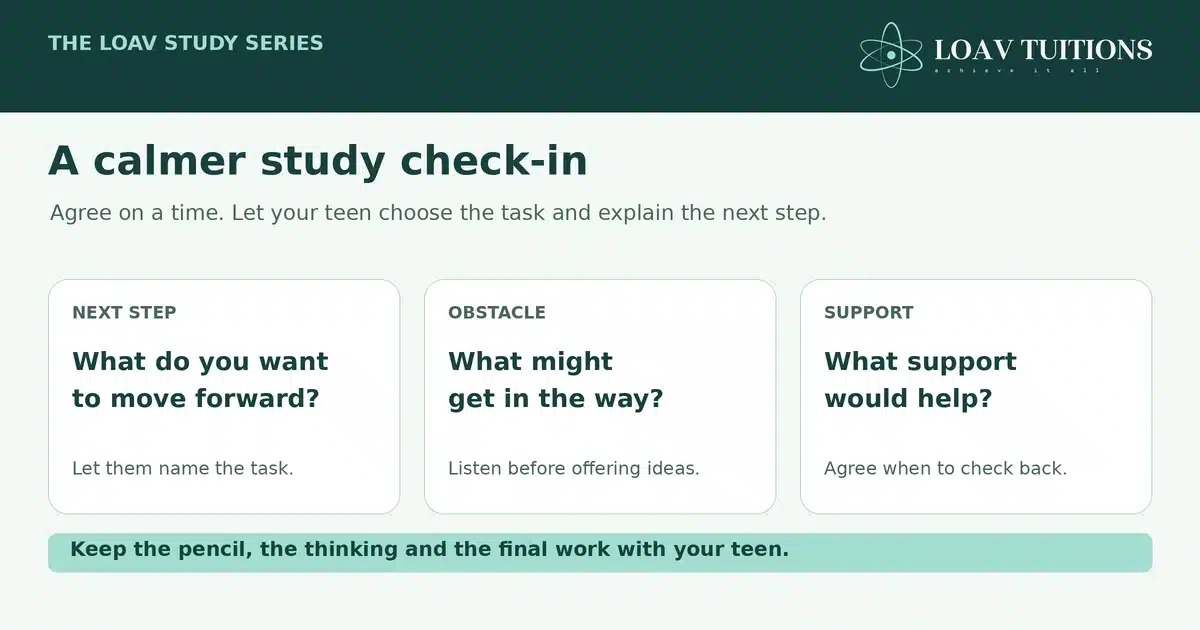
Repeated reminders can make every conversation feel like a progress inspection. Instead, agree on a brief check-in at a time that suits both of you. Keep it focused on three questions:
- What is the next piece of work you want to move forward?
- What might get in the way?
- What support would help, and when should we check back?
For example: “I'll attempt the first three questions, mark where I get stuck and ask my teacher tomorrow. Could you help me find a quiet space after dinner?” Your contribution might be practical: coordinating family noise, making shared materials available or helping them identify a realistic starting point.
Let your teen propose the task and report back in their own words. Adjust the amount of support as they become more able to manage it.
Keep the pencil and the decisions with your teen
If your teen asks for help with a question, invite them to show what they have tried. Ask “Which example from class might help here?” or “What would your first step be?” Give them time to respond before offering another prompt.
With written work, you could ask them to read a paragraph aloud and explain what they want it to show. If the meaning is unclear, say where you lost the thread and let them decide how to revise it. Avoid supplying replacement sentences for assessed work, and follow the school's guidance about permitted assistance.
If neither of you knows what to do next, record the question. Guessing at an unfamiliar method can create more confusion than bringing a specific uncertainty to the teacher.
Offer to be an audience for practice
The Australian Education Research Organisation's spacing and retrieval practice guide explains that recalling previously learnt material and revisiting learning across separate sessions can support longer-term retention. Retrieval should be appropriately challenging, low-stakes and followed by correction of errors.
At home, you might offer: “Would you like to explain yesterday's concept to me without your notes, then check it?” Your teen can use class materials to verify the explanation and identify anything missing. You are providing an audience; the notes or teacher provide the subject-specific check.
They could return to that concept on another day, rather than relying on one long review. These are options to discuss with their teacher, not a guaranteed formula for marks. AERO's Vary practice guide also describes modelling practice strategies as students gradually take more responsibility for revision.
Use school feedback to choose the next question
After an assessment, begin with “What did the feedback help you notice?” A mark alone gives you less direction than a specific comment or worked example.
If the feedback says “show your reasoning”, ask your teen which answer they could discuss with the teacher. They might ask: “I included these steps. What extra reasoning would make the method clear?” Then encourage them to apply that feedback to a similar practice question themselves.
Repeated uncertainty about instructions, difficulty starting without a worked example, or the same error across several tasks are reasons to clarify the learning need. Avoid turning those observations into labels such as “lazy” or “bad at maths”. With your teen involved, ask the teacher what they have noticed and which skill should come next.
Ask a tutor how independence will develop
If you are considering VCE tutoring, ask questions about the learning process:
- How will you identify what my teen understands independently?
- How will sessions connect with schoolwork and teacher feedback?
- What should they practise between sessions?
- How will you check whether they can tackle a similar question without help?
Include your teen in that conversation. Agree on a specific starting goal, such as choosing a method independently or explaining a solution clearly.
You can enquire about a Loav Tuitions trial class to discuss suitable support. At home, keep the goal manageable: help your teen recognise what they understand, ask a clearer question and take the next step themselves.
Free parent–teen weekly study check-in
Agree on a short check-in together. Let your teen choose a manageable priority, name the support they want and decide when to revisit it. Keep the completed sheet private; it is a conversation aid, not a scorecard or a substitute for school guidance.
Download the printable check-in worksheet (PDF) or download the editable check-in worksheet (Word). Free to use, with no email sign-up.
