
When a science task feels difficult, two habits can keep you stuck: waiting silently for it to make sense, or asking someone to give you the whole answer. A more useful middle step is to show what you have tried and ask for help with one decision.
This is a study habit for students interested in John Monash Science School, and for anyone working on more challenging school science. It is not an interview script or an admission technique. You can practise it during ordinary homework without adding another full preparation session.
Keep study advice separate from admissions information
The official JMSS FAQs identify scientific aptitude and scientific writing among the assessed areas, say that the assessments are unique to JMSS and change each year, and state that the school does not encourage tutoring for the entrance test or interview. The routine below is independent learning advice, not an official requirement, endorsed preparation method or guarantee of entry.
For the current application cycle, use the school's admissions information. Learning to ask a clear science question is worthwhile regardless of which school you attend.
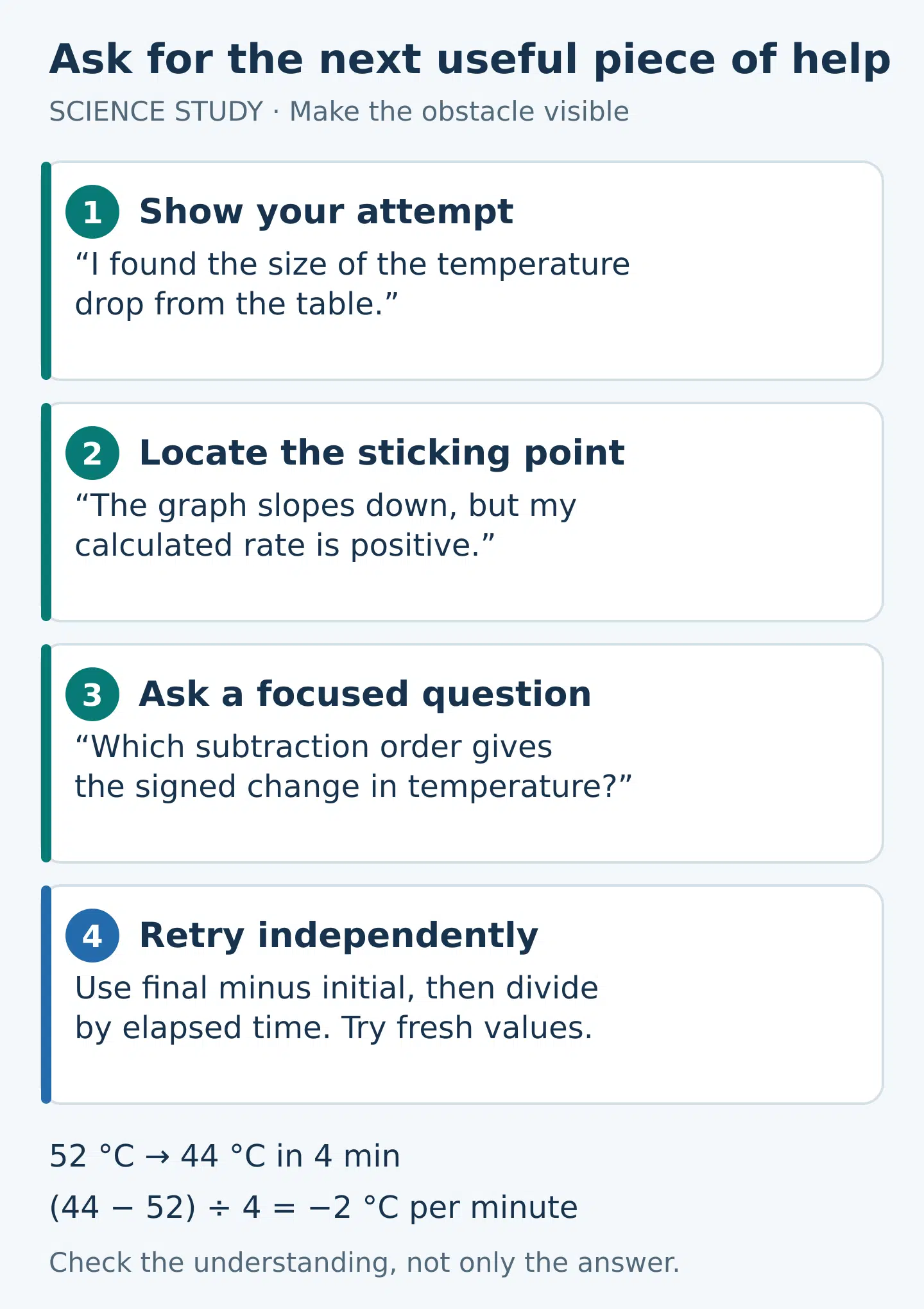
First, find the point where understanding stops
Read the instruction once more and make a small attempt. This might be labelling the axes, listing the information given, sketching the setup or writing the equation you think applies. You do not need a polished solution before you are allowed to ask for help.
Then choose the closest description of the obstacle:
- A word is unclear: “I understand the graph, but what does ‘rate’ mean in this question?”
- A representation is unclear: “I can read each axis, but I cannot explain what this point represents.”
- A step is unclear: “I know the two temperatures. I do not know which order to subtract them in.”
- Two ideas conflict: “My calculation is positive, but the graph slopes down. Which part of my reasoning should I check?”
If you are missing the background concept altogether, say so. A hint may be too small; you may need a short explanation and an easier example. Repeating the same unsuccessful attempt for half an hour is not a condition you must meet before asking.
Use a three-line help request
Before speaking to your teacher or a suitable study partner, write three short lines:
- My attempt: “I tried…” Include the relevant working, not your whole notebook.
- My sticking point: “I can follow… but I cannot explain…”
- My question: “Could you help me decide…?” Ask for the next useful piece of information.
For example: “I calculated the temperature drop from the table. I can find the size of the change, but my answer has a different sign from the graph's gradient. Could you help me decide the subtraction order for a signed change?”
That question gives the other person something to respond to. It also lets you check whether the response actually resolves your uncertainty. “Can you check everything?” may be reasonable during a review, but it is less useful when one decision is blocking your next step.
Try an original example: a cooling table
These are invented values for a paper exercise, not instructions to carry out an experiment. A liquid's temperature is recorded as 60 °C at 0 minutes, 54 °C at 2 minutes and 48 °C at 4 minutes. The task asks for the average rate of change of temperature from 0 to 4 minutes.
A student writes The student then notices that the temperature is falling. A focused request is: “I found a drop of 12 degrees. When the question asks for the rate of change, how do I show the direction of that change?”
A useful hint is: write final temperature minus initial temperature before dividing by elapsed time. The student can then complete the calculation: The negative sign describes a decrease in temperature.
The size of the temperature drop per minute is 3 °C per minute; the signed average rate of change is −3 °C per minute. Read the question's wording and state clearly which quantity you mean. The goal of the exchange is to understand that distinction, not merely to replace one answer with another.
Close the loop after receiving help
Put the explanation aside and complete the blocked step yourself. Say what changed in your thinking: “I had used initial minus final. For the signed change, I need final minus initial.”
Now try a fresh case: a sample's temperature changes from 52 °C to 44 °C over 4 minutes. Its average rate of change is If you can calculate and interpret this without seeing the earlier working, you have evidence that the hint helped.
If you still cannot explain the new case, return with the new attempt. “I understood the first calculation but cannot apply it here” is useful feedback. Ask for a different representation or a simpler example instead of pretending the explanation was enough.
Make help practical and respectful
Ask at an appropriate time and follow your teacher's preferred way of receiving questions. If there is no time during class, keep the exact question and ask when an opportunity is available. A short written note can help if speaking in front of others feels difficult.
When helping a friend, let them finish explaining their obstacle before you start solving. Offer one hint or clarify one term, then hand the task back. Do not insist that every learner should need the same amount of support. For assessed work, follow the school's rules about permitted assistance and keep submitted work your own.
A 1997 study by Ryan and Pintrich surveyed 203 Year 7–8 students in mathematics classes. It examined how perceived benefits and social concerns related to reported help-seeking, and distinguished useful requests for clarification or hints from avoiding help. This was not a trial of the routine above, nor a study of JMSS applicants. It offers context for treating help-seeking as a learning skill rather than a sign that a student should already know everything.
If your question begins with something you have read, Loav's short science-reading routine can help you separate the source's statement from the uncertainty you want to discuss.
Your next step: choose one genuinely unresolved science question this week. Bring your attempt, name the obstacle and request the smallest explanation that is useful. Afterwards, complete a fresh example yourself. Keep the new understanding, not just the corrected answer.
