
If you are interested in John Monash Science School, science reading can begin with something small: a paragraph from your current school topic, one explanation in your own words and one question worth checking. You do not need to turn every interesting idea into another timed test.
This routine is for Year 8–9 students who want to understand what they read. It is an independent learning suggestion, not a replica of a JMSS admission task or a prediction of assessment content.
Keep the goal small
Choose a short section of your science textbook or a resource your teacher recommends. Start with a topic you have already encountered in class. If almost every sentence introduces unfamiliar vocabulary, ask for a more accessible starting point before adding extra reading.
Try one paragraph in a ten-minute session, perhaps once or twice in a week that allows it. Those numbers are flexible starting points, not a research-tested prescription. Keep the source title and page number or link so that you can return to the evidence.
Read the paragraph once for its main idea. Then identify one relationship: a cause and an effect, a structure and its function, or a measurement and the conclusion drawn from it. Your goal is to understand that relationship, rather than collect impressive terminology.
Separate what the source says from what you infer
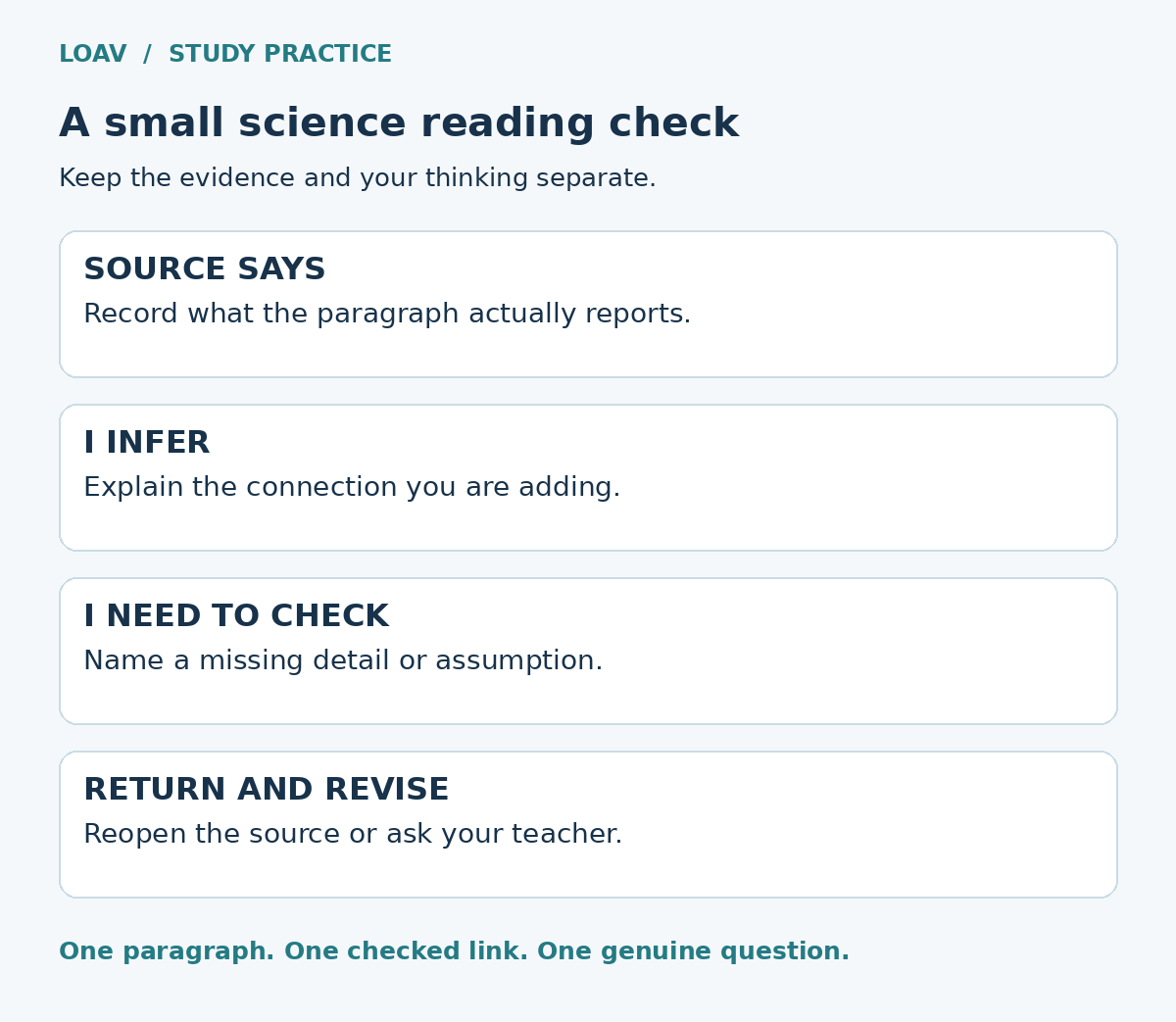
Use three short note headings:
- Source says: What does the passage actually report? Preserve important conditions, quantities and qualifications.
- I infer: What conclusion or explanation am I adding? Give the reason that makes it plausible.
- I need to check: Which missing detail, unfamiliar term or assumption could change my explanation?
An inference can be useful without being certain. Marking it separately makes it easier to revise when you find better information. If a passage says a result occurred in one experiment, do not silently turn that into a claim that it always happens.
Try an original science example
The following is an invented example with hypothetical measurements, not a report of an actual experiment or official assessment material:
Suppose two groups of ten seedlings of the same variety begin at similar heights. One group receives bright light and the other less light for seven days. The average increase in stem height is 1.6 centimetres in the brighter group and 2.8 centimetres in the dimmer group. The report gives no measurements of leaf area or plant mass.
Source says: The dimmer group has a larger average increase in stem height over these seven days. The difference is 1.2 centimetres.
I infer: Less light might have contributed to the difference. However, this description alone does not establish the cause or show that the dimmer group was healthier.
I need to check: Were water, temperature and other growing conditions comparable? How much did individual seedlings vary? Does the full report explain how seedlings were assigned to groups?
Notice the distinction between height and overall growth. A stem-height measurement cannot, by itself, tell you how plant mass or leaf area changed. You can identify that limitation without needing to explain every biological mechanism behind the result.
Explain and check one link
Choose one part of your thinking and ask, “Why does that follow?” In the example, examine the leap from “larger increase in height” to “healthier plant”. Explain aloud why the available measurement does not establish that conclusion.
Now reopen the source. Check whether it provides the missing evidence or whether you supplied an assumption. Revise one sentence so that its confidence matches the evidence. For example: “The dimmer group increased more in average stem height, but these measurements do not establish which group was healthier.”
With real school reading, check your explanation against the surrounding text, a labelled diagram or your teacher's explanation. If the answer remains unclear, keep the uncertainty visible rather than filling it with a confident guess.
There is a research basis for trying self-explanation. In Chi and colleagues' 1994 study, 24 eighth-grade students read about the circulatory system. Students prompted to explain showed greater improvement than those assigned to read twice. The prompted group also spent longer studying. This small study did not test a ten-minute home routine or JMSS admission outcomes, so it supports a cautious learning idea rather than a guaranteed result.
Keep a genuine question and protect your school balance
Finish with one question you actually want answered. For the example: “Would measuring leaf area lead to the same comparison between groups?” Bring it to a suitable class discussion or ask your teacher when convenient. You do not need a polished answer immediately.
Keep ordinary homework, sleep and other interests in the picture. During a busy assessment week, shorten or skip the extra session. A small habit should support school learning, not become another source of pressure.
For application requirements, use the official JMSS enrolment page independently of study advice. JMSS states that its entry process differs from other selective-entry schools and that it does not endorse tutoring companies. This article offers no admission guarantee.
For separate background, see Loav's independent JMSS admissions guide and science reasoning and writing guide. Keep this reading session focused on one paragraph, one checked link and one genuine question.
Want feedback on your next study step? Request a trial lesson with Loav and tell us which subject and skill you would like help with.
Sources
- John Monash Science School: Student Enrolment.
- Chi, de Leeuw, Chiu and LaVancher (1994): Eliciting Self-Explanations Improves Understanding, Cognitive Science, 18, 439–477.
