
A worked Physics solution can look obvious while it is open beside you. The difficulty appears when the next question has different numbers, a different direction or no suggested first equation. To bridge that gap, change how much of the solution you can see.
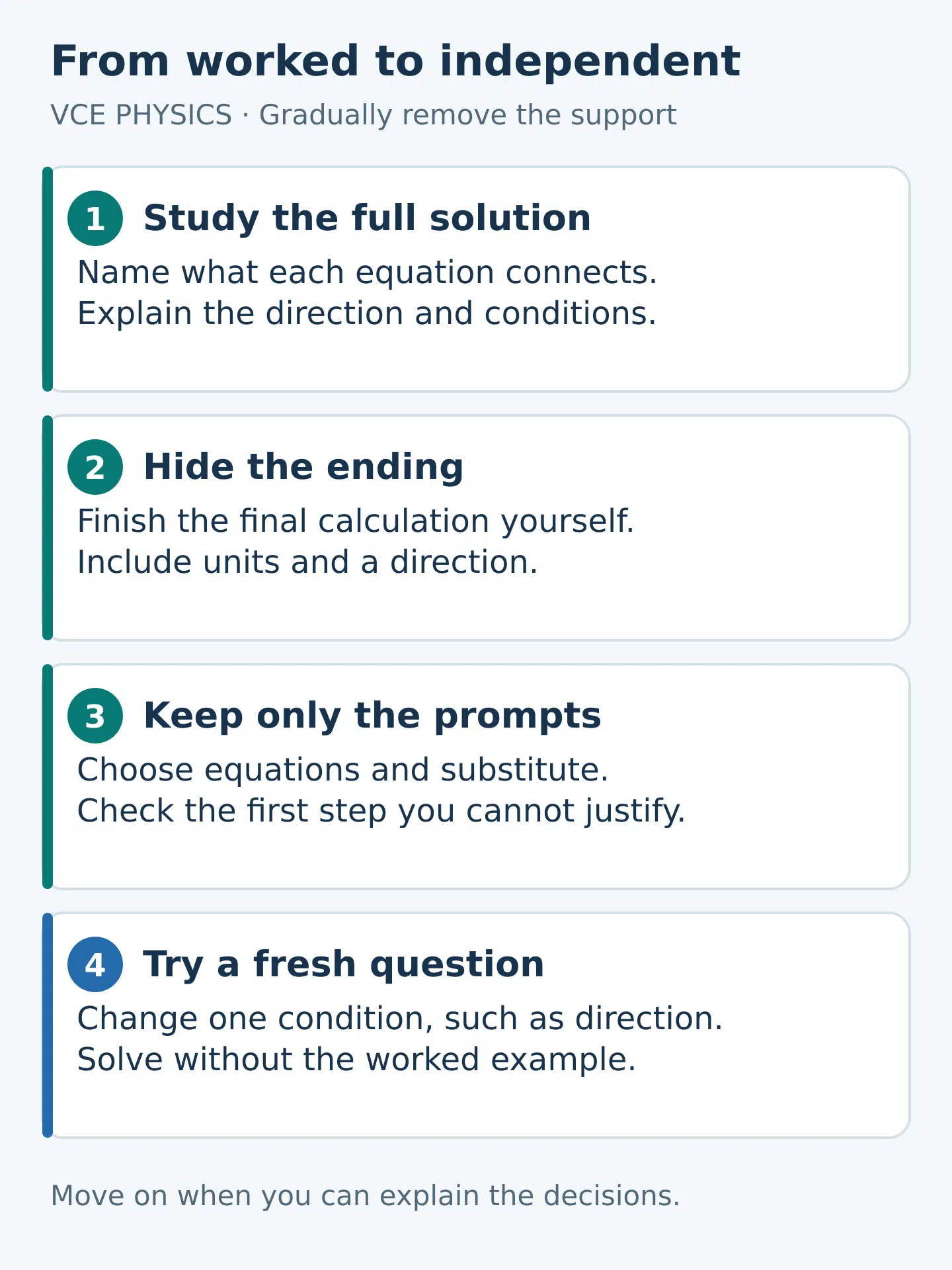
Try moving through four stages: study a complete example, finish a partly completed one, complete more of a new solution, then attempt a fresh question independently. The aim is to make the decisions yourself, not to reproduce a familiar page from memory.
Choose one small skill and a reliable example
Start with a question type you have been taught but cannot yet complete reliably. Combining net force with constant-acceleration motion is a manageable example. Do not begin with a multi-page problem that contains several unfamiliar ideas.
Use your teacher's checked working or a trustworthy worked example. VCAA's Physics examination resources identify papers linked to the current study design and provide the current formula sheet. Older papers can include material from earlier designs, so select questions with your teacher's guidance. The exercises below are original practice, not VCAA questions or a marking scheme.
Stage 1: explain a complete solution
Original example: A 0.50 kg cart initially travels east at 2.0 m/s. A constant net force of 1.5 N acts east for 4.0 s. Find its final velocity. Treat the cart as a particle moving along a straight line.
- Choose a direction: take east as positive. The initial velocity is +2.0 m/s and the net force is +1.5 N.
- Find acceleration: ΣF = ma, so
- Find final velocity: v = u + at = 2.0 + (3.0 × 4.0) = +14 m/s.
- Interpret: the final velocity is 14 m/s east. The cart speeds up because its acceleration is in the direction of its initial motion.
Next to the working, answer three questions: Why can the constant-acceleration equation be used? Why is 1.5 N divided by mass? What tells us the final direction? The given force is already the net force; do not add another imagined force to it.
The force and motion equations are included on the 2026 VCAA Physics formula sheet. Your job is to connect them to the conditions in the question.
Stage 2: finish the ending
Use a fresh but similar question: a 0.40 kg cart starts east at 1.0 m/s and experiences a constant net force of 0.80 N east for 3.0 s. Take east as positive.
Keep this scaffold visible: Then v = u + at = 1.0 + (2.0 × 3.0). Cover the answer and finish it yourself, including direction. Then check: 7.0 m/s east.
If only the arithmetic is missing, this is a small step. That is useful at the beginning. It should not become the whole session. Once you can finish and explain the line, remove more help.
Stage 3: complete the missing reasoning
Now try a 0.60 kg cart initially moving east at 3.0 m/s. A constant net force of 1.2 N acts east for 2.0 s. Leave only two prompts visible: find acceleration, then find final velocity.
Write the equations, substitution, units and final direction yourself. Check only after a genuine attempt: a = +2.0 m/s2, and v = 3.0 + (2.0 × 2.0) = +7.0 m/s, or 7.0 m/s east.
Identify the first line you could not justify. If it was choosing an equation, another round of arithmetic will not address the problem. Return to the complete example and explain what each equation connects. If it was substitution, practise naming each quantity before entering values.
Stage 4: solve independently, with one condition changed
Put the worked examples away. A 0.80 kg cart initially travels east at 5.0 m/s. A constant net force of 0.40 N acts west for 4.0 s. Find the final velocity. Keep east positive.
This time, choosing a sign matters. The acceleration is: Therefore v = 5.0 + (−0.50 × 4.0) = +3.0 m/s: 3.0 m/s east. The force points west, but the cart is still travelling east at the stated time. It has slowed down; it has not yet reversed.
If you obtained 7.0 m/s, locate the line where the westward force became positive. If you wrote 3.0 m/s west, separate the direction of acceleration from the direction of velocity. Repair that decision before doing another question.
Use the support level as your progress check
A flexible session might take 20–25 minutes. Spend a few minutes understanding the full example, then use most of the time on incomplete and independent questions. Stop sooner if fatigue is producing repeated slips; take longer if a concept needs explaining. These timings are a practical suggestion, not a research-tested prescription.
- Still need the full solution? Ask for an explanation of the specific line you cannot follow.
- Can finish with prompts? Try a new question with fewer prompts.
- Can solve without prompts? Change one feature, such as force direction, and explain why the method still applies.
- Can do it only immediately afterwards? Return to a fresh question in a later session before treating the skill as secure.
Research by Renkl and colleagues (2002) examined gradually removing worked solution steps. Across their studies, this supported learning, especially on similar transfer problems; removing later steps first was more favourable than removing early steps first. The research did not test this cart sequence or establish a VCE score improvement. It provides a reason to try a gradual transition, rather than assuming that reading a solution is enough.
For a separate accuracy check after solving, see Loav's Physics units and estimation routine. Keep the focus here on removing solution support rather than adding more checks at once.
Your next step: choose one checked example from your current Physics revision, prepare two partially completed questions and finish with one unseen attempt. Record which decisions you made without help. That tells you more than how many solutions you read.
