
A calculator can evaluate the expression you enter perfectly while the expression itself is wrong. Physics revision therefore needs a small checking habit between choosing a relationship and trusting the displayed number.
Try adding two lines to a few practice calculations: one prediction before substitution, and one comparison afterwards. The aim is to catch errors while their cause is still visible. This is a suggested study routine, not an additional VCAA examination requirement.
The current VCAA Physics examination specifications include the key science skills as well as Units 3 and 4 knowledge. The 2026 Physics formula sheet supplies relationships and metric prefixes. Practise using them to check your reasoning, rather than treating the first familiar formula as automatically suitable.
Predict a scale or direction first
Before entering numbers, write something you can test. A useful prediction may concern an approximate size, a sign, or the way an answer should change when one input changes. It does not need to be an accurate mental calculation.
For example, dividing a few hundred by a number smaller than one should produce a result larger than a few hundred. That expectation will not identify every mistake, but it can expose a missing conversion immediately.
Keep the prediction independent of your calculator result. If you write it afterwards, it is easy to adjust your expectation to match whatever appeared on the screen.
Keep units visible: an electric-field example
Original practice question: Two large parallel plates have a potential difference of 240 V and a separation of 8.0 mm. Estimate the magnitude of the electric field in the approximately uniform region between them, away from the edges.
Start with the physical model: a uniform field between parallel plates. For its magnitude, use E = ΔV ÷ d. Here ΔV is the potential difference across the gap and d is the plate separation. This is not the expression for the varying field around an isolated point charge.
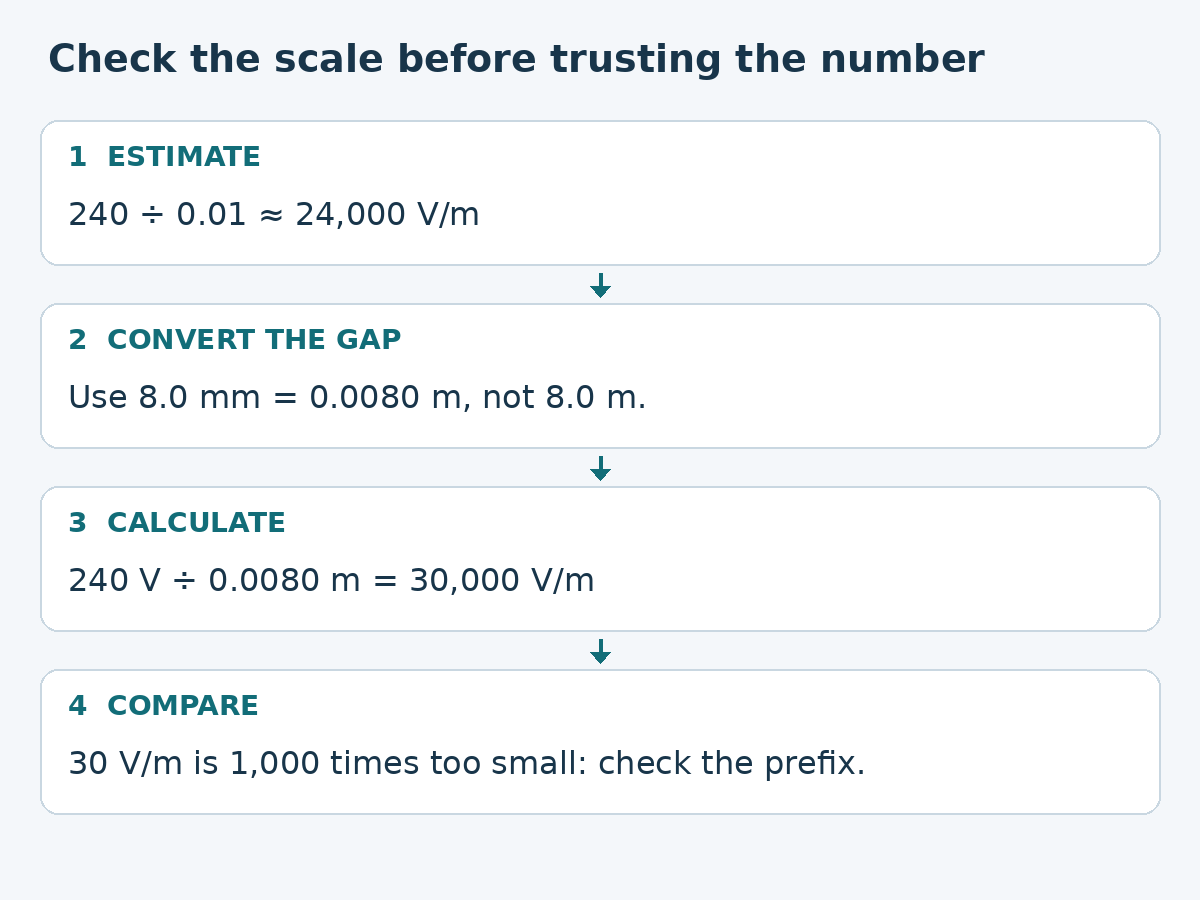
Before calculating: the gap is about 0.01 m, so a rough calculation gives 240 ÷ 0.01 = 24,000 V m−1. Because 0.0080 m is smaller than 0.01 m, the final magnitude should be somewhat larger.
Convert visibly: 8.0 mm = 8.0 × 10⁻³ m = 0.0080 m.
Calculate: E = 240 V ÷ 0.0080 m = 3.0 × 10⁴ V m−1.
Compare: 30,000 V m−1 is close to the estimate and larger in the expected direction. The answer has the units of electric field, and two significant figures are appropriate given the stated separation.
Diagnose the wrong answer, not just its size
Suppose you entered 240 ÷ 8 and wrote 30 V m−1. The division is correct, but the unit label is not. With the gap entered in millimetres, the quotient is 30 V per millimetre. Converting that field to volts per metre gives 30,000 V m−1. Simply attaching the expected unit after calculation hid a factor-of-1000 error.
In your correction, write “converted millimetres to metres before substitution”, rather than “careless mistake”. That description tells you what to do on the next question. Re-entering the same expression several times would confirm the arithmetic without repairing the setup.
Matching units does not prove the model is right
Unit checks are necessary, but they cannot establish that a relationship applies. The expressions ΔV ÷ d and 2ΔV ÷ d both have field units; only one fits this ideal parallel-plate model. A dimensionless factor can be wrong without changing the units.
Ask what assumptions your calculation needs. Is the field approximately uniform? Does the given distance represent the plate separation? Have you used the potential difference across that gap? Are you finding a magnitude, or has the question also asked for direction?
For the latter, a magnitude alone is incomplete: the electric field points from the positive plate towards the negative plate. Do not invent a left or right direction unless the plate labels or diagram establish it.
Practise a two-line check on a short set
Choose three calculations from material your class has covered. Before each, write “I expect…” followed by a scale or trend. After each, write “This is consistent because…” and compare units, magnitude and assumptions. Use a worked solution only after making your own check.
With the plate example, try two quick variations without recalculating every step. Halving the gap while keeping the potential difference fixed should double the field magnitude. Doubling both the gap and the potential difference should leave it unchanged. Explain those predictions from the ratio, then check numerically if needed.
If your estimate and result disagree, inspect the relationship, prefix conversion, powers of ten and calculator entry in that order. If they agree, still check the requested quantity: a sensible field value cannot answer a question asking for force without further reasoning.
Use the current VCAA Physics resources when choosing examination practice. For organising short sessions, see our study-routines guide. Our VCE tutoring information explains the support available if you need help identifying why a calculation keeps going wrong.
Want feedback on your next study step? Request a trial lesson with Loav and tell us which subject and skill you would like help with.
