
A returned school test can leave a Year 7 or Year 8 student looking at the mark rather than the advice beside it. A more useful starting point is one comment that can change the next piece of work. The aim is a small, specific improvement, not another evening spent redoing the whole test.
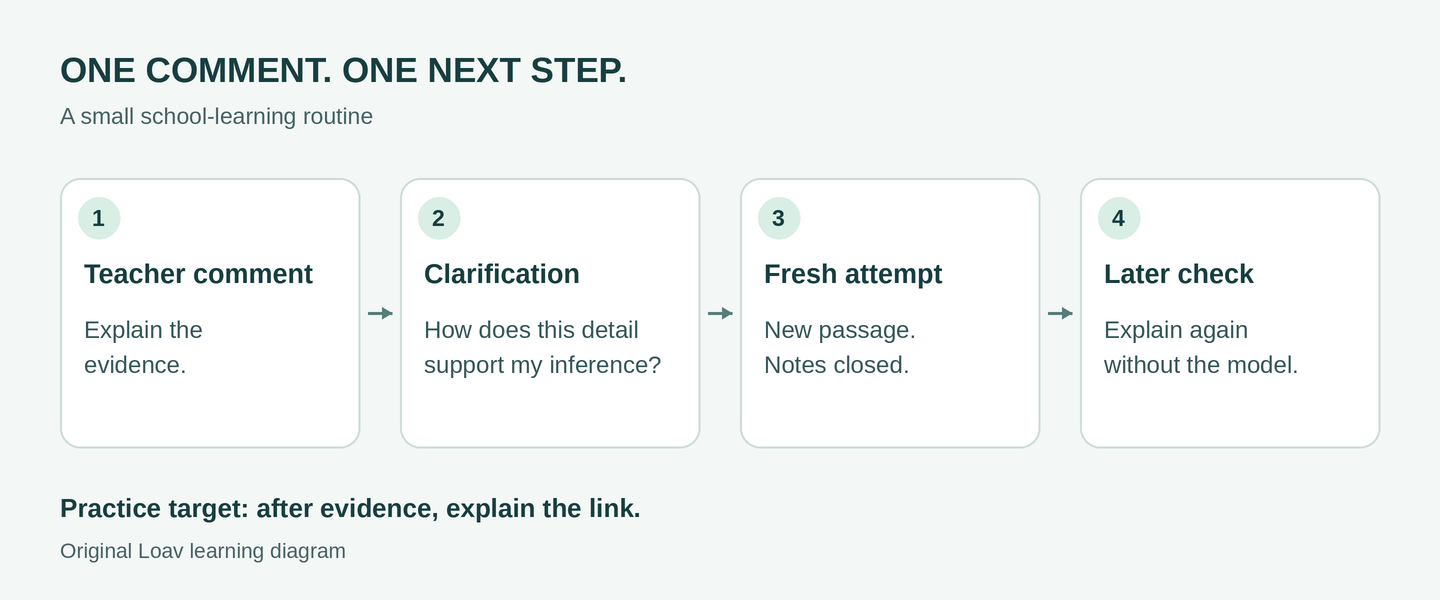
This Loav routine uses four steps: choose a comment, clarify it, attempt a fresh task and check again later. It is a suggestion for everyday school learning, including for families considering Victorian selective entry high schools.
Choose a comment you can act on
Look for feedback about a skill: explaining an inference, keeping units consistent or showing how a calculation follows from the question. Choose something your class is still using. Comparing your mark with a friend’s does not identify what you need to practise.
If the comment says only “more detail”, avoid guessing that the answer needs to be longer. Ask: “Could you show me one place where I needed to explain my reasoning?” Take the marked response with you so the teacher can point to the gap.
Write the next step as an action you can see. For example: “After giving evidence, explain how it supports my inference.” That is easier to check than “get better at English”.
Understand the correction before trying again
Here is an original reading example, written for this activity rather than taken from a school test or entrance examination:
At the classroom door, Mina unfolded her speaking card for the third time. She whispered the opening sentence, took a slow breath and slipped the card into her pocket as the teacher called her name.
Question: What can you infer about Mina’s feelings? Use a detail from the passage to explain your answer.
A first response might be: “Mina is nervous because she looks at her card.” The inference is plausible, but the connection needs explanation. Imagine the teacher comments: “Explain how the detail supports your inference.”
A clearer response would be: “Mina seems nervous about speaking. She checks her card repeatedly and rehearses her opening, suggesting that she wants reassurance that she will remember what to say.” Notice the cautious word “seems”: the passage supports an inference, not certainty about everything Mina feels.
Compare the two responses. The improvement is the connection between the behaviour and the interpretation, rather than extra description. If you cannot explain that difference yet, ask the teacher to talk through one model with you.
Try a fresh school-level task
Close the model answer and use a different, short passage at the level you are studying. A teacher-approved classroom or textbook question is suitable. You can also try this second original example:
When the coach read the team list, Leo’s shoulders dropped. He folded his unused training bib and watched the selected players walk towards the pitch.
What might Leo be feeling, and which detail supports that inference? Write two connected sentences before checking. A plausible answer is that he feels disappointed about not being selected: his dropped shoulders suggest a change in mood, while the unused bib and his position away from the selected players support that reading.
Check the skill, not whether your wording matches exactly:
- Have I made a plausible inference?
- Have I selected a relevant detail?
- Have I explained the link between them?
If the link is still missing, identify that gap and revise once. If you are unsure whether your interpretation fits, save the question for your teacher rather than rehearsing an uncertain answer repeatedly.
In McDaniel and colleagues’ 2011 eighth-grade science research, low-stakes quizzes with feedback improved later performance on assessed content. That supports taking retrieval seriously, but it does not establish that this particular reading routine improves entrance-exam results.
Return after a gap
Leave a short note: “Next check: explain an inference from a new paragraph without the model.” Choose a later school-study session that fits your workload. If the next lesson depends on the skill, seek clarification sooner.
At the later check, try first, then compare with the criteria. If you can explain the connection independently, move on. If not, return to a model or ask for help.
Cepeda and colleagues’ spacing study found that useful gaps depended on how long information needed to be remembered. It studied adults learning trivia facts, so it does not prescribe a universal timetable for Year 7–8 schoolwork.
Keep family support light and the SEHS context accurate
A parent can ask, “What did the comment help you change?” and listen to the explanation. Let the student choose the evidence and write the answer. Our guide to helping your teen study without doing the work offers related support.
For selective entry, ACER’s official advice says exam practice or revision is unnecessary. It recommends familiarity with the question style and format, alongside age-appropriate learning, and cautions that sample questions may not reflect exam difficulty. This article’s routine is Loav’s school-learning suggestion, not an ACER requirement.
Tutoring is not required to use it, and progress on school tasks does not predict admission. For context, read our selective entry exam overview and check the Victorian Government’s current entry information.
Want feedback on your next study step? Request a trial lesson with Loav and tell us which subject and skill you would like help with.
