
Loav reading room · VCE English · 2026
Shirley Jackson makes the home both a refuge and a disturbing enclosure. Merricat Blackwood’s account draws readers close enough to understand her fear, while making that closeness uncomfortable. The novel rewards a double reading: examine the violence directed at the sisters, then examine what their defence against that violence demands. Spoilers follow.
Course and edition
The novel appears on the 2026 VCAA English and EAL List 1. The nominated edition is Penguin Classics, 2009, ISBN 9780141191454. The quotations below are checked against the Penguin 2006 text, which includes Jonathan Lethem’s introduction. Only Jackson’s novel is quoted; introductory criticism is excluded. Chapter references are used because pagination varies between editions.
Understand the story’s changing boundaries
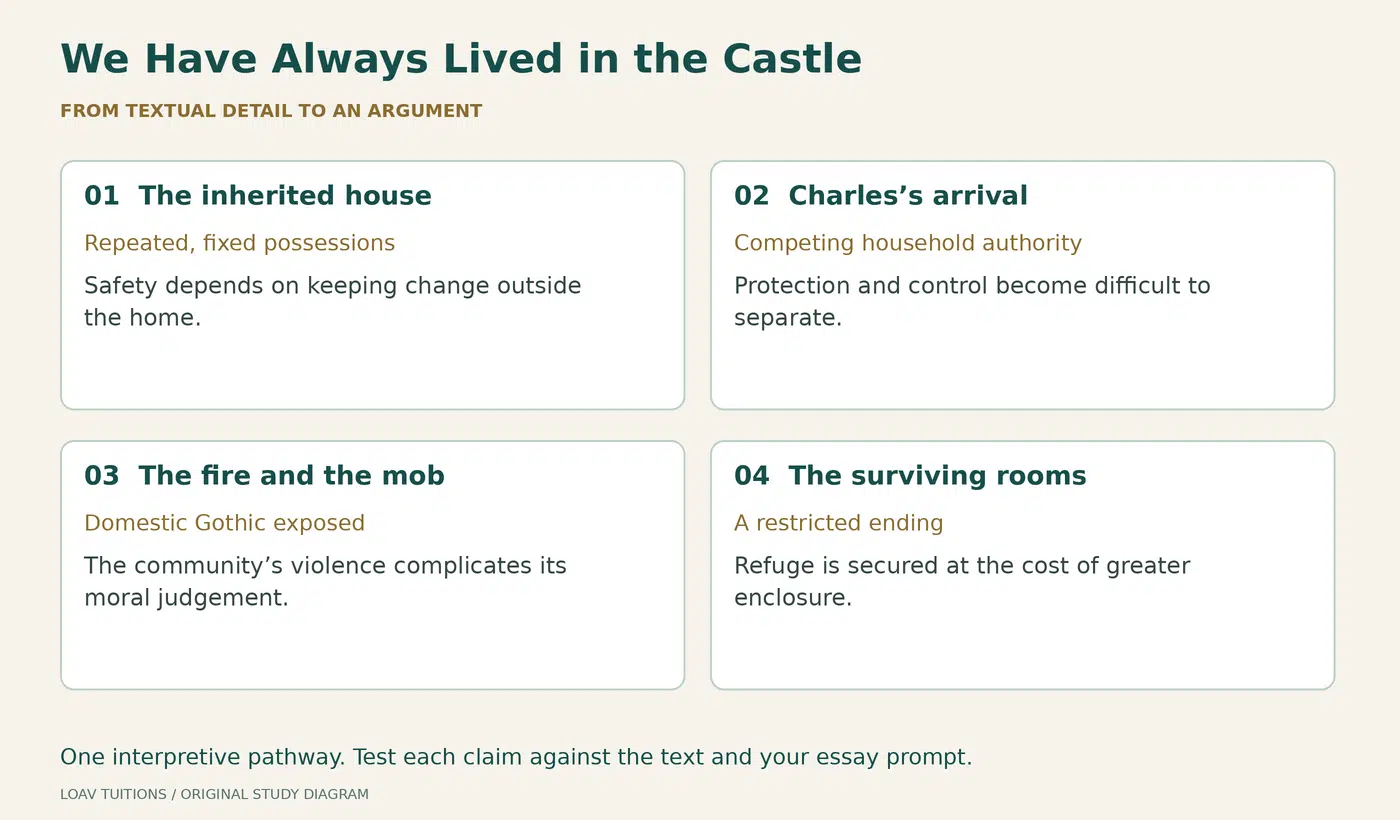
Merricat, her sister Constance and their uncle Julian live apart from the village after most of their family died from poisoning. Constance was tried and acquitted, but acquittal has not restored ordinary membership of the community. Merricat handles essential trips outside while Constance’s life remains closely bounded by the property. Repeated routines make their household seem stable, yet those routines are also organised around fear.
Cousin Charles’s arrival disturbs that arrangement. His interest in the family’s money and his growing influence within the house threaten Merricat’s position. The conflict should not be reduced to a stranger invading an entirely harmonious home. He reveals tensions already present: Constance’s possible desire for change, Merricat’s need for control and the continuing power of property and family hierarchy.
A fire is followed by the villagers’ destruction of the house. Julian dies, and the sisters retreat into the surviving space. Merricat’s responsibility for the original poisoning becomes explicit. The ending therefore offers no simple return to innocence. The sisters establish a new routine, and gifts left by villagers can suggest guilt or attempted reparation. Yet distance survives. Their security is achieved through a smaller world rather than a repaired relationship with the community.
Characters: sympathy without simplification
Merricat controls the narrative as well as trying to control the household. Her rituals and fantasies express a desire for predictable boundaries. They are not evidence that supernatural magic objectively works. Because the reader receives events through her, intimacy and reliability must be distinguished: understanding why she fears something does not prove that every interpretation she offers is accurate.
Constance provides food, care and continuity. Her practical work sustains the home, but care can become inseparable from accommodation of Merricat’s demands. Avoid describing her as merely passive. Ask what she chooses, what she fears, and which alternatives remain imaginable at different points.
Julian repeatedly reconstructs the poisoning. His attempted record contrasts with Merricat’s selective account, but his own memory is fragile. Charles connects family authority to money and possession. The villagers should be analysed through collective actions without assuming every individual behaves identically. Their later gestures complicate persecution without automatically undoing it.
Theme Analysis
Safety can depend on restriction. The house protects the sisters from hostility, yet the conditions of protection reduce movement and connection. Rather than deciding that the house is either safe or imprisoning, examine how the same boundary performs both functions. This is particularly productive for a prompt about freedom.
Community does not guarantee morality. Public suspicion survives legal acquittal, and collective action can become permission for cruelty. Jackson unsettles the assumption that ordinary neighbours necessarily represent reason against a disturbed individual. Nevertheless, recognising persecution does not require excusing Merricat’s violence.
Domestic care has political significance. Cooking, cleaning and preserving are not merely decorative details. They determine how the household continues and who performs the work of sustaining it. Compare Constance’s practical care with Merricat’s symbolic protections and Charles’s claims to influence.
Control of a story is a kind of power. Merricat decides what to disclose and when. Julian tries to impose another order on the same family history. The reader’s changing understanding makes narration itself part of the conflict rather than a neutral window onto it.
Form and atmosphere
Jackson uses first-person narration to align readers with an unsettling consciousness before requiring them to reassess it. Domestic Gothic locates disturbance in familiar rooms, family relationships and everyday rituals. Repetition can create comfort while signalling a life resistant to change. The contrast between public village space and private household space organises encounters through exposure and retreat. The title sounds permanent, but the action shows violent alterations in what living there means. Fairy-tale patterns invite a reading of the ending as escape while its losses complicate the possibility of uncomplicated happiness.
Quote Bank by Theme
Grouped by theme for planning, with short contextualised extracts from the text. Chapter or section references are the stable locators. Any printed page numbers apply only to the identified edition, never automatically to a different school edition. Read each passage in context before adapting it.
Security, property and change
“we had always a solid foundation of stable possessions”
Voice and location: Merricat. Chapter 1.
Context: She explains why the household seldom moves its inherited objects.
Authorial analysis: The architectural metaphor turns property into emotional support; its solidity also suggests resistance to adjustment.
“A change was coming, and nobody knew it but me.”
Voice and location: Merricat. Chapter 3.
Context: After Helen Clarke’s visit, Merricat watches Constance look towards the driveway.
Authorial analysis: Exclusive knowledge asserts narrative authority, while Constance’s outward gaze suggests desires Merricat cannot wholly control.
“Get the safe out of the study downstairs”
Voice and location: Charles. Chapter 8.
Context: During the fire Charles calls from the crowd for the safe to be rescued.
Authorial analysis: The imperative prioritises property during a human emergency, exposing the material interests behind his familial authority.
Community, persecution and violence
“Fridays and Tuesdays were terrible days, because I had to go into the village.”
Voice and location: Merricat. Chapter 1.
Context: The opening explains her twice-weekly errands.
Authorial analysis: The ordinary weekly schedule normalises fear: public participation becomes a recurring ordeal rather than liberation.
“Above it all, most horrible, was the laughter.”
Voice and location: Merricat. Chapter 8.
Context: After Jim Donell breaks a window, the crowd attacks the house.
Authorial analysis: The superlative locates horror in collective pleasure as well as physical destruction, making communal respectability morally unstable.
“Merricat, said Constance, would you like a cup of tea?”
Voice and location: The crowd’s chant. Chapter 8.
Context: The villagers repeat the mocking rhyme as the sisters try to escape.
Authorial analysis: The borrowed voices and domestic invitation turn hospitality into public humiliation; the collective performance spreads cruelty across generations.
Love, control and restricted survival
“our most loved daughter Mary Katherine is never punished”
Voice and location: A parent’s voice imagined by Merricat. Chapter 7.
Context: Alone in the summerhouse, Merricat invents a family dinner that centres her wishes.
Authorial analysis: The fantasy converts love into exemption from consequences. It is imagined speech, not a reliable memory of parental behaviour.
“We are going to lock ourselves in more securely than ever.”
Voice and location: Constance. Chapter 9.
Context: After the fire and Julian’s death, Constance rules out renewed visits.
Authorial analysis: The comparative makes protection an intensification of confinement; Constance now voices the retreat rather than merely submitting to it.
“I never wanted to speak about it, ever, and I’m sorry I did.”
Voice and location: Constance. Chapter 9.
Context: Constance apologises for having reminded Merricat of why the family died; Merricat then explicitly identifies the sugar as the poison’s vehicle.
Authorial analysis: The apology treats speaking about the poisoning as the wrongdoing, revealing how protective tenderness can suppress accountability.
“The boards across the kitchen windows were ours, and part of our house, and we loved them.”
Voice and location: Merricat. Chapter 10.
Context: The final chapter describes the sisters’ attachment to the altered house.
Authorial analysis: Possessive repetition transforms barriers into beloved possessions, connecting survival to a diminished world without proving their happiness false.
Practice Prompts
- In Jackson’s novel, the desire for safety makes freedom increasingly difficult. Discuss.
- How does Jackson make readers question the moral authority of the community?
- The sisters’ relationship is sustained by both love and control. To what extent do you agree?
- How does Merricat’s narration shape the reader’s response to violence?
Full Annotated Essay
Past-exam basis: Adapted from 2025 VCAA Section A, Question 20ii, concerning resistance to change in the novel. Official 2025 examination. Adapted practice wording: How does Jackson portray change as threatening, and does the ending complicate that portrayal?
This complete original essay uses BCAS, three TEEAEAL paragraphs and CAS as teaching scaffolds. Six contextualised quotations span Chapters 1, 3, 8, 9 and 10, linking close language analysis to the whole narrative. The theme bank supplies additional evidence for adaptation.
Introduction
Shirley Jackson’s We Have Always Lived in the Castle places two sisters within a household organised against intrusion and uncertainty. Change is largely experienced as unwelcome because it threatens the protective order through which they survive, but the novel ultimately shows that resistance cannot prevent transformation. Inherited routines make stability seem essential, hostility outside the home makes openness genuinely dangerous, and the retrospective narrative reveals that the sisters must construct a new order after catastrophic disruption. Jackson presents resistance to change as understandable, controlling and finally unable to preserve the world it seeks to defend.
Body 1: preservation as security
Jackson first makes change threatening by associating security with the preservation of an inherited domestic order. Merricat’s rituals, Constance’s practical care and Julian’s reconstruction of the poisoning organise the household around different forms of continuity. Their dependence on familiar arrangements makes Charles’s arrival a struggle over who defines its future. Explaining the inherited objects, Merricat insists that “we had always a solid foundation of stable possessions”. The architectural metaphor makes property support emotional security. Yet the foundation sustains a household already damaged by violence; its stability cannot be equated with innocence or mutual freedom. Anticipating Charles’s arrival, she announces, “A change was coming, and nobody knew it but me.” The exclusive claim makes anticipation a form of narrative control. It is immediately complicated by her observation that Constance looks outward towards the driveway: what Merricat reads as a threat may contain a possible future for her sister. Charles then turns that possibility towards his own authority and material interests. Jackson therefore stages competing desires within the home, rather than opposing a wholly harmonious household to one intrusive stranger. Resistance protects familiar relationships while also defending the power to decide which changes those relationships may accommodate.
Body 2: external hostility
Moreover, Jackson represents communal hostility as a material reason why greater openness is unwelcome. Helen Clarke’s visits show that outside contact remains possible, but the village’s collective conduct makes such contact genuinely dangerous. Narratorial anxiety and observable aggression must be considered together. Merricat explains that “Fridays and Tuesdays were terrible days, because I had to go into the village.” The weekly schedule makes fear habitual, turning an ordinary shopping routine into recurrent exposure. Because the judgment belongs to Merricat, it cannot alone establish the moral character of every neighbour. However, during the attack she observes, “Above it all, most horrible, was the laughter.” The superlative locates horror in communal pleasure as well as smashed possessions. Jim Donell’s movement from firefighting to throwing a rock further destabilises the community’s claim to protective authority. The contrast between routine taunting and the later mob reveals how a town can manufacture the isolation it condemns. Charles’s cries for the safe additionally show that an apparent family ally may prioritise property over the sisters’ welfare. Resistance to change is thus neither merely irrational nor an adequate moral defence of everything Merricat does; it emerges from the interaction of fear and actual persecution.
Body 3: unavoidable transformation
Nevertheless, Jackson shows that resistance cannot prevent change, but can shape the restricted form in which survivors accommodate it. The fire destroys the possibility of preserving the original household. Julian’s death, the damaged rooms and the loss of ordinary contact force Constance and Merricat to create another way of living. After the fire, Constance declares, “We are going to lock ourselves in more securely than ever.” The comparative turns security into increasing exclusion. Crucially, Constance speaks this decision herself: her agency survives, but after violence its expression takes the form of closing possibilities that she had earlier contemplated. Merricat later reports, “The boards across the kitchen windows were ours, and part of our house, and we loved them.” The repeated conjunctions and possessive language incorporate a barrier into the family’s cherished belongings. This echoes the earlier foundation of possessions while changing what those possessions are. The sisters’ affection is real within the narrative, yet the boards make its restrictive conditions visible. The villagers’ offerings can acknowledge guilt without rebuilding reciprocal community life; survival does not amount to reconciliation. The final order is therefore a product of transformation, exposing the paradox that the pursuit of permanence creates a narrower shared world.
Conclusion
Change is consequently unwelcome without being avoidable or uniformly destructive. The authority of inherited routines, the reality of external hostility and the retrospective revelation of a new domestic order explain both resistance and adaptation. Jackson’s ending offers survival, but its restricted form asks whether securing a world against further change also diminishes what living freely within it could mean.
Analysis annotations
Structure map: The introduction follows BCAS: background establishes the text’s central tension, the contention gives a qualified answer, the arguments forecast the three body paragraphs, and the summary draws those claims into an authorial perspective. Each body follows TEEAEAL: an idea-led topic sentence and elaboration establish the claim; two evidence-and-analysis movements develop it; the link returns to the prompt. The conclusion follows CAS: it restates the qualified contention, synthesises the arguments and resolves their wider significance. These functions remain within the continuous prose; the labels are teaching tools, not VCAA requirements.
Transitions should name a logical movement, not merely announce another paragraph. Nominalisations such as refusal, possession and reconstruction help track concepts, but keep the author and textual action clear.
- Argument: The contention explains why change is resisted, then qualifies resistance through the ending rather than contradicting itself.
- Evidence range: Quotations from the opening, the anticipation of change, the mob attack and the aftermath test the argument across the novel.
- Transitions: “Moreover” gives an additional cause for resistance. “Nevertheless” moves from motives to the limits of control.
- Perspective: The essay distinguishes Merricat’s interpretation from Jackson’s construction and identifies the narrator’s retrospective position.
- Nominalisation: Preservation, continuity and adaptation name linked concepts. Each remains connected to a textual example.
Sources and quotation checks
- VCAA 2026 text list: status, nominated edition and contextual annotation.
- Penguin authorised primary-text sample: earlier opening comparison only; the expanded bank is checked against the Penguin 2006 text identified above.
- LitCharts plot reference: secondary cross-check of the late plot, not a quotation source or source of the original models.
- VCAA 2025 assessment report: guidance on topic-responsive analysis.
For help applying this analysis to your own writing, explore Loav’s VCE tutoring or enquire about a trial class.
