
Loav reading room · VCE English · 2026
Debra Dank’s collective narrative asks readers to encounter belonging as a continuing relationship. Its stories connect people, place and generations without making an isolated individual the measure of everything.
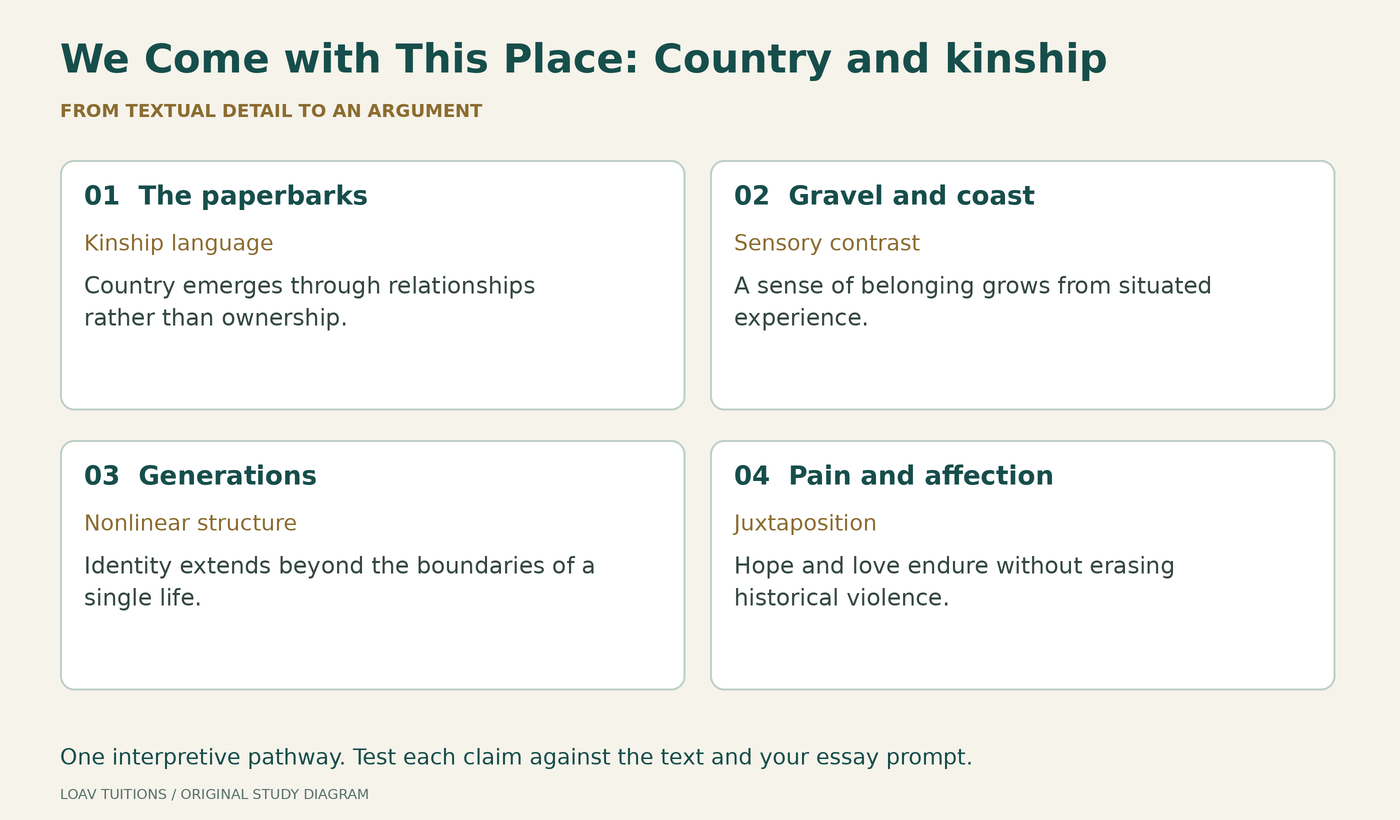
2026 scope and respectful orientation
The prescribed edition is Debra Dank’s We Come with This Place, Echo Publishing, 2022, ISBN 9781760687397. It is a List 1 nonfiction text. The VCAA annotation describes its resistance to a simple memoir or biography classification: calling it a collective narrative helps recognise how family, Country and other lives participate in its account of identity.
Dank is a Gudanji/Wakaja and Kalkadoon woman. Locate your analysis in the particular relationships and Country represented, rather than treating one work as an exhaustive account of all Aboriginal cultures. Capitalising Country can mark the relational and cultural significance being discussed; it should accompany understanding, not replace it. The text includes racism, frontier violence and domestic violence. Attend to these realities without reducing the book to suffering.
The writing moves between generations, places, memories and forms of knowledge. This structure is integral to its meaning. A chronological summary may help orient revision, but it should not become your essay plan. Ask why a recollection appears beside another, what a return to place changes, and how the narrative teaches a reader to attend.
Theme Analysis
Belonging as relationship. The title’s preposition presents place as accompanying the people whose lives the book records. An individual is not merely produced by a location and then detached from it. This offers an argument about identity as continuing responsibility: belonging concerns how one remembers, listens and participates, not simply where one was born.
Knowledge through attention. Sensory details are not decorative interludes between more important events. They show knowledge becoming available through an attentive body: feet encounter surfaces, breath encounters air, memory encounters familiar surroundings. Analyse the movement from sensation to understanding. Avoid describing Country as merely a therapeutic backdrop for an otherwise independent human story.
Family beyond the individual life. Stories of parents and grandparents make an account of the self possible without turning those people into minor supporting characters. The narrative asks what a person receives from others and what they may pass on. A strong paragraph can connect structural movement across generations with the ethical importance of continuity.
Survival without sanitising. Love, humour and everyday pleasure coexist with violence and racial exclusion. This coexistence prevents two reductive readings: that the narrative is only a record of injury, or that affection somehow cancels historical harm. Hope becomes substantial because it is expressed through relationships that continue despite the realities the book refuses to conceal.
Form, language and narrative movement
Nonlinear composition. The narrative’s movement is associative and relational rather than an uninterrupted progression towards individual success. When an earlier generation enters a present recollection, history becomes active in the current act of remembering. Explain the relationship created by a transition, rather than simply identifying a flashback. Different temporal positions can illuminate the same place or obligation.
Sensory language. In the published opening extract, the contrast between gravel and coastal sand makes familiarity tactile. Comfort is not equated with the smoothest surface. The passage allows the body’s particular recognition to challenge a visitor’s assumptions about what a welcoming environment should feel like. This is a useful basis for arguing that knowledge of place is situated and learned.
Kinship in description. The opening’s treatment of paperbarks brings the language of family into an encounter with trees. A conventional technique label can help, but should not flatten the relationship into an ornamental comparison. Ask how the naming changes the reader’s position: the observer is encountering a world of relationships, rather than collecting attractive scenery.
Pronouns and perspective. Track movements between individual and collective reference. These shifts can prevent the speaking self from becoming the sole owner of the story. They also raise a responsibility for readers: entering an account does not mean possessing all its knowledge. An essay can describe the invitation to listen without claiming complete access to the experiences represented.
Juxtaposition of pain and pleasure. The placement of ordinary affection beside accounts of coercion can challenge the idea that the historical record consists only of what powerful outsiders recorded. The lives remembered contain pleasure, agency and instruction as well as injury. Make this claim through a pair of particular episodes from your reading, preserving their differences instead of merging them into a generic theme of resilience.
Quote Bank
Six short, verified quotation fragments are embedded in the full essay below. Each fragment is linked to its use in the essay. The notes identify context and analytical use; always read the surrounding passage as well.
- “grandmother paperbarks” — Evidence 1: Narrator, paperbark encounter. Kinship language. Trees are represented through sustaining relationship.
- “comfort” — Evidence 2: Narrator, gravel and dust. Sensory contrast. Familiarity changes the significance of physical sensation.
- “aeons” — Evidence 3: Narrator, falling leaves. Temporal scale. The place’s life extends beyond one human memory.
- “not-yet-earth” — Evidence 4: Narrator, leaf litter. Hyphenated process. Transformation keeps the present open to a future.
- “new stories” — Evidence 5: Narrator, return to Country. Prospective adjective. Storytelling remains responsive rather than closed.
- “memory” — Evidence 6: Narrator, air and recollection. Embodied remembering. Place participates in the work of memory.
Practice Prompts
- In We Come with This Place, belonging is learned through attention and relationship. Discuss.
- How does Dank’s narrative structure challenge an individual-centred understanding of identity?
- Hope in We Come with This Place depends on remembering difficult histories. To what extent do you agree?
- How does Dank present storytelling as a responsibility between generations?
These are original practice questions, not VCAA topics or predictions. For prompt one, distinguish attention from passive observation. Consider what the attentive person learns and how that knowledge affects their obligations. A response about the beauty of the landscape alone would not address the proposition.
Full Annotated Essay
Prompt: How does Dank present belonging as a relationship that must be sustained?
Original cross-text adaptation of the 2025 VCAA English examination, Section A, Question 1(ii), which asks how relationships contribute to self-discovery in Bad Dreams and Other Stories. This version transfers the relational focus to the sustaining of belonging in Dank’s text. See the official 2025 paper. Dank’s work was first listed in 2026: this is not a past examination question about her book.
This complete original model uses BCAS, three TEEAEAL body paragraphs and CAS. These are optional learning scaffolds, not VCAA rules. The separate annotations explain the construction; the essay itself uses continuous prose.
Introduction
Debra Dank’s We Come with This Place interweaves personal recollection, family stories and encounters with Gudanji Country, refusing to make an isolated individual the centre of every experience. Belonging is presented as a continuing relationship because identity depends upon attentive participation in lives and places that exceed the self. Sensory language establishes intimate knowledge of Country, movement across generations makes continuity an active responsibility, and the narrative’s openness to renewed telling prevents memory from becoming a closed possession. Dank suggests that belonging is sustained through recognition, transmission and listening rather than merely asserted through origin.
Body 1
Dank’s sensory language constructs belonging as a learned relationship with Country rather than a detached judgement of attractive scenery. The narrative makes bodily perception a source of understanding, showing how particular sensations acquire meaning through familiarity. This challenges an observer’s assumption that comfort must correspond to universally pleasant surfaces or views. The opening’s “grandmother paperbarks” names trees through a relationship of kinship. The expression brings age and sustaining presence together, placing the speaker within an inhabited network rather than outside an object of admiration. Through that naming, Dank invites readers to reconsider the position from which they observe: the movement among these trees becomes an encounter with continuity, rather than an inspection of scenery. Familiar gravel and dust offer “comfort”, despite the sharpness associated with the ground. That emotional noun makes the significance of sensation depend upon relationship. Its contrast with the less familiar coast does not establish one landscape as universally superior; it shows how a particular body recognises home. Read within the book’s recurrent encounters with Country, the passage makes attention an ongoing practice. Belonging therefore requires learning how a place is lived with, rather than simply announcing that it is beautiful.
Body 2
Dank’s movement between temporal scales presents continuity as something living relationships must sustain. Recollections of family life on cattle stations and learning about hidden water sources prevent the individual life from being detached from previous generations, while descriptions of Country place human duration within a wider pattern. Dank’s associative ordering requires readers to connect these scales without making a chronological ladder of personal achievement their default measure of significance. The structure itself contests an individual-centred account of belonging. The opening’s reference to leaves falling for “aeons” extends the immediate encounter beyond an individual memory. The temporal scale unsettles a reading in which the place begins to matter only when the speaker arrives. It invites attention to processes already underway and helps establish why belonging carries responsibilities beyond immediate use. The description “not-yet-earth” presents the leaf litter through an unfinished transformation. Its hyphenated form holds the present material and its emerging future together. Alongside the book’s stories of parents and grandparents, this process offers a way to understand transmission as active rather than static: continuity depends upon relationships that change while sustaining life. Yet the histories of violence within the narrative complicate this regenerative image: human continuity requires care and remembrance, rather than unfolding as an assured natural cycle. Dank’s temporal construction makes belonging an obligation within ongoing life, not a completed inheritance.
Body 3
Dank also represents storytelling as a responsive activity through which connection can be renewed without erasing difficult experience. The narrative’s movement between family affection and the father’s escape from frontier violence resists both a romantic picture of uninterrupted harmony and an account in which injury becomes the whole identity of a people. Sustaining relationship requires room for more than one kind of remembered experience. The opening’s movement towards “new stories” makes narration prospective as well as retrospective. The adjective prevents tradition from becoming a sealed archive whose only possible use is repetition. Returning to Country can generate further understanding, allowing continuity to coexist with the demands of a changing present. The air is described in relation to the speaker’s “memory”. This meeting of bodily environment and recollection challenges the idea that remembering occurs in an entirely private interior. Read beside the collective narrative’s intergenerational stories, it makes telling a form of participation rather than exclusive ownership. This construction positions the reader as an attentive recipient rather than the new owner of the story. Dank’s invitation can widen understanding without implying that reading confers complete cultural knowledge. Belonging is sustained when memory remains accountable to place and other lives, while allowing their stories to continue.
Conclusion
Ultimately, We Come with This Place presents belonging as a relationship maintained through practice. Sensory recognition, intergenerational continuity and responsive storytelling connect identity to obligations beyond the individual. Dank’s narrative asks readers to reconsider the difference between knowing facts about a place and listening to how people live with it: sustained attention begins where easy possession of another’s experience ends.
Use the model without memorising it
Plan a response to one of the original practice prompts before rereading the essay. Decide which of its arguments remain relevant and which need to change. A strong response is shaped by the question, not by a prepared sequence of quotations. For each selected example, record its context, a formal choice and the inference that connects it to your contention.
The 2025 VCAA report stresses the need to address relationships and qualifiers in the topic. Keep more than one part of the text in view, use evidence analytically, and make the conclusion resolve the argument. Check quotation wording against your prescribed text or licensed film. These models illustrate a defensible reading rather than an official assessment, a guaranteed mark or the only acceptable interpretation.
Sources and evidence notes
- Echo Publishing: edition, author biography and overview.
- Published opening extract: the brief quotations and sensory passage analysed here, printed page 7.
- ABC Awaye! author feature: context for writing on Country.
- 2025 VCAA English assessment report: assessment approach.
For help applying this analysis to your own writing, explore Loav’s VCE tutoring or enquire about a trial class.
