
You can remember a psychology definition and still hesitate when the question describes someone you have never met. The missing practice may be connecting the concept to the particular evidence in the scenario. Instead of rewriting another page of definitions, try a short scenario-mapping session.
This is an original revision routine for VCE Psychology, not an official answer formula. Use it alongside your teacher's feedback and the current VCAA Psychology examinations and assessment reports. That page separates current-study-design material from older examinations. Read the actual instruction before choosing how much explanation to give.
Make three small columns before writing
On scrap paper, label three columns: concept, scenario evidence, connection. In the first, put the relevant psychological term. In the second, identify what the person actually does or experiences. In the third, explain why that detail fits the concept. Keep the columns brief enough that they help you think rather than become a second essay.
The connection column matters most. Writing a person's name into a memorised definition is not necessarily application. If your explanation would still make sense after replacing every scenario detail with “something happens”, it probably needs a more precise link.
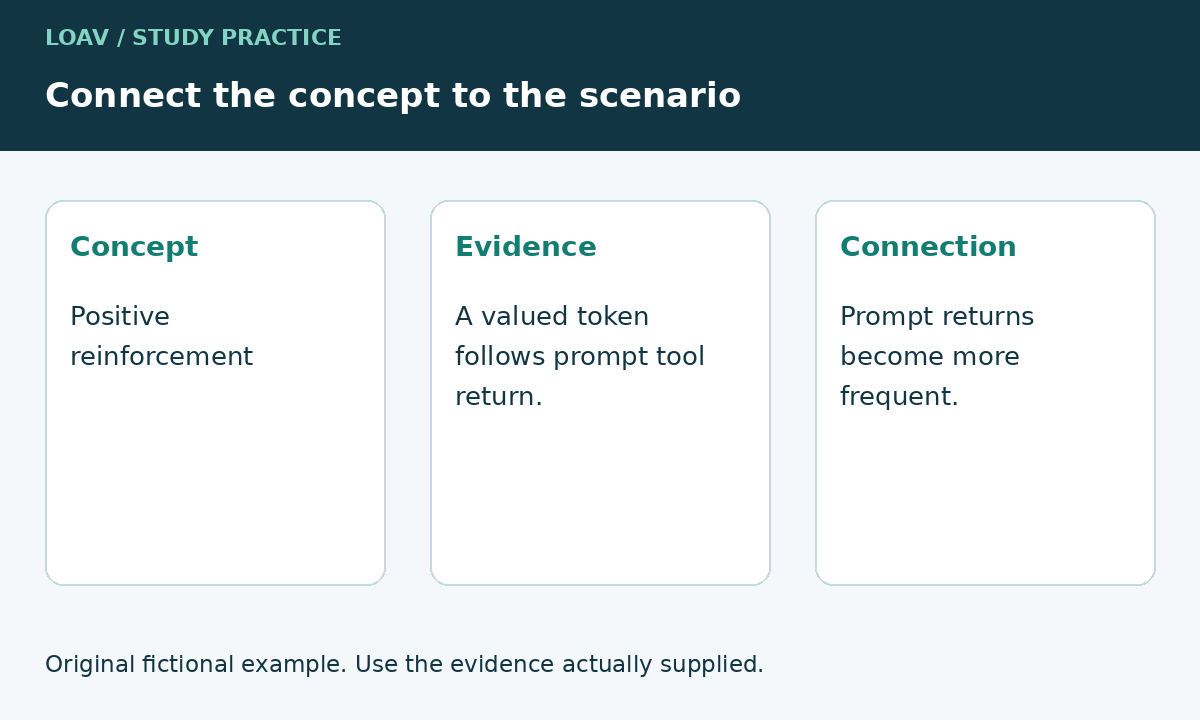
Work through one original example
Consider this fictional learning scenario: each time Ravi returns a borrowed tool promptly, the workshop leader gives him a token he values. Over the following weeks, Ravi returns tools promptly more often. Explain how positive reinforcement is illustrated.
- Concept: positive reinforcement.
- Evidence: a valued token is given after prompt tool return; prompt returns become more frequent.
- Connection: the added consequence strengthens that particular behaviour.
A concise practice response could be: “Giving Ravi a valued token after he returns a tool promptly adds a desirable consequence. His prompt tool-return behaviour then becomes more frequent, illustrating positive reinforcement.” The response identifies the consequence, the behaviour and the stated change, rather than merely saying Ravi is rewarded.
For this distinction, positive means a stimulus is added, while reinforcement refers to strengthening a behaviour. Those meanings are explained in OpenStax's operant-conditioning section. VCAA's Psychology teaching and learning activities also include classifying consequences in operant conditioning. Use your current course terminology when checking an answer.
Change the detail that carries the explanation
Now remove the final sentence about Ravi's behaviour becoming more frequent. You still know what the leader gives him, but the scenario no longer reports whether prompt returns increased. In a practice discussion, distinguish an intended reinforcing consequence from evidence that the behaviour was strengthened. Do not invent a later improvement just to complete your answer.
Next, keep the improvement but change the consequence: an irritating reminder sound stops when Ravi returns the tool. Ask what changed in the environment. Here, something unpleasant is removed rather than a valued item being added. This contrast helps you notice the feature that determines the classification. It is a study exercise about a fictional example, not advice for managing someone's behaviour.
Use a 20-minute application session
- Minutes 0–3: choose one concept already taught and recall its essential features without your notes.
- Minutes 3–8: answer one suitable scenario question. Mark the detail that supports each part of your explanation.
- Minutes 8–12: check the relevant source or teacher guidance. Separate a definition error from a missing scenario link.
- Minutes 12–17: change one meaningful feature and explain whether your conclusion should change. Keep all other facts stable.
- Minutes 17–20: write one corrected response without looking at the earlier wording.
The time allocation is a flexible suggestion, not an examination rule. If you cannot recall the concept accurately, pause for a worked explanation before trying more scenarios. If you can define it but cannot identify relevant evidence, ask a teacher to compare your chosen detail with theirs.
Check relevance before adding length
- Did I answer the command word and the specific question?
- Did I name the relevant concept accurately?
- Did I identify the particular behaviour, event or finding in this scenario?
- Did I explain the connection instead of repeating the example?
- Did I avoid adding motives, outcomes or diagnoses that were not supplied?
Different question types need different responses. A question asking you to evaluate a research design cannot be answered with this learning-example template alone. Your next step is to take one answer you already wrote and highlight the exact words that make it specific to its scenario. If there are none, repair that link before adding more content. For broader revision planning, see Loav's study skills collection.
