
A CAS result can be mathematically correct and still be the wrong answer to the question you were asked. It might include a value outside the domain, give a decimal when an exact answer is required, or solve an equation that was entered incorrectly.
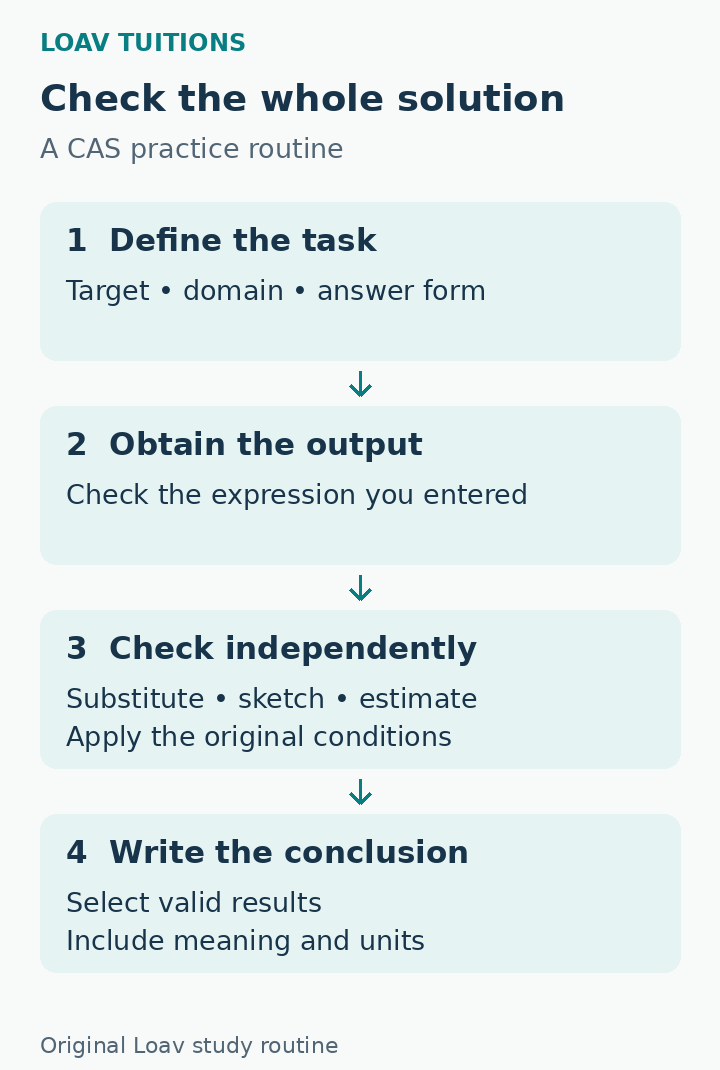
Use a small part of your Methods revision to practise the whole sequence: define the task, obtain an output, check it independently and write a conclusion. The routine below is original Loav practice for students preparing for the 2026 examination. It is not a predicted examination question or a compulsory response template.
Start with the task, not the calculator
Before entering anything, write three short notes beside the question:
- What am I finding? A value of a variable, a coordinate, a probability, a maximum or an interval?
- What restrictions apply? Record the domain, relevant units and any condition from the context.
- How must I report it? Look for exact form, decimal places, significant figures or a written explanation.
For example, “find when the height reaches 8 metres” asks for a time, not a height coordinate. A list of roots is only an intermediate result. Your written answer must identify the relevant times and their units.
Keep this planning brief. The aim is to prevent avoidable input and interpretation errors without turning every straightforward calculation into a long checklist.
Try a short calculation with a deliberate restriction
Original Loav practice: a model uses h(t) = −t2 + 6t, for 0 ≤ t ≤ 3. The height h is measured in metres and time t in seconds. Find when the model gives a height of 8 metres.
The equation to solve is:
−t2 + 6t = 8.
Solving without a domain restriction gives t = 2 or t = 4. Check both in the original equation: −4 + 12 = 8 and −16 + 24 = 8. Both are algebraic solutions, but only 2 lies in the stated domain. The conclusion is: the model reaches 8 metres at t = 2 seconds.
This is a useful distinction to rehearse. Substitution checks the equation; the domain check decides whether a solution answers this particular question. One does not replace the other.
Now change the domain to 0 ≤ t ≤ 5. Both times become relevant. Explain that change before touching the CAS again. If your explanation still rejects 4, you have memorised a previous answer rather than reread the conditions.
Make the check genuinely different
Repeating the same command with the same mistaken input is unlikely to expose the mistake. Choose a check that tests a different part of the solution:
- Substitution: insert a proposed solution into the original expression, not a later rearrangement that might contain an error.
- Graph: use a suitable viewing window to inspect where curves meet. Treat a graph as a useful check, not automatic proof that all solutions have been found.
- Estimate: decide whether the size and sign of the answer are plausible.
- Conditions: reject values that violate a domain, a probability range or the context.
For the height example, the parabola rises from 0 to 9 over the restricted interval, so reaching 8 before 3 seconds is plausible. That observation supports the result without merely repeating the solving command.
Leave a readable mathematical trail
In written-response practice, show the mathematical relationship you are solving and explain any selection or rejection that matters. A calculator command may be useful in your personal revision notes, but another reader should be able to understand the mathematics without owning your calculator model.
A compact response to the example could show the equation, the two unrestricted roots and the domain-based conclusion. For a more complex problem, include the definitions and intermediate relationships needed to justify the answer. Follow the actual command words and mark allocation rather than applying a fixed number of lines to every question.
The current VCAA Methods specifications describe Examination 2 as assessing mathematical communication, interpretation, analysis and problem solving. They also direct students to use the task wording and mark allocation to guide responses. The check-and-conclude routine here is Loav advice for practising those habits.
Use the correct examination conditions
For 2026, approved CAS technology is permitted in Methods Examination 2, while no calculators are permitted in Examination 1. CAS software use has school-approval conditions. Check your exact equipment with your school using the VCAA approved technology page and authorised materials list. The technology page separately lists 2027 rules, so do not assume this year's permissions carry forward.
A focused session for tonight
- Select three already-taught questions: one equation, one graph-based task and one probability problem.
- Write the target, restrictions and required answer form before using CAS.
- Complete each question and choose one appropriate independent check.
- Review any error as input, method, interpretation or communication.
- Later, try one changed question that tests the same weakness.
Use the Methods guide collection when the underlying concept needs repair, and the official examination resources for current-design practice. Want feedback on your next study step? Request a trial lesson with Loav and tell us which skill you would like help with.
