
A multiple-choice answer can be correct for an unhelpful reason. Perhaps one option looked familiar, the numbers seemed about right, or you remembered the letter from an earlier attempt. During VCE General Mathematics revision, give yourself a second check: can you explain the correct answer and identify the step that would produce a tempting wrong one?
This short activity focuses on distractors, the incorrect answer options. You do not need to invent a story for every option. Concentrate on the one that attracted you and use it to locate a specific misunderstanding.
Commit to a reason first
Before checking a solution, record your answer and one line of working. If you are unsure, write what you think the question is asking: a predicted value, a residual, a percentage, or something else. That small distinction can matter more than the calculator entry.
After checking, compare your method with the required quantity. A useful correction sounds like “I calculated the prediction but stopped before finding the residual.” “Be more careful” gives you much less to act on next time.
Inspect an original question
The following is an original practice example, not a reproduced VCAA examination question.
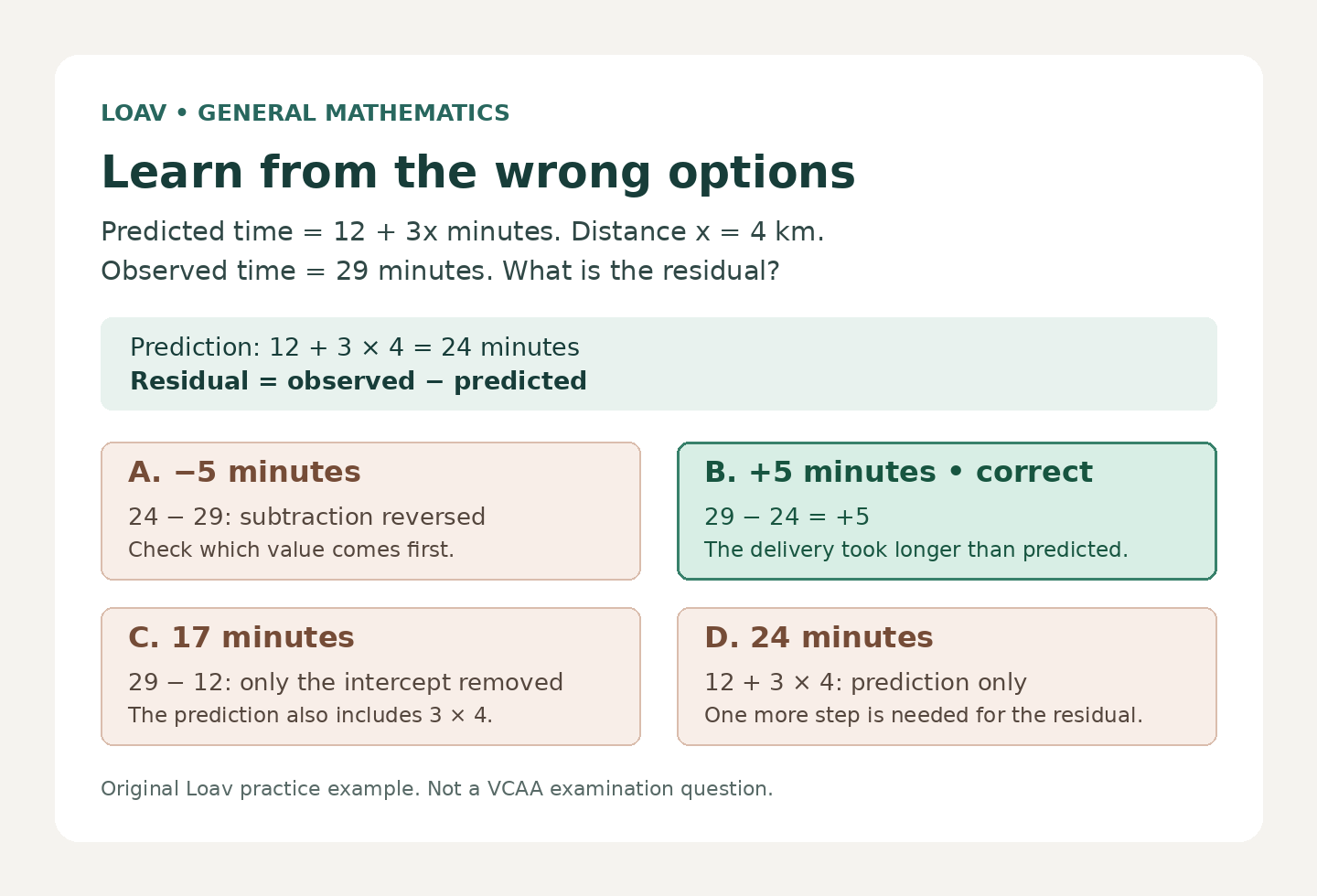
A fitted linear model predicts delivery time, y minutes, from route distance, x kilometres:
Predicted delivery time = 12 + 3x.
A delivery over a 4 km route actually takes 29 minutes. What is its residual, in minutes?
- A. −5
- B. +5
- C. 17
- D. 24
Choose an option before reading on. First calculate the model's prediction: 12 + 3 × 4 = 24 minutes. A residual is the observed value minus the predicted value, so the residual is 29 − 24 = +5 minutes, option B.
Check the sign against the situation. The delivery took longer than predicted, so its observed time lies above the fitted line. A positive residual makes sense. The model underestimated this particular delivery time by five minutes.
What might lead to the other options?
- A, −5: calculating 24 − 29 reverses the subtraction. Keep the words “observed minus predicted” beside your working until the order is secure.
- C, 17: calculating 29 − 12 subtracts only the intercept. The prediction at 4 km includes both 12 and 3 × 4.
- D, 24: this is the correct prediction, but the question asks for the residual. A correct intermediate result is not necessarily the answer.
These are plausible routes to the options, not a diagnosis of everyone who chooses them. If you selected A after making a different mistake, record your actual working rather than adopting an explanation that does not fit.
Finish with a reusable check: “Name the quantity, calculate the prediction, then subtract predicted from observed.” Keep the correction short enough to use on another question.
Change one condition
Keep the same fitted model and the same 4 km route, but suppose the observed delivery time is now 19 minutes. Before calculating, decide whether the residual should be positive or negative.
The prediction remains 24 minutes because neither the model nor the distance changed. The new residual is 19 − 24 = −5 minutes. Option A, previously incorrect, now gives the residual. The delivery took five minutes less than predicted.
This is why memorising “B” or “a residual is five” is fragile. You need the relationship between the quantities. Ask yourself which information changed, which calculation stayed the same, and why the sign changed.
For an extra check, ask what observed time would produce a zero residual. It would be 24 minutes: the observation would equal the prediction. Explain that without looking back at the worked solution.
Try a fresh question later
At a later study session, try this original example without the worked solution beside you:
A model predicts a workshop's packing time in minutes as 8 + 2.5x, where x is the number of items in an order. An order of six items takes 21 minutes. Find the residual and explain what its sign means.
Then check: the predicted time is 23 minutes, so the residual is −2 minutes. The order took two minutes less than predicted. If your answer was +2, revisit the subtraction order; if it was 23, revisit the requested quantity.
Place this question among a few different, already-taught problem types. In a randomised trial by Rohrer and colleagues, 54 seventh-grade mathematics classes completed mostly mixed or mostly blocked practice. The mixed-practice group performed better on a delayed test. However, time on task was not measured, students received feedback, and the study was not a VCE trial or a test of this distractor activity. Use it as support for practising strategy selection, not as a promised score improvement.
For exam-format practice, use the current specifications, current-study-design papers and instructions on the VCAA General Mathematics resources page. Check authorised materials rather than relying on an old paper's cover. Keep detailed distractor explanations for revision; in timed practice, work within the examination's demands.
Build the activity into a manageable routine using our VCE study-skills guide, or explore VCE tutoring support if you want help identifying the step that keeps going wrong.
Want feedback on your next study step? Request a trial lesson with Loav and tell us which subject and skill you would like help with.
