
With VCE English scheduled for Tuesday 27 October 2026, final revision can be small enough to finish. Choose one paragraph you have already written, repair its most important weakness, then test that repair once. You do not need to turn Saturday into another full practice examination.
This routine focuses on English Section A: an analytical response to a studied text. Allow about 25 minutes, adjusting to your school’s advice. The suggested timing is a practical boundary, not a prescribed VCAA method.
Choose an existing paragraph and its exact topic
Take one body paragraph from a recent practice response. Keep the question, your teacher’s feedback and the studied text beside it. Choose a paragraph you understand well enough to improve, rather than the most confusing passage in your folder.
Read the paragraph alongside its original topic. Write one sentence answering: “What is this paragraph trying to argue about the question?” If you cannot answer, repair the claim first. A polished quotation cannot rescue a paragraph answering a different question.
Turn the criteria into one repair decision
The current VCAA English specifications connect Section A with understanding the text and its construction, developing analysis responsive to the topic, supporting that analysis with evidence, and expressing it fluently. Use those priorities to ask:
- Does my claim answer the actual topic?
- Is the textual detail accurate and relevant?
- Have I explained how the writer’s choices develop the idea?
- Can a reader follow the connection between sentences?
Choose the first important break in that chain, using one teacher comment if available. For example: “I need to explain what this contrast suggests about belonging.” Leave unrelated vocabulary polishing for another time.
VCAA’s assessment criteria and expected qualities state that marking is holistic. These questions guide revision; they do not award separate points or predict a mark for a paragraph. Section B has different priorities for creating a text, while Section C concerns argument and persuasion. Do not apply this Section A example as a universal template.
Rewrite the evidence-to-explanation link
The following short fictional source was created for this exercise. It is not a prescribed text or an examination extract. Every quotation in the example comes from the source printed here.
Original practice extract: “The Empty Chair”
Mara stood beside the hall’s only empty chair. Above it, a paper sign read VISITORS. She had painted the hall doors each summer since she was twelve. When the chairperson called for local voices, Mara kept her hand down. At the break, Asha crossed out VISITORS and wrote MARA. When the meeting resumed, Mara raised her hand.
Original practice topic: Belonging requires recognition, not simply participation. Discuss.
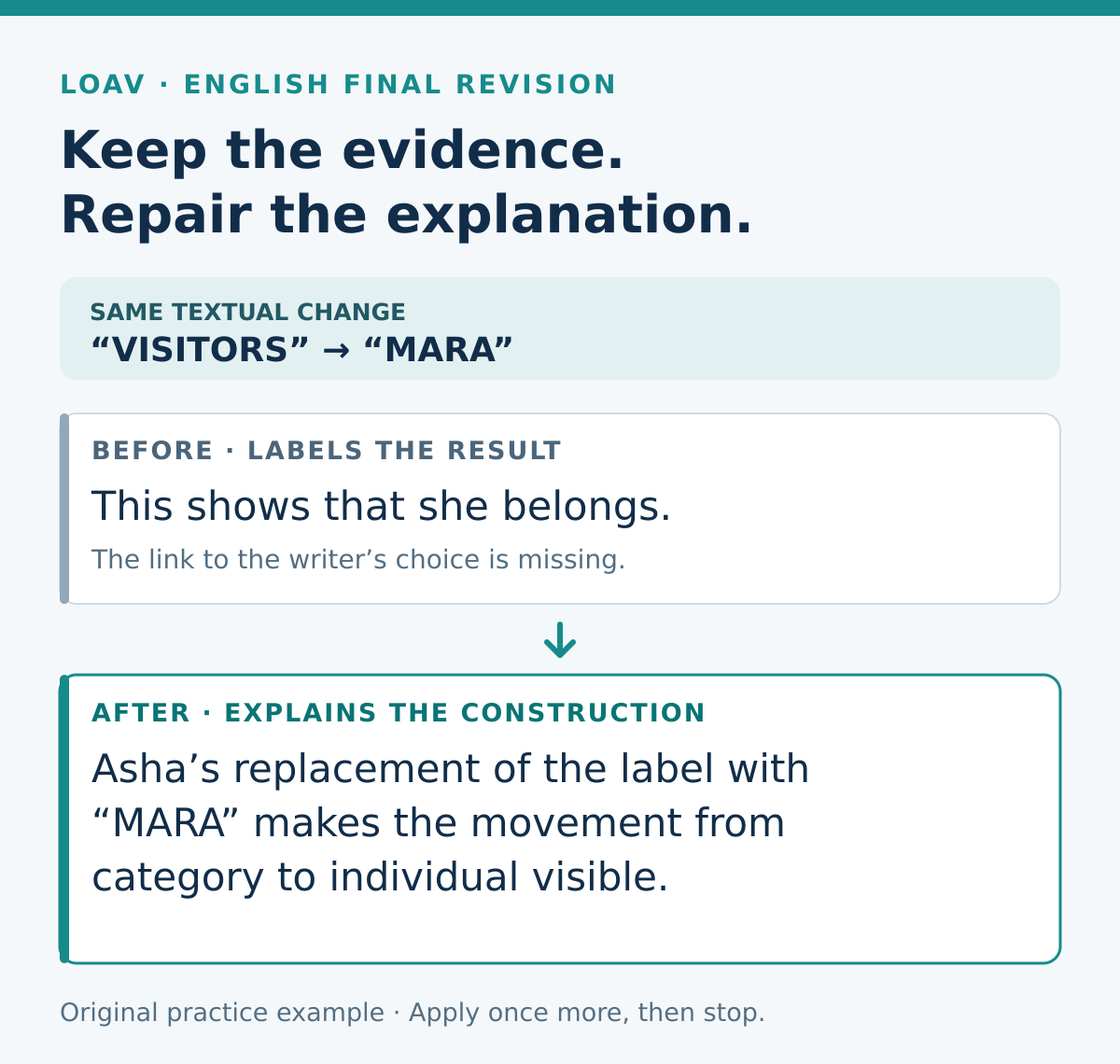
Before: The writer presents belonging as needing recognition as well as participation. Mara’s work does not make her feel included. The sign above her chair says “VISITORS”. This shows she is an outsider. Asha then replaces the word with “MARA”, and Mara raises her hand. This shows that she belongs. The extract therefore shows that recognition matters.
The evidence is relevant, but “this shows” mostly labels the result. The chosen repair is to explain how the writer’s contrast constructs that meaning. Keep the same central claim and evidence.
After: The writer presents belonging as needing recognition as well as participation. Mara’s repeated work on the hall contrasts with an official label that still excludes her. The impersonal sign “VISITORS” reduces an established contributor to a temporary presence. By placing that label beside Mara’s silence during the call for local voices, the writer exposes a community that accepts her labour without recognising her authority to speak. Asha’s replacement of the label with “MARA” makes the movement from category to individual visible. Mara’s raised hand then turns recognition into participation in the discussion, inviting readers to question who gets treated as a legitimate member. Belonging consequently depends on being acknowledged, not merely being useful.
Compare the reasoning, not the paragraph length
The revision starts with an idea and treats Mara’s actions as evidence of the writer’s wider concern. It explains the contrast between contribution and recognition instead of simply retelling what happens. Extra words are useful only where they make that reasoning clearer.
Within Loav’s planning approach, this body paragraph follows TEEAEAL: topic, elaboration, evidence, analysis, evidence, analysis and link. In a full response, BCAS frames the introduction through background, contention, arguments and summary; CAS closes with contention, arguments and significance. These are flexible teaching scaffolds, not VCAA rules. This example is one body paragraph, not a complete essay.
Before keeping your revision, check:
- The original topic is still being answered.
- Every quotation matches the source, including its speaker and context.
- The explanation names a specific authorial choice and a defensible meaning.
- The interpretation does not claim more than the evidence supports.
- The final sentence advances the argument rather than repeating the topic.
Apply once more, then stop
Choose a different moment from your studied text. Write two or three fresh sentences connecting a precise detail, a writer’s choice and the idea you are arguing. Check the detail against the text, then record one reminder: “Explain the relationship, not just the event.” Stop there.
For your next session, use Loav’s text guides to revisit the relevant passage, or the study-routine guide to keep revision manageable. If a teacher comment still feels unclear, take them the original and revised paragraph and ask one specific question.
Want feedback on your next study step? Request a trial lesson with Loav and tell us which subject and skill you would like help with.
