
A page of quotations can look reassuring until a practice essay asks a question you have not prepared. A more useful evidence bank helps you choose a precise moment, explain how the text presents it and connect it to the topic in front of you.
This is a short revision routine for VCE English Section A. It works with the text you have studied at school. It is not a list of quotations to memorise or a prediction of the examination topic.
The current VCAA English examination resources emphasise an analytical response supported by close reference to the text. That makes the relationship between your argument and your evidence worth practising.
Start with a claim you can test
Choose one practice topic from your teacher or a suitable current-design resource. Underline the part that asks you to make a judgement. A topic about belonging might ask whether it brings comfort, whether it demands compromise, or whether a character can ever achieve it. Those are different questions.
Write one provisional answer in a sentence. Then ask: which part of the text supports this, and which part makes it less straightforward? You are looking for material that helps you think, rather than trying to fit every remembered quotation into the paragraph.
If you cannot yet form a claim, reread a relevant scene with your class notes nearby. Identify what happens, how it is presented and what changes by the end. Ask your teacher or tutor about an interpretation you cannot justify.
Make a small evidence record
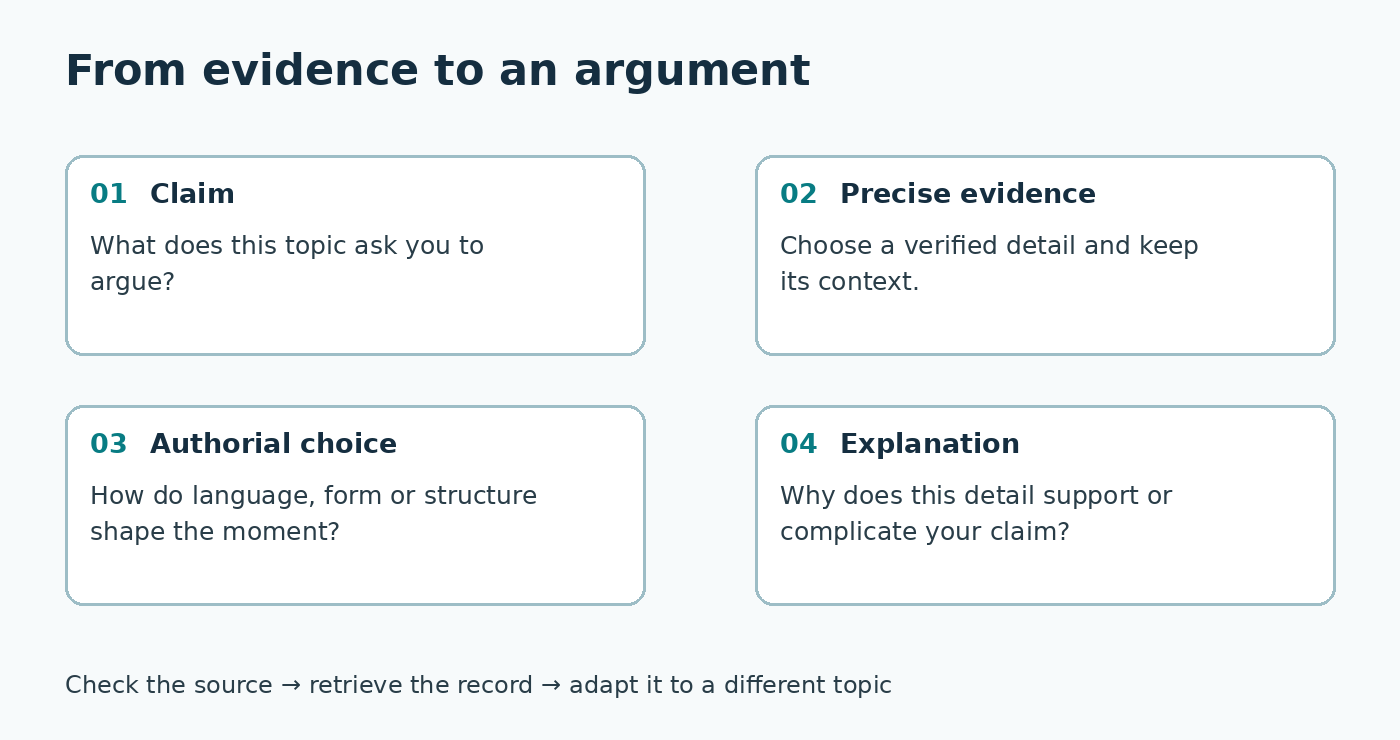
Begin with three useful moments. This is an adaptable starting point, not a required number. For each one, record:
- Location and context: the chapter, scene or other reliable locator, who is involved and what is happening.
- Precise evidence: a short verified quotation, a significant action, a structural contrast or another specific detail.
- How it is presented: a relevant choice in language, perspective, form or structure.
- What it helps you argue: an interpretation linked to the topic, including a possible complication.
Check quotations against the edition you study. Preserve their wording and speaker, and keep enough context to avoid changing the meaning. If you remember the event but not the exact words, use a precise reference to the event in your practice paragraph until you can check the quotation. Do not put an approximate recollection inside quotation marks.
Try the routine on an original miniature example
The following passage is invented for this exercise. It is not from a VCE text or an official examination:
On the library's last afternoon, Mara returned every borrowed book. She kept the brass key in her coat. Outside, the new owner measured the doorway while she stood where the children's shelf had been.
Suppose your practice claim is that Mara's attachment outlasts her practical role. A useful evidence record could select the key she keeps after returning the books. The contrast between returning one thing and retaining another suggests that the closure is easier to complete administratively than emotionally. Her position near the former children's shelf adds a particular memory to that attachment.
The record also needs a limit. This short passage does not establish every motive Mara might have. Avoid presenting an interpretation as though it were a fact stated by the narrator. The aim is to explain what makes your reading plausible.
Now transfer that process to your studied text. Use its actual details and your own reading; the miniature example is only a demonstration of the activity.
Close the source, retrieve, then check
Cover your record and reconstruct it on a blank page. Can you remember the moment accurately? Can you explain the authorial choice? Can you connect it to the claim without repeating a prepared sentence?
Open the source again and correct omissions or distortions. A study by Roediger and Karpicke found that recall testing supported delayed retention in prose-learning experiments. That supports trying retrieval alongside checking; it does not establish a particular improvement in VCE essay marks.
Return to the record on a later day. Choose the interval around your timetable and how securely you recalled it. If it has become familiar, change the question rather than simply rereading it again.
Adapt the same evidence to a different topic
Try another practice topic and decide whether the moment still belongs. If it does, the explanation may need to change. If it does not, choose different evidence. Being able to leave out an attractive quotation is part of selecting evidence well.
Finish by writing one paragraph. Check whether it answers the actual topic, introduces the evidence clearly and explains how the detail supports your interpretation. Look for a sentence that only retells the event and ask what analysis it still needs.
For text-specific reading, visit our 2026 VCE English study guides. Our study skills hub can help you fit this task into a manageable week.
Want feedback on your next study step? Request a trial lesson with Loav and tell us which text and skill you would like help with.
