
You may recognise every term in a Chemistry question and still struggle to explain the result. A useful written answer connects the details of the question to a chemical principle, then shows how that principle produces the outcome. Practising that connection can reveal gaps that rereading a definition leaves hidden.
This routine focuses on constructing explanations. Choose material you have already been taught, using the VCAA Chemistry examination resources to find current-study-design practice. VCAA separates those papers from older examinations, which may not match the current course.
Read the command and the context
Before writing, identify three things:
- The job: does the question ask you to identify, explain, compare or justify? An explanation needs a reason connecting the stated conditions to the result.
- The system: which substances, equipment, observations or data are involved?
- The boundaries: what changes, what stays constant, and which assumptions are supplied?
Write a short planning note: “I need to explain why ___ changes when ___, while ___ stays constant.” Adapt that note to the actual task. For a comparison, name both cases. For a question about evidence, identify the observation or data your conclusion must account for.
Use the mark allocation to judge the likely scope, but avoid inventing a rule that every mark equals one sentence. The reasoning and the question's instructions determine what belongs.
Build the chain before polishing the sentences
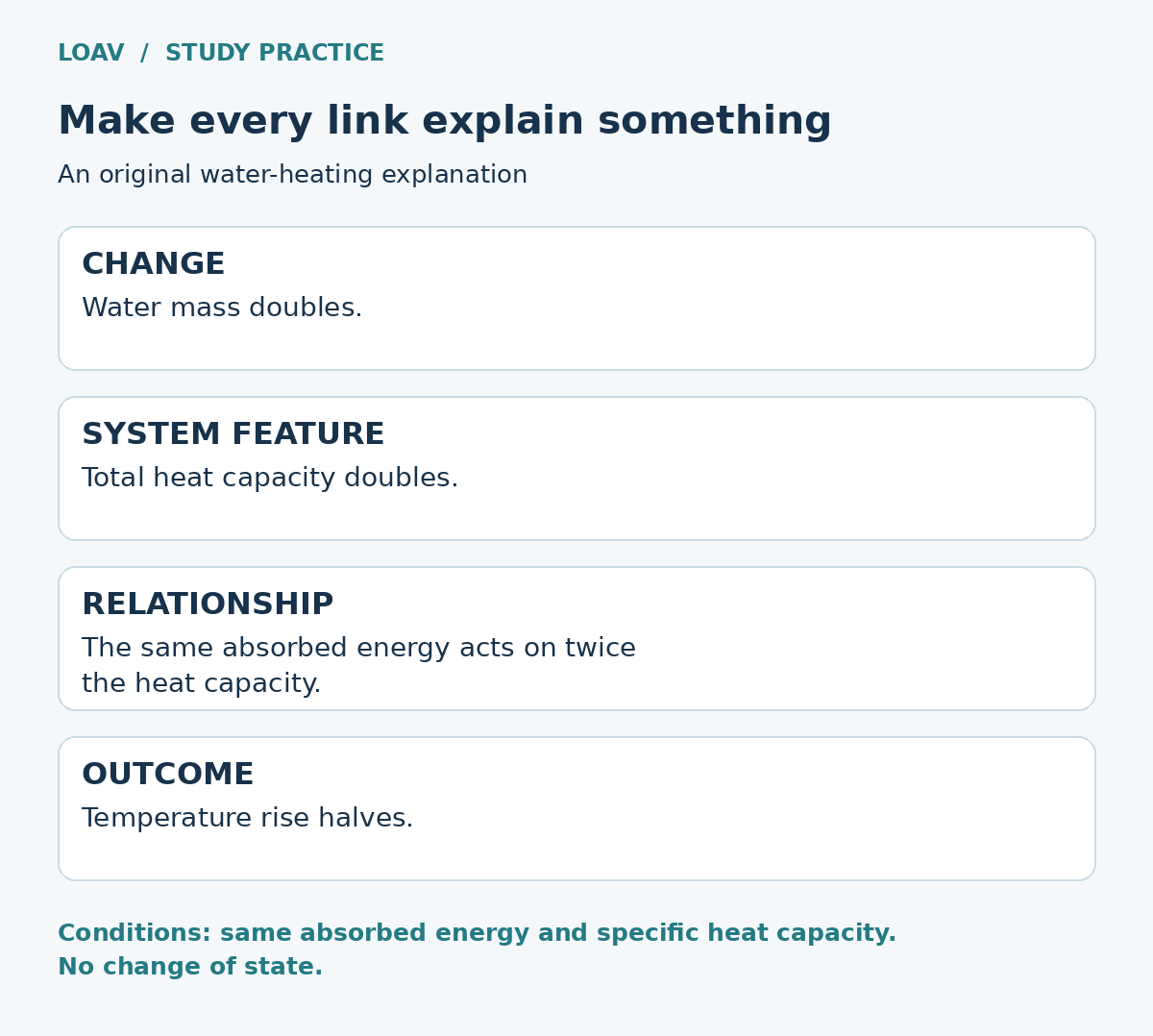
A practical planning sequence is: change → relevant feature of the system → mechanism or relationship → outcome. Add the conditions beside it. This is a revision aid, not an official answer formula.
Each arrow needs an explanation. “This causes that” is only useful if you can say how. Depending on the topic, the connection might involve electron transfer, molecular structure, energy transfer or a quantitative relationship. Do not force a particle-level explanation into a question that is asking about a measurement or a calculation.
Try an original calorimetry example
Practice prompt: Two samples of liquid water, one of 100 g and one of 200 g, each absorb 4.18 kJ of thermal energy. Explain why the temperature rise is smaller for the 200 g sample. Assume both samples have the same constant specific heat capacity, 4.18 J g−1 K−1, and neither changes state.
This is an invented paper-based exercise, not a VCAA question. The energy stated is the energy actually absorbed by each water sample; you do not need to invent losses from a burner or container.
A first attempt might say: “There is more water, so the temperature is lower.” That leaves the link unexplained and confuses final temperature with temperature rise.
A developed answer: The 200 g sample has twice the total heat capacity because the mass is doubled while the specific heat capacity is unchanged. It therefore requires twice as much energy for each degree of temperature increase. Since both samples absorb the same energy, the 200 g sample has half the temperature rise of the 100 g sample.
The relationship q = mcΔT, listed in the 2026 Chemistry Data Book, provides a check: 4180 J produces rises of 10 K and 5 K respectively. The calculation checks the direction and size of the change; the sentences explain why. Calorimetry and interpretation of energy transfer appear in VCAA's Chemistry teaching and learning materials.
Remove keywords that do no explanatory work
Underline each technical term in your answer and ask what it contributes. “Activation energy”, “equilibrium” and “collision frequency” do not belong in this water-heating explanation merely because they are Chemistry vocabulary. Keep the relevant terms and connect them accurately.
Also check ordinary words. “Lower” needs a named quantity and comparison. “Energy is lost” needs a destination and a reason it matters. “The result increases” needs to specify which result. Replacing a vague word with the correct quantity is often more useful than adding another sentence.
Change one condition and explain again
Now change the prompt: the 100 g and 200 g samples undergo the same temperature rise, with the same specific heat capacity and no change of state. Which absorbs more energy?
The 200 g sample now absorbs twice as much energy because its total heat capacity is twice as large and the temperature rises are equal. The earlier conclusion about a smaller temperature rise no longer applies: equal absorbed energy was a condition of the first question, not a permanent property of a larger sample.
Use a small practice-and-feedback routine
- Choose one short explanation question and write an answer before checking a solution.
- Label the cause, connecting reason, outcome and relevant conditions.
- Compare the reasoning with your class material or the matching official report. Check ideas, not just matching words.
- Rewrite the weakest link, then attempt a changed scenario.
- Ask your teacher or tutor about any connection you still cannot justify.
Chi and colleagues' 1994 self-explanation study found greater gains for students prompted to explain while reading. It involved 24 eighth-grade students learning about circulation, and the prompted group spent longer studying. It supports exploring self-explanation, but does not establish that this short routine improves VCE marks.
For your next session, select a familiar topic from Loav's Chemistry study guides and fit one explanation task into your revision routine.
Want feedback on your next study step? Request a trial lesson with Loav and tell us which subject and skill you would like help with.
Sources
- VCAA: Chemistry examination resources.
- VCAA: Chemistry teaching and learning materials, Unit 3 energy measurement activities.
- VCAA: 2026 Chemistry Data Book, Version 2, February 2026, pages 4–5.
- Chi, de Leeuw, Chiu and LaVancher (1994), Eliciting Self-Explanations Improves Understanding, Cognitive Science, 18, 439–477.
