
A chemistry investigation question can look familiar until it asks you to judge the evidence. Writing “repeat it to make it more accurate” is tempting, but the proposed change may not address the problem. A useful revision session makes you identify the limitation before choosing the improvement.
This is a Loav practice routine, not a VCAA marking formula. VCAA’s current Chemistry support materials include evaluating data, recognising limitations and considering measurement quality. For assessment requirements, use the current study design and examination materials, alongside your teacher’s instructions.
Make a four-box investigation check
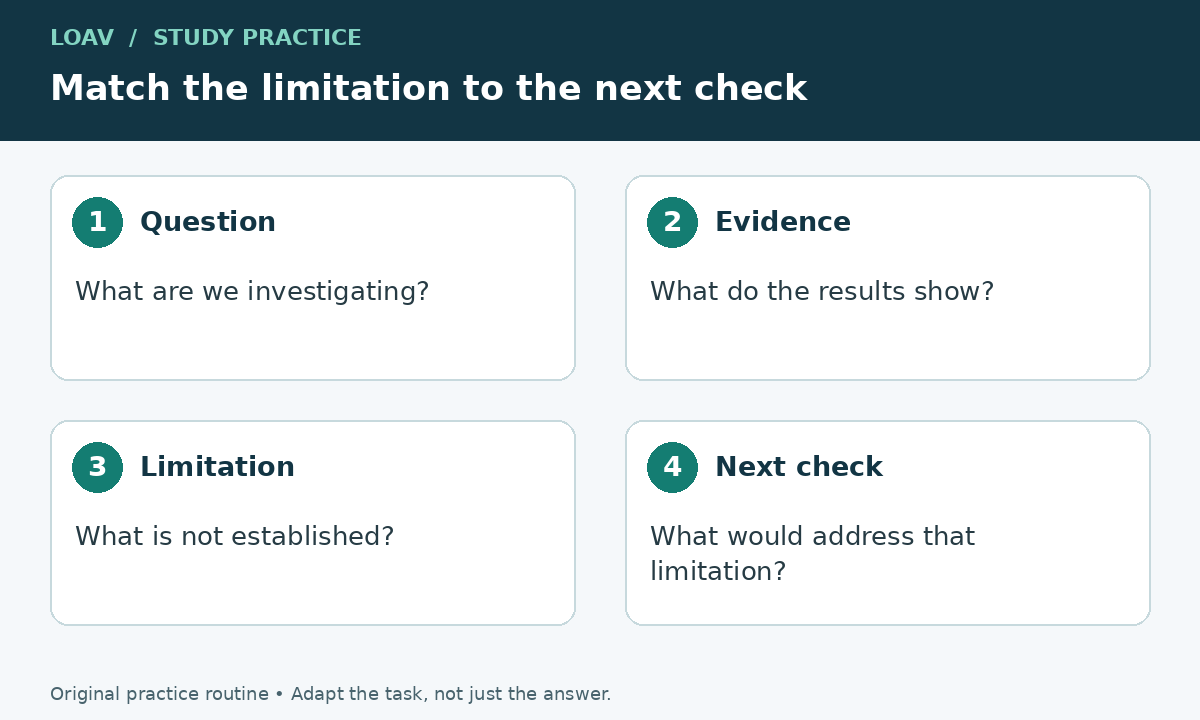
Choose one investigation question you have already attempted. Put the solution away and divide a page into four boxes: the question being investigated, the evidence available, the limitation, and the next check. Do not write a list of every laboratory problem you can remember. Your job is to select the issue that matters for this particular conclusion.
- Question: What relationship or quantity is being investigated? Name the independent variable and dependent variable where relevant.
- Evidence: Which observation, measurement or comparison supports the proposed conclusion?
- Limitation: What can this evidence not establish? Identify the method detail that creates the uncertainty.
- Next check: What specific additional evidence or method change would address that limitation?
Write one sentence in each box before expanding your answer. If you cannot connect the fourth box to the third, your suggested improvement is probably too generic.
Practise with an original miniature example
Imagine a student measuring a reference solution with a stated pH of 7.00 under the measurement conditions. Three readings from the same meter, taken by the same student using the same method in a short period, are 6.62, 6.63 and 6.62. These are invented practice data, not a record of an actual experiment.
The readings cluster closely, supporting good repeatability under those conditions. Their closeness does not establish accuracy: all three differ from the stated reference. A useful next check is to check the meter’s calibration against suitable reference buffers and the measurement procedure, rather than assuming that more identical readings will remove an offset.
Do not announce that calibration is definitely the cause. The data alone do not identify it. Say that calibration is a plausible issue to investigate. A careful answer separates what the results show from what might explain them.
Now change just one detail: remove the reference value. You can still discuss how close the readings are, but you no longer have the same basis for judging agreement with that reference. This small variation tests whether you understood the evidence or simply memorised the first answer.
Use an error-to-action pair, not a stock phrase
Try these three prompts with a question from your own revision folder. They are questions to investigate, not automatic conclusions.
- Results are scattered: Which part of the measurement procedure might vary between repeats? Consider whether repeated measurements and a more consistent procedure would help characterise or reduce that variation.
- Results consistently differ from a reference: Is there a possible systematic effect to check? Repetition alone is not evidence that it has been removed.
- Two variables changed together: Can the observed difference be attributed to the intended independent variable? Identify the relevant controlled variable and explain how it should be kept consistent.
“Use better equipment” is not yet a useful improvement. Name the instrument or measurement issue and explain why the change is relevant. Equally, do not propose a more finely graduated instrument when the main problem is an uncontrolled condition.
A focused 20-minute revision session
- Minutes 0–4: Select one short investigation question. Read the method, axes, units and any reference information. Circle the actual command term.
- Minutes 4–9: Complete the four boxes without looking at the answer. Keep observations and possible explanations separate.
- Minutes 9–13: Check the official report or teacher feedback. Identify one missing link, not just a missing keyword.
- Minutes 13–17: Rewrite your answer so the limitation and improvement refer to the same measurement or design issue.
- Minutes 17–20: Change one condition in the question and explain which part of your judgement changes. Keep the altered example clearly labelled as your own practice.
Repeat this routine later with a different investigation context. Keep a short record of the judgement you found difficult, such as distinguishing repeatability from accuracy, rather than copying a whole model answer.
Before you finish
- Have I used evidence from the stated investigation?
- Have I distinguished the observed pattern from a possible cause?
- Does my improvement address the limitation I named?
- Have I avoided claiming that repetition guarantees accuracy?
- Have I answered the command term, rather than supplying unrelated definitions?
Your next step is small: take one previously marked question and replace one generic improvement with a specific, justified action. For more subject material, browse Loav’s study articles and guide collections.
Sources and official guidance
- VCAA Chemistry planning: scientific investigations, data and measurement.
- VCAA Chemistry assessment advice: evaluating data and its limitations.
- VCAA Chemistry examination specifications, papers and reports.
The four-box routine, timing suggestions and miniature dataset are original practice advice. They do not predict examination questions or guarantee marks.
