
The Chemistry Data Book can supply a value, relationship or reference table. You still need to recognise which information is relevant and how to use it. A short navigation routine can help you practise that decision before you attempt another full paper.
For 2026 revision, start with the VCAA Chemistry Data Book, Version 2, February 2026, linked from the official Chemistry examination page. Check the version on the document itself rather than relying on the filename of an old download.
Separate a lookup from a chemical decision
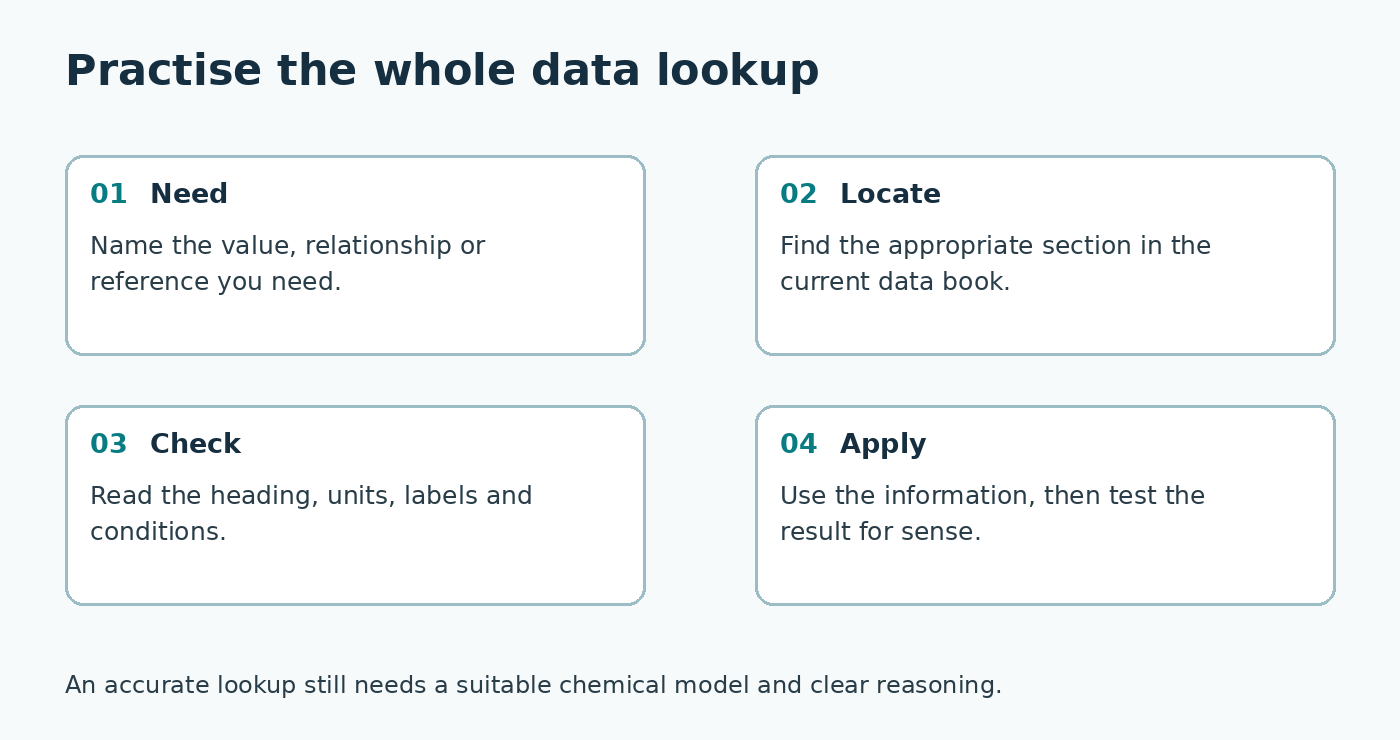
Before opening the book, name what you need. “I need a relative atomic mass to calculate a molar mass” is more useful than “I need something from the data book”. It gives you a reason to choose a section.
After finding an entry, read the heading, units, labels and any stated conditions. Ask whether it matches the quantity and situation in the question. A numerical value can be copied correctly and still be used in the wrong way.
Keep a separate practice note with three columns: what I needed, where I found it and what I had to check. This is a home-study aid. It does not establish what you may take into the examination room. Consult the current VCAA materials rules and your school's instructions; do not assume an annotated practice copy or loose notes are permitted.
Try a locate and explain round
Choose three small tasks from content you have already studied. The examples below practise different kinds of lookup; they are not official examination questions.
- A molar-mass task: find the relevant atomic masses, then explain how the chemical formula determines the number of each atom included.
- A conversion task: find an appropriate unit conversion or metric prefix, then state which direction the conversion must go.
- A structure-identification task: locate a relevant spectroscopy table, then say what an observation might support and what further evidence you would need.
For the third task, choosing the table is not the same as establishing a molecular structure. A feature may be consistent with more than one possibility. Use the question's other evidence and the methods you have been taught rather than treating a single lookup as a complete identification.
Begin without racing a timer. Once you understand the process, try the same kind of lookup within a normal practice question. If you spend a long time searching, record which section or label confused you and practise that specific distinction.
Work through an original small example
A sample contains 0.880 g of carbon dioxide, CO₂. Calculate its amount in moles using C = 12.0 and O = 16.0 from the data book.
1. Name the information needed. The formula relates mass and molar mass to amount: n = m/M. We need the molar mass of CO₂.
2. Interpret the formula. One carbon atom and two oxygen atoms contribute to each molecule. The molar mass is 12.0 + 2 × 16.0 = 44.0 g mol⁻¹.
3. Substitute with units. n = 0.880 g ÷ 44.0 g mol⁻¹ = 0.0200 mol.
4. Check the result. The mass is one-fiftieth of 44.0 g, so the amount should be one-fiftieth of a mole. The units also reduce to mol. A result of 20.0 mol would not fit this mass.
The lookup supplied atomic masses. Understanding CO₂, choosing n = m/M and checking the result still required chemistry. If a different question asks for the amount of oxygen atoms rather than the amount of CO₂ molecules, the requested quantity changes even though the initial sample does not.
Make the next attempt slightly different
Return to the routine on another day with a new substance, unit or task. Before looking up the answer, predict which section you will need and explain why. Then check whether that prediction was useful.
You can also practise rejecting an irrelevant table. If a question requires a concentration calculation, what information does the periodic table provide, and what does it leave unanswered? Being able to say “this is not enough information yet” is a useful part of resource handling.
When a task exposes a content gap, pause the navigation drill. Read the relevant explanation, ask a precise question and attempt a new example. Faster searching will not repair an incorrect equation or a misunderstood chemical condition.
Keep the routine small enough to finish
A useful session might end with three completed lookups and one clear note about an error to avoid. That is an example, not a study quota. You should be able to describe what the session helped you do more independently.
Use our Chemistry Units 3 and 4 study guides when the underlying concept needs attention. The study skills hub brings together other practical revision advice.
Want help checking how you use the data book in a question? Request a trial lesson with Loav and tell us which Chemistry skill you would like to practise.
