
Some Chemistry mistakes happen before the calculator is touched. A concentration is treated as an amount, a mole ratio is reversed, or a final division uses the volume of the wrong solution. Repeating the arithmetic will not catch those errors if the setup remains unchanged.
A useful revision exercise is to practise the setup separately: name the target, label the given quantities, draw the route between them, and only then substitute. The routine below is original study advice, not a prescribed examination layout.
The current VCAA Chemistry examination specifications include key science skills alongside Units 3 and 4 knowledge. Use this exercise to strengthen calculation foundations, then apply the habit to the topics and question types your teacher has selected.
Name the requested quantity before choosing a formula
Write the unknown with its substance and final unit. “Concentration of oxalic acid, in mol L−1” gives you more direction than simply writing “x”. It tells you that the final step will need an amount of acid divided by the volume of the acid solution being analysed.
Next to each given value, write what it measures. A titre is a volume delivered, not a concentration. A concentration tells you the amount per unit volume; it is not already the amount that reacted. Keep substance labels attached to intermediate quantities so that one number does not quietly change meaning midway through the working.
Connect quantities before substituting
For a reaction calculation, let the balanced equation control the link between substances. Convert a known concentration and its matching volume into an amount, apply the mole ratio, then convert that new amount into the quantity requested.
The relationship n = cV requires compatible units. If c is in mol L−1, using V in litres gives n in moles. The current 2026 VCAA Chemistry Data Book includes chemical relationships and unit conversions. Finding a relationship is only the start: you must still decide which substance and which volume belong in it.
Check this original setup
Practice question: A 20.00 mL sample of aqueous oxalic acid, H2C2O4, requires 24.60 mL of 0.1000 mol L−1 sodium hydroxide for complete neutralisation. Calculate the acid concentration. Assume the stated volume corresponds to complete neutralisation of both acidic protons, with no interfering reactions.
The balanced reaction is:
H2C2O4(aq) + 2NaOH(aq) → Na2C2O4(aq) + 2H2O(l)
Read the coefficients in words: one mole of oxalic acid reacts with two moles of sodium hydroxide. Therefore, the acid amount is half the sodium hydroxide amount. Do not assume an acid–base reaction always has a one-to-one ratio.
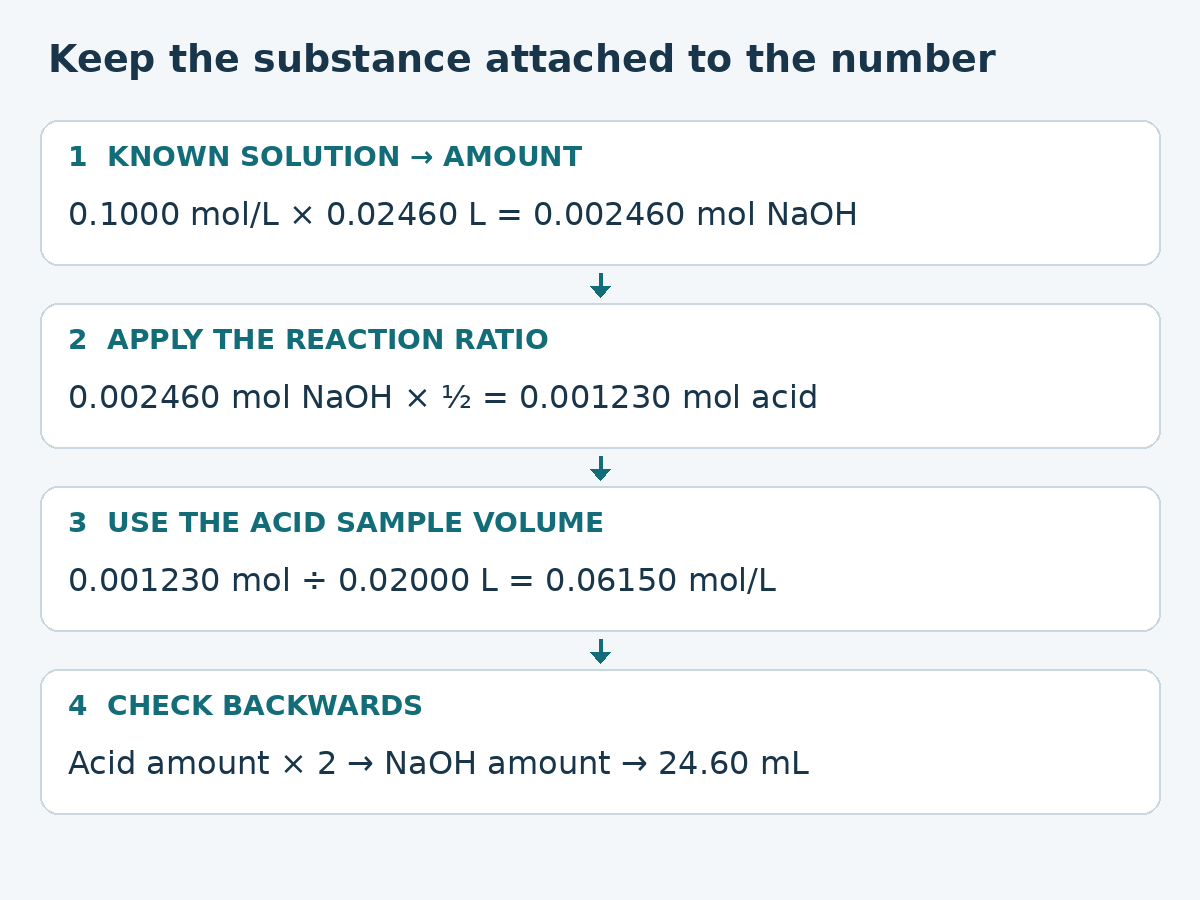
- Known amount: n(NaOH) = 0.1000 mol L−1 × 0.02460 L = 0.002460 mol.
- Reaction link: n(H2C2O4) = 0.002460 mol × ½ = 0.001230 mol.
- Requested concentration: c(H2C2O4) = 0.001230 mol ÷ 0.02000 L = 0.06150 mol L−1.
The final answer has four significant figures, consistent with the supplied measurements. Retain sufficient digits in intermediate working; round at the end rather than repeatedly trimming numbers.
Explain the wrong turn
If you reverse the mole ratio and multiply the sodium hydroxide amount by two, you obtain 0.004920 mol of acid and a concentration of 0.2460 mol L−1. That answer is four times the correct value. It can still carry the correct concentration unit, so a unit check alone will not expose the reversed relationship.
A second wrong turn is dividing by 0.02460 L at the final step. That is the volume of sodium hydroxide delivered, not the original acid sample volume. Circle the words “acid concentration” and connect them back to 20.00 mL.
Now check backwards. At 0.06150 mol L−1, the 0.02000 L acid sample contains 0.001230 mol. Complete neutralisation requires twice that amount of sodium hydroxide. Dividing 0.002460 mol by 0.1000 mol L−1 gives 0.02460 L, matching the stated titre.
Practise setup alone, then finish independently
Choose three fresh questions. For each, spend about one minute writing only the target, relevant relationship, substance labels and unit conversions. Avoid looking at the worked solution during this stage. Compare the setups before doing any arithmetic: which involve a reaction ratio, and which preserve the amount of the same solute during dilution?
For dilution without reaction or solute loss, the solute amount stays constant. A reaction calculation instead connects amounts through a balanced equation. Similar-looking concentration and volume data do not make the two situations interchangeable.
Then complete each calculation and check it independently. Try a fresh version of the example: 10.00 mL of oxalic acid requires 12.40 mL of 0.1000 mol L−1 sodium hydroxide under the same complete-neutralisation assumption. Your concentration should be 0.06200 mol L−1. Explain why the ratio is still one-to-two before comparing answers.
Keep your next-step note specific: “label the sample volume before dividing” is more useful than “revise calculations”. Use the current VCAA Chemistry resources for suitable practice, our Chemistry study guides for topic revision, and our study-routines guide to keep the practice manageable.
Want feedback on your next study step? Request a trial lesson with Loav and tell us which subject and skill you would like help with.
