
You recognise the topic, but the diagram looks nothing like the one in your notes. Before deciding you have forgotten the biology, check whether the difficulty is actually the representation: unfamiliar letters, a rotated layout, an unexplained arrow or a key you have skimmed.
Diagram practice should train you to extract information, not memorise the appearance of a favourite picture. The routine below is original study advice, not an official VCAA answer template. Use the current VCAA Biology study design to check the knowledge relevant to your course.
First separate the picture from your assumptions
Take one diagram-based question and leave the answer covered. Before recalling a whole chapter, identify four things:
- Objects: What do the letters, shapes, bands or branches represent?
- Connections: Does a line mean movement, a reaction, ancestry or simply a label pointing to a structure?
- Conditions: What does the caption specify? Are there different treatments, times or environments?
- Task: What must you identify, compare, explain or predict?
Write a plain-language reading of one feature: “This arrow shows material moving from X to Y.” If the key does not establish what an arrow means, do not quietly invent a meaning. Read the accompanying text again. A correct fact recalled from class can still be irrelevant to the particular diagram.
Practise with a changed layout
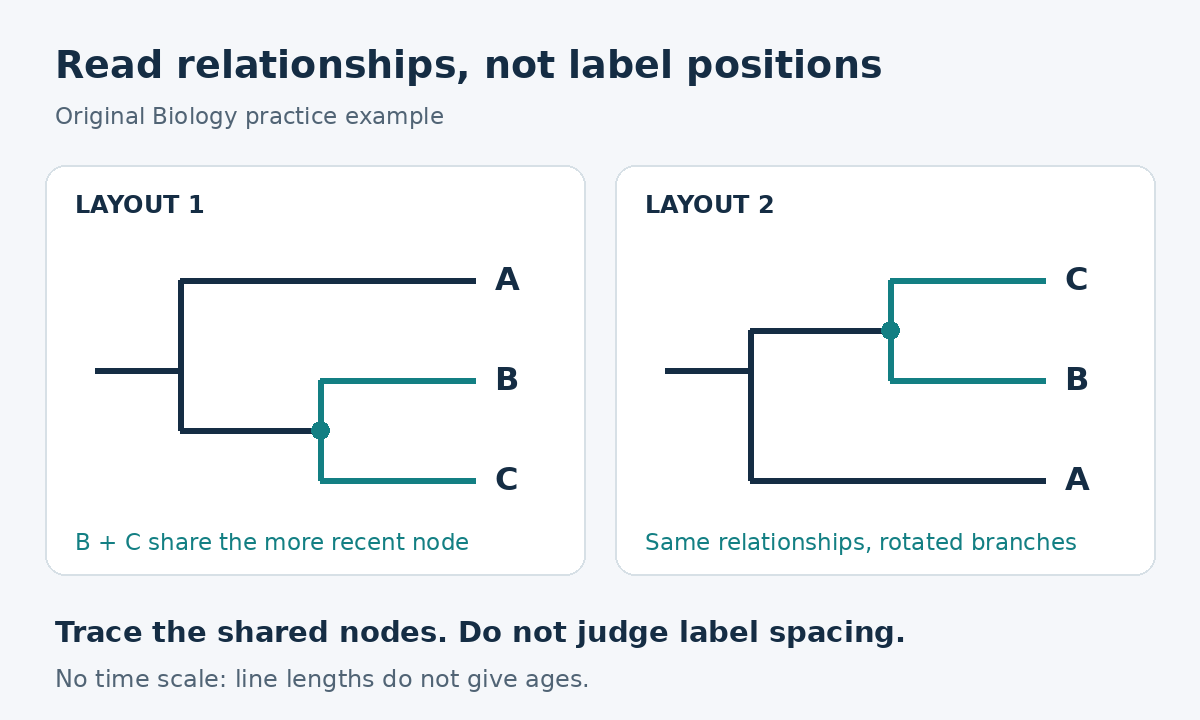
For a simple original example, consider a rooted evolutionary tree in which a root first separates A from the lineage that later splits into B and C. B and C share a more recent common ancestor with each other than either shares with A.
Now redraw the same tree with A at the bottom instead of the top. You have changed the display, not the branching relationships. Ask: “Is A now more closely related to C because their labels look closer?” No. Trace the branches to the shared nodes rather than judging the spacing of the labels. In this tree, A is equally related to B and C.
The example deliberately includes no time scale. You therefore cannot calculate how many years ago a split occurred from the length of a line. Record that as a limit of the evidence, not a gap to fill with a guess.
This is a useful practice target because the 2025 VCAA Biology assessment report, Section A Question 34, discusses identifying relatedness through the most recent common ancestor. Elsewhere, its explanations of pictured pathways and DNA bands illustrate why reading the specific representation matters. Consult the original questions and report rather than treating this example as an exam prediction.
Use a 20-minute diagram session
- Minutes 0–3: choose and orient. Pick one question from the official current-study-design examination collection. Read its caption, labels and task. Note what each type of line means.
- Minutes 3–7: answer with evidence. Write a response without opening the report. Point to a named feature in your reasoning. Replace “the diagram shows it” with the particular relationship or observation.
- Minutes 7–11: check the interpretation. Compare your response with the report. Did you misunderstand the biology, misread a symbol, overlook a condition or answer a different question? Choose the main cause rather than writing “careless”.
- Minutes 11–16: change one feature. Redraw the layout without changing its meaning, or ask a new question about the same representation. Keep the biological relationships accurate. If you change a condition, label it as a new hypothetical case.
- Minutes 16–20: explain and schedule. Cover your corrected answer and explain the reasoning again. Leave one short prompt to revisit later, such as “Why does rotating this branch not change relatedness?”
Use memory, but do not replace observation with memory
Covering your explanation tests whether you can reconstruct the reasoning. In experiments with undergraduate students studying science texts, Karpicke and Blunt (2011) found benefits from retrieval practice compared with the study conditions they tested, including concept mapping with materials available. That supports including a recall attempt; it does not establish this exact 20-minute routine as a tested VCE intervention.
Keep the question diagram visible during the first attempt. Interpreting supplied evidence is different from remembering every detail of a picture. Later, cover your explanation rather than turning every exercise into an art-from-memory task.
A final check before moving on
- Have I used the labels and conditions actually supplied?
- Can I explain what the relevant line, arrow or node means?
- Does my conclusion rely on evidence rather than visual resemblance?
- Have I stated only what the representation supports?
- Can I handle the same relationship in a different layout?
For your next session, choose just one unfamiliar diagram. A useful outcome is not a prettier copied page. It is being able to identify what confused you, justify a corrected interpretation and recognise the same relationship when the picture changes.
