
Loav reading room · VCE English · 2026
Shakespeare’s comedy promises reunion, love and release from mistaken identities. Yet its enjoyment depends partly on people who are deceived, excluded or hurt. A strong response asks how the celebration works and who pays for it. This guide contains spoilers and original practice material.
Course and text
Twelfth Night is on the 2026 VCAA English and EAL List 1. The nominated edition is New Cambridge Shakespeare, 2017, ISBN 9781107565463. The quotations below were checked against the Folger Shakespeare Library’s complete play. Modern editions differ in punctuation and line numbering; act and scene references identify the passages without inventing a common page reference. Analyse the written play and its dramatic possibilities, rather than presenting choices from a particular film as Shakespeare’s stage directions.
The two plots and their collision
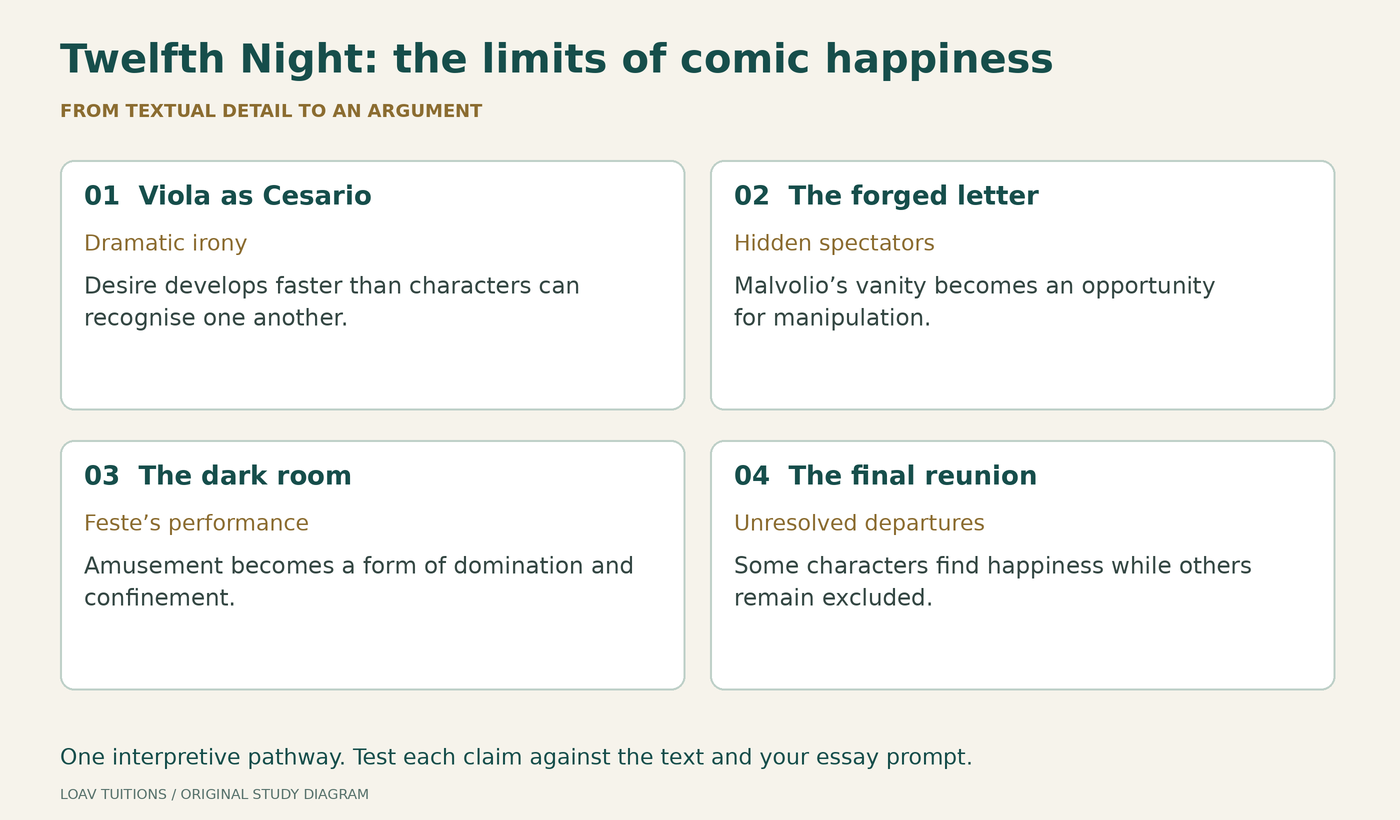
After a shipwreck, Viola believes her twin brother Sebastian may be dead. Disguised as Cesario, she enters Orsino’s service and is sent to court Olivia on his behalf. Viola falls in love with Orsino; Olivia falls in love with Cesario. The audience knows why this arrangement cannot proceed as the characters expect. The resulting dramatic irony creates humour, but it also gives the audience privileged access to Viola’s frustration.
Meanwhile, Olivia’s household becomes a contest over pleasure and authority. Sir Toby’s disruptive company clashes with the steward Malvolio. Maria’s forged letter persuades Malvolio that Olivia loves him and wishes him to behave absurdly. His compliance makes him appear irrational, and the joke escalates into confinement and psychological torment. The prank is not simply a harmless parallel to Viola’s disguise: it gives one group deliberate control over another person’s interpretation of reality.
Sebastian’s arrival allows mistaken identity to become a route towards marriage. Antonio’s loyalty to him also generates confusion when he mistakes Viola for her brother. In the final scene, the twins’ appearance together resolves the central puzzle. However, Malvolio leaves threatening revenge, Antonio has no equivalent romantic resolution, and Feste’s closing song places festive happiness within a world where difficulty persists. Resolution and remainder belong to the same ending.
Characters beyond a list of traits
Viola combines practical invention with emotional vulnerability. Her disguise gives her access to work and intimate conversation, but prevents straightforward disclosure of her desires. Orsino loves the language and experience of being a lover; his shifts of feeling invite examination of the difference between devotion and self-dramatisation. Olivia moves from elaborate mourning into active pursuit, unsettling the claim that her emotions can be fixed in advance.
Malvolio is self-important and socially ambitious, but those qualities do not make every punishment just. Maria understands how to turn his hopes into evidence he wants to believe. Sir Toby champions pleasure while exploiting Sir Andrew and disregarding the costs imposed on others. Feste can expose pretension through wit, yet his role in the prison scene complicates any description of him as an entirely detached truth-teller. Antonio makes care visible through risk and action rather than ornamental speeches.
Theme Analysis
Disguise reveals as well as conceals. Viola’s assumed identity obstructs recognition, but it also creates conversations that conventional gender roles might prevent. Shakespeare uses theatrical performance to show that appearances can both distort relationships and make new understanding possible.
Desire is not a reliable interpreter. Olivia, Orsino and Malvolio each interpret the world through what they want. Compare their differing levels of self-awareness. The comedy does not make all desire false; it tests the stories people construct around it.
Festivity can become a form of domination. Sir Toby’s resistance to restraint initially seems liberating, especially against Malvolio’s moral superiority. Once the prank becomes imprisonment, the celebration requires a victim. Trace that escalation rather than deciding from the beginning that either side is wholly right.
Order returns without satisfying everyone. The ending restores family relationships and promises marriages, but it does not distribute happiness evenly. A qualified contention can recognise genuine reunion while examining unresolved injuries.
Dramatic methods: explain their work
Dramatic irony depends on uneven knowledge: the audience understands Viola’s disguise while others do not. Soliloquies and asides make the gap intimate. The forged letter is a play within the play, complete with hidden spectators who enjoy watching Malvolio perform their script. Music frames romantic excess and later unsettles celebratory closure. Changes between verse and prose can mark shifts of tone and social interaction, but avoid a rigid rule that every noble character always speaks verse. Above all, follow who controls the scene, who is watching and who is denied the power to correct a false account.
Quote Bank
Each quotation is paired with its speaker or narrator, location, immediate circumstances and analytical use. The same evidence is developed in the full essay; chapter and act–scene references avoid edition-dependent page numbers.
- “Give me excess of it, that, surfeiting, / The appetite may sicken and so die”: Orsino to the musicians, Act 1 scene 1, at the play’s opening. He requests more music in order to extinguish his own appetite for love; the contradiction makes emotional intensity unstable rather than evidence of constancy. The slash marks a verse-line break.
- “Her sweet perfections with one self king”: Orsino, Act 1 scene 1, after hearing that Olivia will mourn her brother for seven years. He imagines the exclusive romantic authority that might replace her other attachments; the surrounding speech supplies the image of sovereign thrones.
- “I am not what I am”: Viola, disguised as Cesario, to Olivia, Act 3 scene 1, while Olivia presses her attraction. The audience knows the disguise that Olivia cannot recognise, so an apparently evasive paradox becomes a truth about the limits of outward recognition.
- “And I, poor monster, fond as much on him”: Viola alone, Act 2 scene 2, after Malvolio returns the ring Olivia pretends Cesario left behind. Recognising Olivia’s attraction, Viola sets her own love for Orsino beside his love for Olivia; the self-description registers distress within the comic triangle.
- “Remember who commended thy yellow stockings and wished to see thee ever cross-gartered”: Maria’s forged letter, read aloud by Malvolio, Act 2 scene 5, while the conspirators hide nearby. Its invented account of Olivia’s approval recruits his hopes to produce a costume Olivia actually dislikes.
- “He hath been most notoriously abused”: Olivia, Act 5 scene 1, after the deception is exposed and Malvolio exits promising revenge. Her judgment identifies mistreatment within the festive ending rather than treating the prank’s success as sufficient justification.
Practice Prompts
- The happiness of Twelfth Night depends on overlooking cruelty. To what extent do you agree?
- How does Shakespeare use disguise to investigate the relationship between identity and desire?
- In Twelfth Night, characters understand others only when their expectations fail. Discuss.
- Does the ending offer reconciliation or merely a return to social order?
Full Annotated Essay
Past-exam basis: Adapted from 2025 VCAA Section A, Question 19i, concerning the extent of Shakespeare’s mockery of social expectations. Official 2025 examination. Adapted practice wording: How far does Twelfth Night invite ridicule of the roles and behaviour society expects?
This complete original essay uses BCAS, three TEEAEAL paragraphs and CAS. The labels are teaching supports, not VCAA requirements.
Introduction
William Shakespeare’s Twelfth Night places conventional courtship and household hierarchy within a world of disguise, mistaken identity and festive disruption. Shakespeare repeatedly makes social expectations ridiculous, but the play also questions mockery when it becomes a means of humiliating vulnerable people. Romantic self-importance exposes the possessiveness beneath idealised courtship, gender disguise destabilises fixed assumptions about identity, and punitive laughter reveals the cruelty through which a community can police social ambition. The comedy therefore tests both established roles and the moral limits of laughing at those who depart from them.
Body 1: romantic convention
Shakespeare mocks conventional courtship by exposing the self-absorption concealed within apparently elevated romantic feeling. Across the central courtship triangle, declarations of devotion repeatedly exceed genuine knowledge of the beloved. Orsino cultivates his own emotional performance, while Olivia’s attraction to the disguised messenger overturns her announced withdrawal from courtship. At the play’s opening, Orsino demands, “Give me excess of it, that, surfeiting, / The appetite may sicken and so die”, treating love as an appetite that music can manipulate. The abrupt movement from wanting more to wanting the appetite extinguished makes emotional constancy doubtful. Rather than presenting romantic intensity as proof of devotion, Shakespeare makes intensity itself seem theatrical and unstable. Later, responding to news of Olivia’s mourning, Orsino imagines exclusive possession of “Her sweet perfections with one self king”. The monarchical image converts anticipated intimacy into exclusive sovereignty. Its confidence is comic because Olivia has refused his advances. Her pursuit of Cesario, however, reproduces the gap between confident desire and knowledge: she loves a socially constructed appearance. By placing both lovers’ certainty beside the audience’s fuller understanding, Shakespeare exposes romantic self-deception across gender roles. Courtship’s prestigious language consequently becomes a vehicle for revealing possessiveness rather than guaranteeing genuine understanding.
Body 2: gender and appearance
Furthermore, Shakespeare uses disguise to unsettle expectations that outward gender presentation makes identity and desire immediately legible. Viola’s performance as Cesario gives her access to relationships unavailable in her original social position, while making those relationships impossible to explain honestly. Olivia’s mistaken attraction and Antonio’s mistaken recognition of Cesario as Sebastian expose this instability beyond the experience of the disguised woman herself. Viola’s admission to the pursuing Olivia that “I am not what I am” turns ordinary self-identification into paradox. The audience can understand the statement through its knowledge of the disguise, while Olivia interprets it within the courtship she desires. This uneven knowledge makes social recognition appear interpretive rather than automatic. Alone after the ring’s return, Viola adds her own love for Orsino to the triangle: “And I, poor monster, fond as much on him”. The troubling noun shows the emotional cost of inhabiting a role that does not fit the available categories of lover and beloved. Antonio’s hurt when the apparent Sebastian fails to recognise him likewise reveals how confident visual identification can wound relationships. Shakespeare therefore does more than invite laughter at mistaken judgments: the private speech reveals the vulnerability beneath a comic situation. Gender expectations are destabilised substantially, although the sympathy given to Viola complicates any account of the play as pure ridicule.
Body 3: the limits of mockery
Nevertheless, Shakespeare challenges mockery itself when the defence of social expectations becomes an excuse for disproportionate punishment. The household conspiracy tests the authority of those who decide which ambitions deserve ridicule. Sir Toby’s entitled disorder and Maria’s clever manipulation complicate any claim that their target’s vanity makes the punishers morally superior. Malvolio reads the forged letter’s instruction, “Remember who commended thy yellow stockings and wished to see thee ever cross-gartered”, turning ambition into a visible comic costume. Because the hidden spectators and audience understand the deception, his confident performance makes him seem ridiculous. Yet that pleasure depends on a manufactured interpretation: the conspirators create the behaviour they subsequently condemn. After Malvolio’s angry exit, Olivia’s acknowledgment, “He hath been most notoriously abused”, changes the terms of judgment. The severity of her evaluation resists treating confinement and torment as merely a successful joke. Malvolio’s refusal of reconciliation then leaves an injury within the festive resolution, showing that communal laughter can enforce exclusion as readily as release people from restrictive rules. The play consequently limits its mockery by exposing the power exercised by those who decide which aspirations deserve laughter.
Conclusion
Shakespeare’s comedy thus makes social expectations unstable without making ridicule an unquestioned good. Romantic sovereignty and assumptions about gender become comic targets, while the treatment of social ambition reveals how laughter can turn coercive. The audience is invited to question prescribed roles, but also to examine whether its enjoyment reproduces the exclusions that the play brings into view.
Analysis annotations
Structure map: The introduction follows BCAS: background establishes the text’s central tension, the contention gives a qualified answer, the arguments forecast the three body paragraphs, and the summary draws those claims into an authorial perspective. Each body follows TEEAEAL: an idea-led topic sentence and elaboration establish the claim; two evidence-and-analysis movements develop it; the link returns to the prompt. The conclusion follows CAS: it restates the qualified contention, synthesises the arguments and resolves their wider significance. These functions remain within the continuous prose; the labels are teaching tools, not VCAA requirements.
Transitions should name a logical movement, not merely announce another paragraph. Nominalisations such as refusal, possession and reconstruction help track concepts, but keep the author and textual action clear.
- Contention: The answer makes a judgment about extent: substantial mockery, qualified by sympathy and ethical limits.
- Topic sentences: Each begins with Shakespeare’s construction of an idea, then uses characters as evidence.
- Transitions: “Furthermore” expands the challenge from romance to gender; “Nevertheless” turns scrutiny onto the mockers.
- Methods: Appetite imagery, paradox, dramatic irony, costume and final-scene evaluation are connected to the argument.
- Nominalisation: Recognition, exclusion and reconciliation connect scene-level observations without replacing clear explanation.
Sources and quotation checks
- VCAA 2026 text list.
- Folger complete play: Orsino, Act 1 scene 1; Viola, Acts 3 scene 1 and 2 scene 2; forged letter read by Malvolio, Act 2 scene 5; Olivia, Act 5 scene 1. Wording checked directly; modern editorial punctuation may vary.
- VCAA 2025 English assessment report: official discussion of focused argument and evidence.
- Supplementary text-response guidance: structural comparison; the model above is original.
For help applying this analysis to your own writing, explore Loav’s VCE tutoring or enquire about a trial class.
