
Loav reading room · VCE English · 2026
2026 List 1 novel: Yōko Ogawa, The Memory Police, translated by Stephen Snyder, Vintage, 2020, ISBN 9781784700447. This guide contains spoilers. Its interpretations, practice topics and model writing are original teaching material.
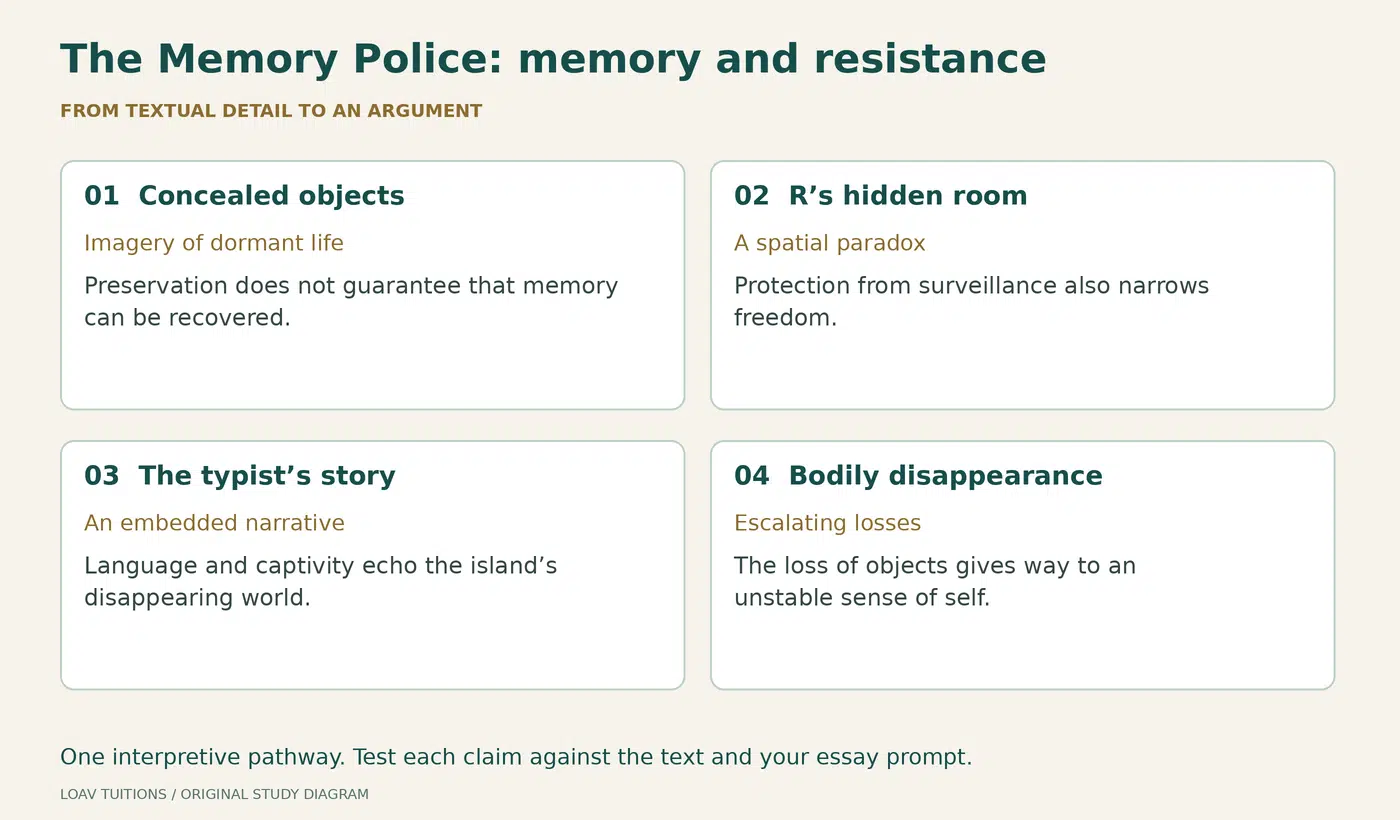
The central problem
What would resistance mean if you could no longer understand what you had lost? Ogawa makes this question more disturbing than a simple struggle between a dictator and a rebellious citizen. The unnamed narrator lives on an island where things disappear, together with most inhabitants’ capacity to attach meaning to them. Physical remnants may survive temporarily; their emotional significance does not. The Memory Police pursue people who remember and destroy traces of disappeared things. Yet the novel does not supply a complete explanation of the disappearances. Distinguish the police’s enforcement of forgetting from a proven account of its ultimate cause.
The narrator, a novelist, shelters her editor R, whose memory persists, with practical help from an older man. Their fragile household sustains care under surveillance. Her own manuscript follows a typist whose loss of voice accompanies captivity. As the island’s losses extend to bodies, the difference between being alive and remaining a recognisable self becomes increasingly uncertain. The narrative offers attachment and creative work without promising that either can defeat disappearance.
Characters as different relationships to loss
- The narrator: her limited first-person account makes accommodation feel ordinary. She is neither simply cowardly nor securely heroic. Her willingness to protect R coexists with an inability to recover meanings he still possesses.
- R: he preserves continuity, but remembering makes him vulnerable. His position tests the assumption that knowledge always increases freedom: the person with the fullest memory has to hide.
- The old man: his practical assistance gives ethical weight to daily work. Friendship is expressed through making survival possible, rather than through a public declaration of rebellion.
- The narrator’s mother: her concealed objects connect artistic creation, forbidden knowledge and maternal intimacy. The daughter can receive an object without inheriting the mother’s experience of it.
- The Memory Police: their collective identity makes institutional power more important than an individual villain’s psychology. Their efficiency turns extraordinary coercion into procedure.
Form, imagery and interpretive possibilities
The island and the hidden room. These settings produce enclosure at different scales. The island separates its population from alternative systems of knowledge; the room protects R by narrowing his physical life. A strong essay can explore this paradox rather than labelling every confined space merely oppressive. Safety can require restriction, while a publicly accessible world can remain politically imprisoning.
The novel within the novel. The typist’s story is a structural counterpart to the narrator’s experience. Both narratives explore diminished agency, dependence and the difficulty of sustaining a voice. Avoid treating the embedded story as a literal prediction with a one-to-one code. Its changes in situation and emphasis allow the reader to compare different forms of captivity. Writing becomes both a means of investigating domination and an activity that domination threatens.
Understatement. The calm narrative manner creates a gap between the narrator’s accommodation and the reader’s alarm. This is not evidence that nothing matters to her. A quieter response may reveal how coercion alters the available vocabulary of feeling. Ask how a sentence presents loss as routine, how that routine develops, and why an audience might resist the narrator’s apparent acceptance.
Objects and embodied identity. An object’s material survival does not guarantee that its use, history or emotional value survives. The later bodily disappearances intensify this problem: selfhood depends on more than an intact inventory of possessions. Read the development from missing things to diminished persons as a change in the stakes of forgetting, rather than as a sequence of increasingly strange events.
Theme Analysis
Power works through adaptation as well as terror. The police’s visible interventions matter, but ordinary efforts to carry on also make losses appear manageable. Be careful with the word complicity: people whose capacity to remember is damaged do not possess the same choices as those who direct repression. An insightful response distinguishes responsibility from constrained survival.
Care can have value without guaranteeing rescue. Sheltering R creates a small, vulnerable alternative to the island’s treatment of difference. The relationship does not reverse the whole system. Its significance lies partly in refusing to make success the only measure of ethical conduct. Ask what practical care preserves, and what it cannot preserve.
Art records vulnerability rather than supplying an easy cure. The narrator’s writing can give form to experiences that ordinary conversation struggles to contain. However, art remains exposed to the same pressures as its maker. A sophisticated argument can defend storytelling’s importance while admitting its limits. Avoid the unsupported conclusion that memory or literature automatically conquers authoritarianism.
Quote Bank
Use these short passages as starting points for analysis, not as fixed answers. Scene descriptions locate the passages; page numbers vary between editions. Each quotation is continuous, with no silent omissions.
Power, silence and erasure
- “They worked in silence, their eyes fixed, making no unnecessary movements.” Narrator. The police sort the father’s research during the raid. Authorial analysis: The clipped description of disciplined movement separates institutional efficiency from ethical attention.
- “my voice was lost in the pile of memories on the floor.” Narrator. Her appeal to preserve family possessions goes unacknowledged. Authorial analysis: The material metaphor puts voice among discarded records, making exclusion a form of erasure.
- “I am absorbed silently into the room, leaving no trace.” Typist narrator in the embedded manuscript. The captive typist approaches the end of her existence. Authorial analysis: The passive construction and spatial absorption connect intimate domination with the island’s destruction of identity.
Care, concealment and resistance
- “my mother kept hidden many of the things that had been disappeared from the island in the past.” Narrator. The child encounters the mother’s secret drawers. Authorial analysis: The domestic archive makes concealment protective, while the unusual passive phrasing leaves the agency behind disappearance unresolved.
- “yet this silence made me all the more conscious of his existence.” Narrator. She listens for R beneath the floor after he goes into hiding. Authorial analysis: The paradox reverses the police’s erasing silence: absence of sound intensifies relational awareness.
- “There was no choice here but to sit practically touching each other.” Narrator. The narrator sits beside R in the cramped refuge. Authorial analysis: Spatial intimacy enables care but the negation of choice prevents the room from becoming a simple emblem of freedom.
Memory, embodiment and identity
- “like little animals in hibernation, sending me no signal at all.” Narrator. Preserved objects fail to communicate their former meaning to the child. Authorial analysis: The simile offers latent life while the communication metaphor exposes the limits of material preservation.
- “We shrug them off with as little fuss as possible and make do with what’s left.” Narrator, speaking to R. She explains adaptation after the disappearance of left legs. Authorial analysis: Colloquial understatement normalises bodily loss; accommodation preserves routine while diminishing the self.
- “R’s hand stirred the water, but no more than a few tiny bubbles rose to the surface and popped silently.” Narrator. R touches the leg that she can no longer experience as her own. Authorial analysis: The extended water metaphor registers the inability of loving touch to restore lost bodily meaning.
Writing, witness and its limits
- “The only sound was the rustling of papers, like the fluttering of wings.” Narrator. The police destroy records of birds. Authorial analysis: The simile lets readers imaginatively encounter the very creatures whose traces are being removed.
- “You can’t write with your head. I want you to write with your hand,” R. The editor advises the narrator about her stalled manuscript. Authorial analysis: The head–hand contrast presents writing as embodied practice, an idea later placed under pressure by bodily disappearance.
- “I may have managed to finish the story, but I’m still losing myself.” Narrator, speaking to R. After completing her manuscript she remains threatened by disappearance. Authorial analysis: The concessive syntax distinguishes artistic completion from personal rescue, qualifying any claim that storytelling defeats oppression.
Practice Prompts
- In The Memory Police, resistance matters even when it cannot prevent loss. Discuss.
- How does Ogawa explore the relationship between memory and personal identity?
- The greatest danger on the island is the acceptance of disappearance. To what extent do you agree?
- How does the relationship between the narrator’s life and her manuscript shape the novel’s exploration of freedom?
Full Annotated Essay: silence and power
Past VCAA topic, 2025: The examination asks students to discuss silence as an instrument of both oppression and resistance in The Memory Police. This is a paraphrase of the official topic, not a new quotation from the novel. Read the official 2025 paper.
The complete five-paragraph model below uses BCAS, three TEEAEAL body paragraphs and CAS. These are teaching scaffolds, not VCAA requirements. The separate annotations explain those functions while the essay reads continuously.
Introduction
In Yōko Ogawa’s The Memory Police, the loss of objects and memories steadily narrows an island community’s capacity to understand its own life. Silence functions as both an instrument of domination and a condition of resistance, although its protective value remains inseparable from vulnerability. Institutional silence suppresses recognition of suffering; concealed relationships preserve endangered meanings; and the narrative’s representation of failed communication exposes what silence cannot restore. Ogawa consequently asks readers to judge silence by the power relations it sustains, rather than assuming that speech always liberates or quietness always submits.
Body 1
Ogawa first presents institutional silence as a means of removing the victim’s experience from consideration. Oppression involves more than destroying objects: it also denies the reciprocal attention through which a person’s loss might acquire public significance. During the removal of the narrator’s father’s papers, the narrator observes, “They worked in silence, their eyes fixed, making no unnecessary movements”. By withholding reciprocal dialogue, Ogawa makes bureaucratic efficiency appear ethically deficient: readers witness a procedure that functions perfectly only because grief has no recognised place within it. The contrast challenges the assumption that orderly action is necessarily legitimate. Correspondingly, the narrator reports that “my voice was lost in the pile of memories on the floor”. Ogawa’s figurative treatment of voice aligns a person’s appeal with the material traces being discarded. This structural anticipation of later bodily disappearances invites readers to see erasure as the progressive withdrawal of personhood. The embedded typist narrative extends the same pattern into an intimate setting, suggesting that domination operates wherever another person controls the conditions under which expression matters. Silence therefore supports oppression when authority can act without listening, leaving the vulnerable person unable to make their experience count.
Body 2
Nevertheless, Ogawa also represents concealment as a necessary protection for relationships that public life endangers. Visibility is not inherently empowering in a society that punishes the survival of memory. Under these conditions, refusing disclosure can preserve possibilities that open expression would expose to destruction. Recalling the secret drawers, the narrator explains that “my mother kept hidden many of the things that had been disappeared from the island in the past”. Through this domestic counter-setting, Ogawa reverses the usual association between openness and freedom. Readers encounter secrecy as the condition of meaningful exchange, exposing the moral inadequacy of a public order that makes preservation dangerous. Later, while listening for the concealed R, the narrator registers a reversal: “yet this silence made me all the more conscious of his existence”. The paradox contrasts with the officers’ unresponsiveness: silence intensifies recognition rather than extinguishing it. Ogawa develops this spatial and tonal opposition through R’s hidden room: care creates refuge, but refuge also confines. Rather than inviting unqualified celebration of resistance, this paradox positions readers to value protective relationships while recognising the losses that survival imposes. Ogawa thus presents resistant silence as valuable because of the person and relationship it shelters, while showing that survival may require painful restriction.
Body 3
Finally, Ogawa distinguishes the preservation of traces from the restoration of communication, qualifying what resistant silence can achieve. Hidden objects and protected people matter, but their survival cannot guarantee the recovery of a shared emotional world. The narrator’s inability to remember is not cured simply by proximity to someone who can. The preserved objects resemble “little animals in hibernation, sending me no signal at all”. Ogawa’s communication metaphor makes preservation insufficient: a trace can survive without restoring the relation that made it meaningful. The later contrast between persistent and diminishing memory develops this limitation, preventing readers from treating physical rescue as a complete recovery of selfhood. After completing her manuscript, the narrator admits, “I may have managed to finish the story, but I’m still losing myself”. The concessive construction refuses to equate a completed work with a restored self. Ogawa makes the manuscript’s survival a limited resistance: R’s promise to remember it sustains a relationship even as its author diminishes. Neither text reverses disappearance, but their representation of vulnerability challenges the equivalence of powerlessness and worthlessness: expression can sustain ethical attention without securing victory. By retaining this distinction, Ogawa refuses both the celebration of silence as sufficient resistance and the dismissal of fragile expression as useless.
Conclusion
Silence in The Memory Police has no single moral meaning; its significance depends on whether it excludes another person or protects them. The police’s unresponsiveness consolidates domination, clandestine care sustains threatened relationships, and failed communication reveals the limits of preservation. Ultimately, Ogawa suggests that neither speech nor silence guarantees freedom. What matters is the difficult work of maintaining attention to lives and meanings that power makes increasingly vulnerable.
Why this argument works
Structure map: The introduction follows BCAS: background establishes the text’s central tension, the contention gives a qualified answer, the arguments forecast the three body paragraphs, and the summary draws those claims into an authorial perspective. Each body follows TEEAEAL: an idea-led topic sentence and elaboration establish the claim; two evidence-and-analysis movements develop it; the link returns to the prompt. The conclusion follows CAS: it restates the qualified contention, synthesises the arguments and resolves their wider significance. These functions remain within the continuous prose; the labels are teaching tools, not VCAA requirements.
- Progression: the argument moves from imposed silence to protective secrecy, then qualifies protection’s limits. Each paragraph develops a different claim signposted in the introduction.
- Authorial construction: the analysis connects wording to setting, structural parallels and the later bodily disappearances, avoiding an opening-only reading.
- Transitions: “Nevertheless” marks a genuine counter-movement; “Finally” introduces a qualification rather than an unrelated example.
- Nominalisation: preservation, restoration and recognition name processes precisely, allowing the essay to compare them without obscuring who acts.
- Evidence: six contextual passages are embedded in analytical sentences, each supported by scene context and a separate explanation. The evidence moves from the mother’s archive and police raid to R’s refuge and the completed manuscript.
Evidence and source notes
The twelve bank passages and six embedded essay quotations use the Pantheon 2019 Stephen Snyder translation (ebook ISBN 9781101870617). Pagination differs from the prescribed Vintage 2020 edition; locate passages by their scene descriptions and check page references in your own copy. The authorised publisher sample below is a supplementary source. This original essay has not been graded by VCAA.
- Vintage publisher sample: primary-text verification.
- Publisher description and translator credit.
- Booker Prizes reading guide.
- VCAA examinations and reports. The 2024 report rewards topic-specific reasoning, connected argument and varied evidence; its examples are not reproduced in this guide.
For help applying this analysis to your own writing, explore Loav’s VCE tutoring or enquire about a trial class.
