
Loav reading room · VCE English · 2026
Billy Wilder’s Hollywood is an industry of manufactured visibility. Its tragedy emerges when people can no longer distinguish being watched from being loved, or being useful from being valued.
2026 scope and narrative foundations
The prescribed work is Billy Wilder’s Sunset Boulevard (1950), the film, not the later stage musical. Study the completed film’s images, sounds, editing and performances. A screenplay can help verify dialogue but cannot replace analysis of what appears on screen. The film concerns coercive dependence, emotional distress and lethal violence.
Joe Gillis, a financially unsuccessful screenwriter, enters the mansion of former silent-film star Norma Desmond and becomes involved in her proposed return to cinema. His paid writing work develops into material and emotional dependence. Max, her servant and former husband, maintains the conditions in which her fantasy survives. Joe’s collaboration with Betty Schaefer suggests a different artistic and personal relationship, but his attempt to sustain incompatible lives becomes increasingly destructive.
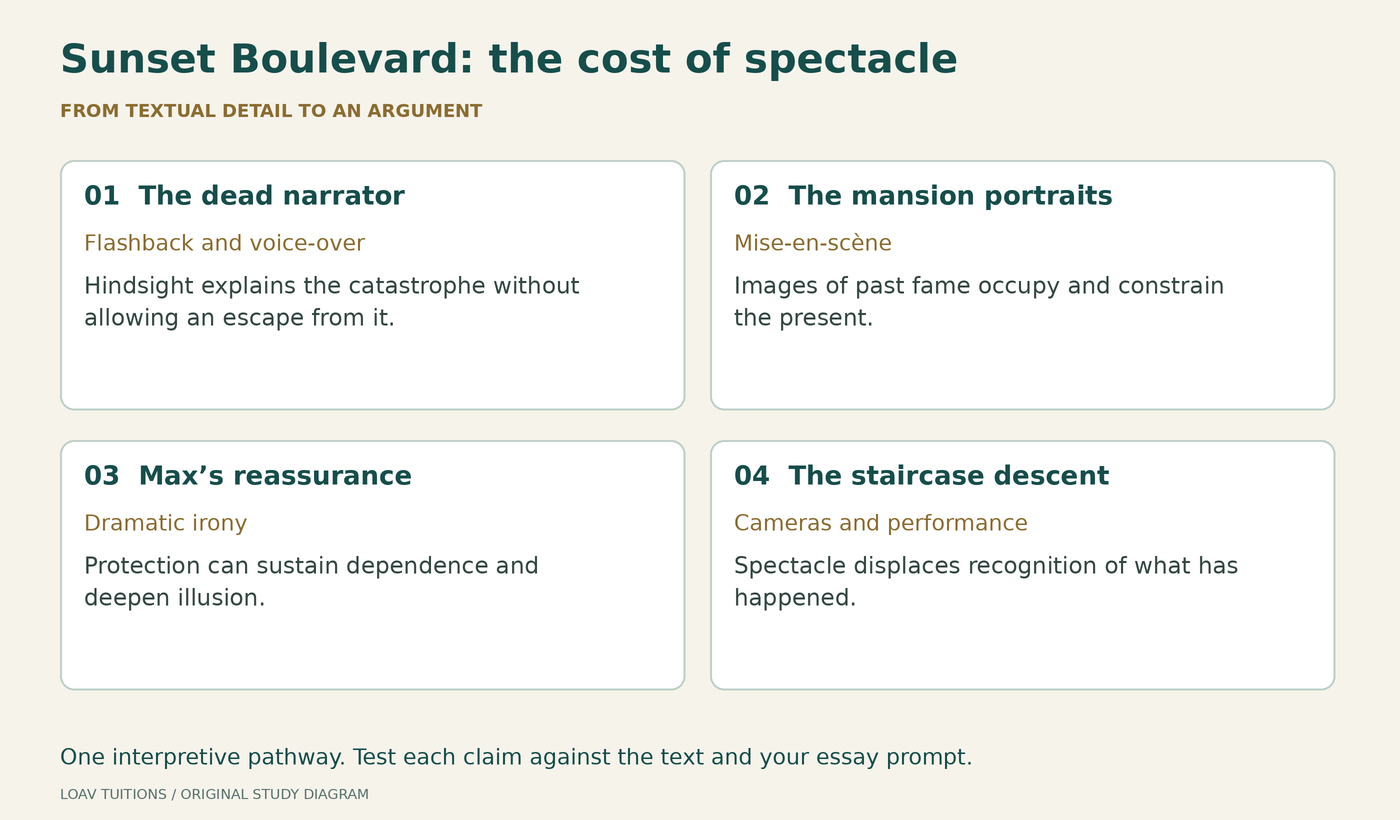
The opening reveals Joe’s death before the narrative explains it. This is not merely a suspense device: knowledge of the outcome makes his subsequent rationalisations appear as steps in a catastrophe he cannot now reverse. His voice-over gives him verbal control over the account while the image of his body exposes the limits of that control.
Theme Analysis
Illusion is socially maintained. Norma’s fantasy is not created by one person alone. Joe profits from indulgence; Max supplies reassurance; the industry’s past worship of its stars gives continued admiration an apparently reasonable basis. An essay can distinguish her responsibility for her actions from the network of incentives that permits her mistaken beliefs to grow. The important question is who benefits from withholding the truth.
Compassion and control can coexist. Max’s devotion is moving because it involves loyalty and loss. It is troubling because it deprives Norma of information she needs to understand her life. Avoid treating care as automatically good or deception as automatically uncomplicated. Wilder asks whether protection that preserves dependence can remain an adequate form of love.
Artistic ambition becomes economic compromise. Joe needs income, but each convenient concession makes independence more difficult. His cynical narration may sound like self-knowledge; it does not necessarily produce ethical action. Betty offers the possibility of shared creative labour rather than one person’s purchase of another’s attention. Yet Joe’s deception contaminates that possibility. Aspiration is neither entirely condemned nor allowed to excuse exploitation.
Visibility can become dehumanising. Norma is both a person and a manufactured image. The industry’s celebration of youth intensifies the gap between those identities. Her desire to return is therefore more than vanity, although vanity remains part of it. The conclusion is especially uncomfortable because public attention finally returns when she becomes a spectacle of catastrophe. The camera grants the visibility she desires while recording the destruction of her grasp on the situation.
How form carries the argument
The mansion as mise-en-scène. Objects, portraits, enclosed rooms and the private projection of earlier films make the house an environment organised around repetition. The past occupies material space. Explain how the arrangement affects relationships: Joe enters a world whose central role has already been assigned to Norma. Do not call the house a prison without showing how its luxury, isolation and routines constrain its inhabitants.
Voice and image. Joe’s dry voice-over can distance the audience from emotional excess, but it also encourages identification with a man who excuses his own compromises. Ask whether the image confirms, complicates or exceeds his description. The dead narrator’s apparent authority is especially paradoxical: he can arrange the story but cannot recover the future his choices have destroyed.
Contrasting spaces. The mansion and the spaces associated with Betty’s working life offer different models of collaboration and time. Norma’s project continually returns to an established image of herself; collaborative writing requires revision and attention to another person. Analyse particular sequences rather than asserting that every studio scene is honest. Hollywood remains the industry that produces both opportunity and exclusion.
The final performance. The staircase descent turns a police and news event into an imagined film scene. Max’s direction, the cameras and Norma’s performance collaborate in this transformation. Her approach towards the camera collapses the distance between viewer and spectacle. The ending implicates spectators: our desire to see the star has become inseparable from watching her vulnerability.
Quote Bank
Six short, verified quotation fragments are embedded in the full essay below. Each fragment is linked to its use in the essay. The notes identify context and analytical use; always read the surrounding passage as well.
- “big” — Evidence 1: Norma, first exchange with Joe. Emphatic self-description. The first fragment asserts continuing significance.
- “small” — Evidence 2: Norma, same exchange. Antithesis. The second shifts decline from the star to the industry.
- “writer” — Evidence 3: Joe, early exchange. Professional self-identification. The third establishes the employment that becomes dependency.
- “rope of words” — Evidence 4: Norma, attack on talking pictures. Violent metaphor. The fourth turns writing into a destructive force.
- “cameras” — Evidence 5: Norma, final sequence. Dramatic irony and props. The fifth marks the mismatch between a news event and imagined filmmaking.
- “close-up” — Evidence 6: Norma, final address. Cinematic terminology and performance. The sixth makes desired visibility inseparable from exposure.
Practice Prompts
- In Sunset Boulevard, illusion survives because it serves more than one person. Discuss.
- How does Wilder expose the relationship between ambition and dependence?
- Love in Sunset Boulevard is inseparable from control. To what extent do you agree?
- How does Wilder make the audience question its desire to watch?
These prompts are independently written for practice, not official VCAA topics. For the first, organise by mechanisms that sustain illusion rather than writing one isolated paragraph about each character. Each argument should explain a relationship between private desire and another person’s participation.
Full Annotated Essay
Prompt: Discuss Wilder’s suggestion that people can be both victims and villains.
Paraphrase of the verified 2025 VCAA English examination, Section A, Question 15(ii). See the official examination.
This complete original model uses BCAS, three TEEAEAL body paragraphs and CAS. These are optional learning scaffolds, not VCAA rules. The separate annotations explain the construction; the essay itself uses continuous prose.
Introduction
Billy Wilder’s Sunset Boulevard places the pursuit of recognition within an industry that manufactures glamorous images while making their human subjects disposable. The film presents victimhood and wrongdoing as potentially intertwined: suffering helps explain destructive conduct without cancelling responsibility for it. Hollywood’s treatment of its stars generates wounds that can become demands upon others, economic insecurity encourages ethically compromising dependence, and apparently protective performances perpetuate deception. Wilder therefore unsettles a simple division between innocent victims and autonomous villains, asking viewers to recognise the relationship between vulnerability and complicity.
Body 1
Wilder presents the damage inflicted by public rejection as a condition that can foster coercive demands for private recognition. The film invites sympathy for a star whose identity has been organised around being watched, while refusing to make that injury a justification for controlling another person. Norma’s declaration that she remains “big” insists upon a continuing status that her professional circumstances no longer confirm. Its certainty is visually reinforced by the mansion’s accumulated representations of her earlier image. The mise-en-scène preserves an audience’s past admiration in a form she can repeatedly encounter, making the loss of public recognition more comprehensible. Max’s fabricated fan mail extends this preservation beyond the image: the household manufactures signs of continuing demand. Wilder thereby presents celebrity as a socially sustained representation whose apparent permanence depends upon other people’s labour and deception. Her judgement that the pictures have become “small” relocates decline from herself to the industry. The reversal permits an element of criticism of Hollywood’s changing priorities, but also reveals her difficulty in accepting a reality she cannot dictate. As that need for confirmation shapes her relationship with Joe, victimisation becomes entangled with possessiveness. Wilder makes Norma’s suffering legible without treating the demands arising from it as morally harmless.
Body 2
Economic dependence similarly complicates the distinction between being exploited and participating in exploitation. The flashback supplies economic pressure as an explanation for compromise, while the knowing voice-over makes that explanation ethically incomplete. Its apparent candour invites an audience’s trust even as the unfolding images reveal participation in the arrangements being criticised. In their early exchange Joe identifies himself as a “writer”, a professional role that appears to provide a legitimate basis for payment. The employment language initially legitimises payment, but the surrounding luxury makes the benefits of accommodation visible. Wilder’s contrast between verbal cynicism and material acceptance asks viewers to separate recognising exploitation from refusing its rewards. Norma’s attack on a “rope of words” gives language a destructive rather than merely creative function. The metaphor suits an industry in which writing can become manipulation, although her hostility also unfairly reduces Joe’s craft to a threat to her preferred cinema. The collision of professional self-description and violent metaphor makes injury operate in both directions: creative work is belittled while hope can be monetised. Wilder thus blocks the reassuring assumption that the person who best describes corruption stands outside it. Joe’s vulnerability explains his compromises, but his participation prevents the viewer from treating dependence as complete innocence.
Body 3
Wilder’s final staging shows how the desire to protect a vulnerable person can itself sustain a destructive illusion. The ending gathers devotion, institutional procedure and spectatorship into one performance, refusing a clean separation between compassionate assistance and participation in deception. Max’s direction makes it possible to move Norma downstairs, but also restores the world in which she imagines herself a star. Her attention to the “cameras” converts the apparatus recording a crime into the apparent confirmation of renewed celebrity. The same visible objects therefore carry incompatible meanings for Norma and the surrounding observers. This dramatic irony makes her isolation painful while revealing how others can cooperate in a representation they know to be false. Her readiness for a “close-up” culminates in the movement towards the camera. The approach brings the viewer into the position of the desired audience. We are not responsible for her actions, but the form challenges the comfort of consuming her collapse as spectacle while condemning her craving to be seen. Protection and spectatorship become ethically compromised when recognition is replaced by the maintenance of a performance.
Conclusion
Ultimately, Wilder presents suffering and wrongdoing as intersecting conditions rather than mutually exclusive identities. Rejection fuels possessiveness, financial vulnerability encourages complicity, and protective performance prolongs deception. The film asks for a judgement capable of recognising how people are harmed without surrendering the demand that they answer for the harm they inflict.
Use the model without memorising it
Plan a response to one of the original practice prompts before rereading the essay. Decide which of its arguments remain relevant and which need to change. A strong response is shaped by the question, not by a prepared sequence of quotations. For each selected example, record its context, a formal choice and the inference that connects it to your contention.
The 2025 VCAA report stresses the need to address relationships and qualifiers in the topic. Keep more than one part of the text in view, use evidence analytically, and make the conclusion resolve the argument. Check quotation wording against your prescribed text or licensed film. These models illustrate a defensible reading rather than an official assessment, a guaranteed mark or the only acceptable interpretation.
Sources and evidence notes
- AFI catalogue: film identification and production record.
- AFI Silver programme: opening quotation and context.
- Film dialogue transcript: short final dialogue fragment; use the film for performance and visual analysis.
- 2025 VCAA English assessment report: topic responsiveness and analytical evidence.
Evidence notes: The brief quotations belong to Joe and Norma’s initial exchange and Norma’s final speech. No screenplay stage directions are treated as evidence of completed-film technique.
For help applying this analysis to your own writing, explore Loav’s VCE tutoring or enquire about a trial class.
