
A study session with friends can produce a page of correct answers without showing what each person understands. One student starts the solution, everyone follows, and the group moves on. Later, the same kind of question feels unfamiliar when you face it alone.
For your next VCE revision session, use a simple rule: everyone produces an answer before discussion and another answer after it. The group helps you examine your reasoning, but it does not write your response. This solo–discuss–retry routine works best with two or three students tackling one small concept.
What the research suggests
In a 2009 undergraduate genetics study, students answered a concept question individually, discussed it, then answered a different question on the same concept independently. The results supported improved understanding through discussion, rather than students simply adopting a neighbour’s answer. Read Smith and colleagues’ study abstract.
That study concerned university classroom questions, not VCE study groups or this exact timetable. The 30-minute routine below is an original practical adaptation, not a tested recipe or a promise of higher marks. Its most useful feature is the fresh individual question: it gives you something concrete to inspect after the conversation.
Before you start: choose a small target
Choose two practice questions that require similar reasoning but have different details. For example, both might ask you to interpret a rate, justify a biological prediction or connect a short quotation to a claim. Avoid pairing an easy definition with a long essay.
Bring separate paper, a timer and a trusted explanation, such as teacher feedback or worked textbook solutions. Keep solutions covered until the checking stage. Use revision material you are allowed to discuss. For assessed work, follow your teacher’s collaboration rules rather than assuming this routine permits sharing answers.
The 30-minute session
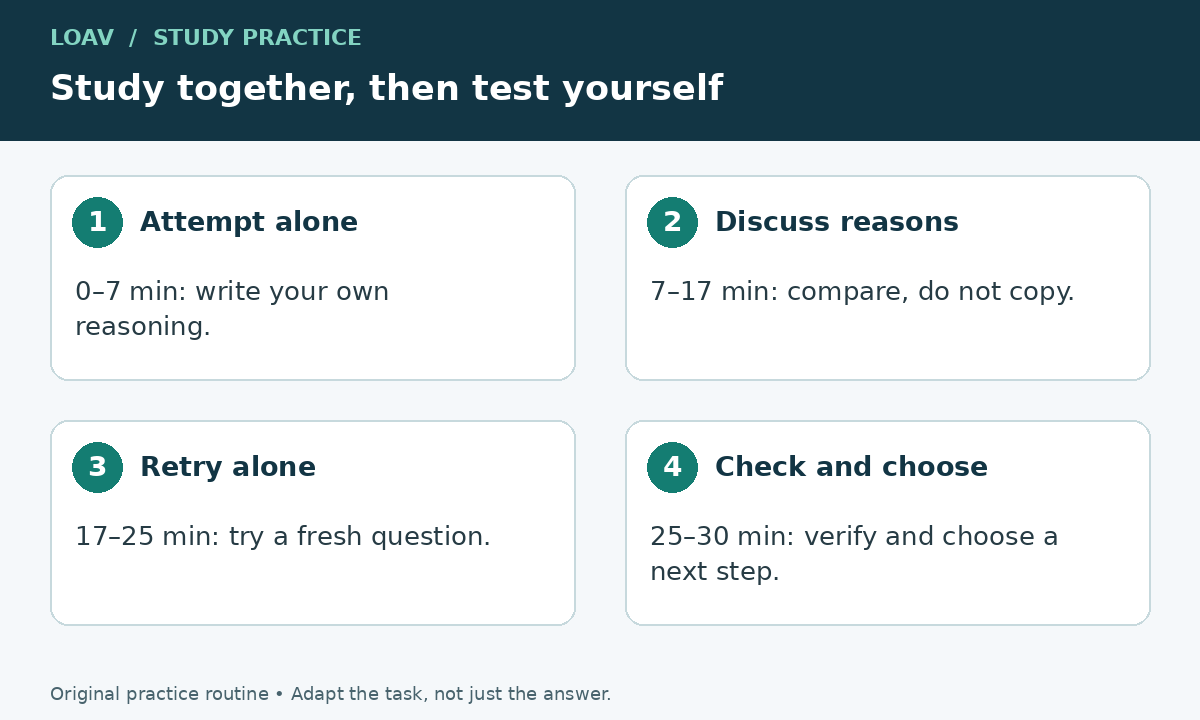
Minutes 0–7: attempt alone
Read the first question silently and write your own response. Include enough working or reasoning for someone else to follow. If you are stuck, write the last step you understand and one precise question about what comes next.
No hints yet. A blank space that identifies a genuine difficulty is more useful for this session than an answer borrowed before you have thought.
Minutes 7–17: discuss the reasoning
Give each person a short uninterrupted turn. Start with the person who has spoken least, not automatically the person who usually finishes first. Describe why you chose your approach before announcing whether you agree with another answer.
Use prompts such as “Which information supports that step?” and “What would make this answer wrong?” When responses differ, locate the first point where the reasoning separates. Avoid deciding by majority vote or confidence. Keep your original work visible so you can distinguish your first attempt from ideas developed together.
Minutes 17–25: retry independently
Put the first question and discussion notes aside. Each person answers the second question in silence, including a short justification. Nobody narrates their working, shares a screen or checks a neighbour’s page.
If you cannot finish, mark exactly where you stopped. Do not turn the final minute into another group solution. The purpose is to see which parts you can now carry out without support.
Minutes 25–30: check and choose
Compare both questions with the trusted explanation. Check the reasoning as well as the final answer. Each person states one thing they can now do and one point that still needs clarification.
If your group cannot resolve a disagreement from the source, turn it into a specific question for your teacher. Agreement among friends is not enough to settle whether an explanation is correct.
A small example: starting amount or rate?
Suppose two savings balances are described by A(w) = 120 + 15w and B(w) = 90 + 20w, where w is the number of weeks. Which balance grows faster? One student chooses A because it begins higher. Another chooses B because it increases by 20 each week rather than 15.
The discussion should separate starting balance from weekly change. For an independent retry, use a new context: V(t) = 80 − 3t and U(t) = 50 − 2t describe water volumes in litres after t minutes. Which volume falls faster? V loses three litres per minute, compared with two for U. Each student must connect that answer to the coefficient, not just repeat the earlier choice.
Your session checklist
- Everyone attempted the first question before receiving hints.
- Everyone explained a reason, including anyone who was unsure.
- The retry used a fresh question and separate working.
- The group checked a trusted explanation rather than taking a vote.
- Each person left knowing one specific next action.
Next step: invite one classmate, choose two short questions on a shared difficulty and set a 30-minute limit. Keep the second question untouched until the independent retry.
Choose a suitable subject task from Loav’s study articles and guide collections.
