
A writing practice session does not always need a full timed response. If your paragraphs repeat the same sentence opening, or your ideas are joined by a long chain of “and”, spend a few minutes practising how sentences fit together. Sentence combining gives you a small piece of writing to improve without simultaneously planning an entire response.
For Victorian selective entry preparation, ACER describes writing in terms of precise language and coherently organised ideas. It does not prescribe the exercise below. These original examples are general writing practice, not official questions, an assessment rubric or a prediction of an exam task.
Keep the meaning before changing the shape
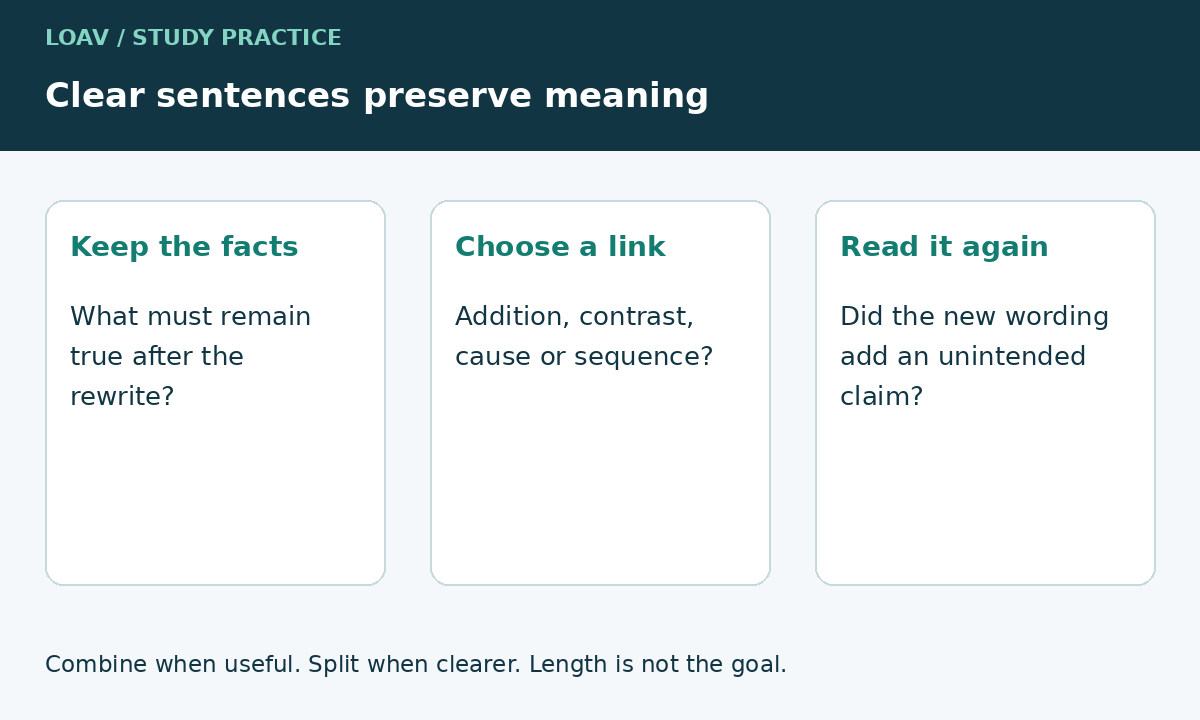
Start with two or three short statements that belong together. Underline the facts you must preserve. Then decide how the ideas relate: addition, contrast, cause, time or description. Choose a joining structure that expresses that relationship accurately. A longer sentence is only useful when it makes the meaning easier to follow.
Try this original pair: “The library was small. It had a quiet study room.” One possible combination is “The small library had a quiet study room.” You have removed repetition without adding information. Another possibility is “Although the library was small, it had a quiet study room.” That version introduces an expectation: a small library might not have such a room. Use it only if that contrast fits the surrounding paragraph.
This comparison is the main task. Do not measure improvement by counting words or subordinate clauses. Ask what the new sentence now implies, and whether you intended that implication.
Practise three different relationships
Cause: “Rain soaked the outdoor reading area. The club moved its meeting inside.” If the move happened because of the rain, write “Because rain soaked the outdoor reading area, the club moved its meeting inside.” If the original context does not establish a cause, do not add “because” just because it sounds fluent.
Contrast: “The proposal was inexpensive. It would take several weeks to organise.” A useful version is “The proposal was inexpensive, but it would take several weeks to organise.” Both points remain visible. The sentence can support a balanced discussion without pretending that a low price removes every practical difficulty.
Sequence: “Leah checked the map. She chose the shorter path.” Try “After checking the map, Leah chose the shorter path.” Leah performs both actions, so the opening phrase attaches clearly to her. “After checking the map, the shorter path was chosen” is less clear about who checked it.
Sometimes split instead of combine
Read this original sentence: “The club wanted a garden because students needed a quiet space and the courtyard was empty but the ground was uneven and the budget was small so they decided to begin with planter boxes.” It carries several decisions in one breath.
A clearer version might be: “The club wanted to turn the empty courtyard into a quiet garden. However, the ground was uneven and the budget was small. They decided to begin with planter boxes.” The three sentences preserve the reasoning while making the problem and response easier to follow. Keep short sentences when they do useful work.
A 15-minute sentence workshop
- Choose: take three short sentences from your own earlier writing, or use one example above. Write the facts that must stay.
- Combine: produce two versions with different structures. Avoid changing the facts to make a favourite connector fit.
- Compare: read both aloud. Explain which meaning is clearer and where the emphasis falls.
- Check: look for missing subjects, unclear pronouns, accidental causes and incomplete sentences.
- Transfer: revise one sentence in the original paragraph, then reread the whole paragraph to ensure the change still fits.
Ask a partner or teacher to point to the exact relationship they understood. If their interpretation differs from yours, rewrite the connection rather than simply replacing words with longer synonyms. Keep the earlier version so you can see what changed.
What research can and cannot tell you
Saddler and Graham's 2005 study investigated peer-assisted sentence-combining instruction with younger school writers. Its findings provide a reason to take sentence-level practice seriously, but it was not a Victorian selective entry study. It does not establish that this particular 15-minute routine will raise an entrance-exam score.
ACER also says its sample questions are for familiarisation and need not reflect the exam's difficulty. Keep broad reading, discussion and meaningful writing in your routine rather than turning every activity into a test. Before a future application cycle, recheck the current official guidance.
Your next writing session
Choose one recurring issue, such as unclear “because” sentences or repeated openings. Practise two short combinations, then write a fresh paragraph on an age-appropriate topic. Check whether the new skill appears naturally. For planning and paragraph-level work, use the complementary SEHS English preparation guide. Sentence practice supports that larger work; it should not replace developing and organising worthwhile ideas.
