
You know what every word means, but two answers still look possible. In a word analogy, that can happen because you are matching a topic rather than a relationship. A gardener, a spade and a garden belong in the same scene. They do not play the same role.
For Victorian selective entry high school (SEHS) verbal reasoning practice, try making the relationship explicit before looking for an answer. Vocabulary matters when a word is unfamiliar. When the meanings are already clear, another vocabulary list may not address the mistake.
What the official guidance says
ACER describes verbal reasoning as reasoning with words, concepts and logic. Its preparation page links to official sample questions, including a verbal analogy, but warns that the samples do not necessarily represent exam difficulty. It also says revision is not required. The optional exercises below are Loav practice suggestions, not official requirements or predictions of future questions.
The Victorian Department of Education describes an exam that assesses reasoning and applying known concepts, with required knowledge no higher than the Year 8 curriculum. Check those official pages for current admissions and exam information.
Turn the first pair into a sentence
Read “A is to B as C is to D” as an instruction to preserve a relationship. Start with A and B. Describe how they connect in a short sentence that gives each word a clear role.
Try this original example:
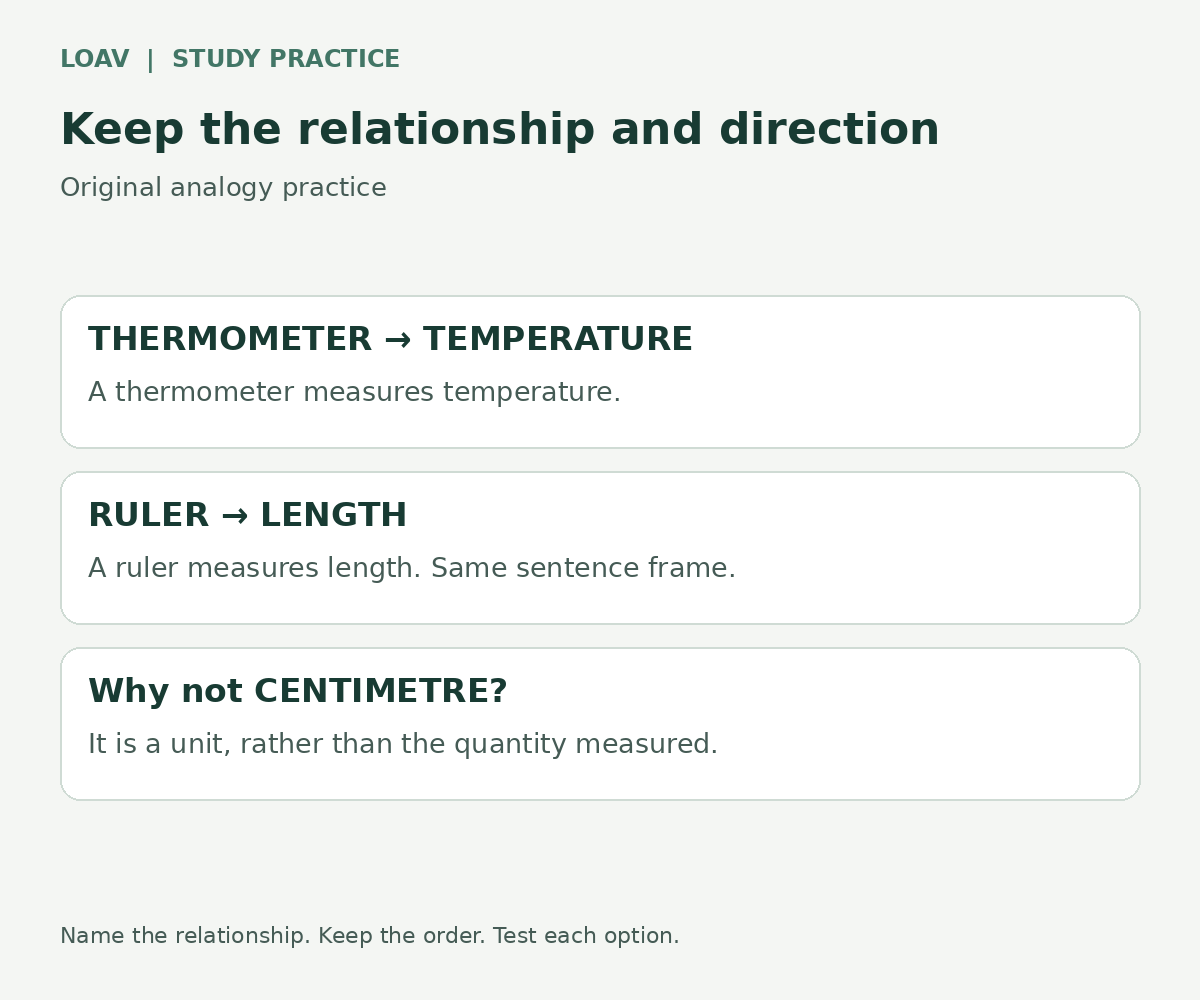
THERMOMETER is to TEMPERATURE as RULER is to:
A. centimetre B. length C. pencil D. straight
“A thermometer measures temperature” is more useful than “both have something to do with science”. Keep the sentence frame: “A ruler measures ___.” The answer is B, length.
A centimetre is a unit used when measuring length. A pencil may be used beside a ruler. Straight describes the edge of a typical ruler. Each distractor has a connection, but none completes the same relationship.
This is the central check: can you substitute the second pair into your original sentence without changing what the sentence means?
Keep the arrow pointing the same way
Naming a relationship is only half the job. Keep its direction too.
CHAPTER is to NOVEL as SCENE is to:
A. actor B. stage C. play D. dialogue
“A chapter is a part of a novel.” A scene is a part of a play, so C preserves the part-to-whole direction. Dialogue can be part of a scene, but that reverses the order: it makes the second item a part of the first.
For practice, write a small arrow: part → whole. Then inspect each option with the same arrow. This helps when a distractor shares the right general relationship but puts its words in the wrong positions.
Make the relationship precise enough
Labels such as “opposites”, “type of” and “tool used for” can help you start. Sometimes you need a more exact sentence.
WARM is to HOT as COOL is to:
A. cold B. mild C. heat D. summer
“Both describe temperature” is too broad. The first pair moves further towards the hotter end of the temperature scale. The matching pair moves further towards the colder end: cool to cold, answer A. The shared relationship is increasing intensity in each pair's direction.
Do not add a story to rescue a weak answer. “Summer can be cool in some places” may be true, but it does not preserve the relationship. Prefer the option that fits the original words directly, with the fewest extra assumptions.
A short practice session that reveals the mistake
Use a small set of analogy questions with explanations. The aim is to inspect your reasoning, so begin without a stopwatch.
- Cover the options. Write a sentence connecting the first two words. If you do not know a word, mark it as a vocabulary gap.
- Predict the missing role. You may not know the exact answer yet, but decide whether you need a whole, a tool, an action, a category or something else.
- Uncover and test. Put every plausible option into the same sentence frame. Check direction and precision.
- Explain one rejection. Say why the strongest distractor fails. “It sounds wrong” is less informative than “it reverses part and whole”.
- Record the cause. Use a brief label: unknown meaning, vague relationship, reversed direction or added assumption.
On the next session, revisit the error before adding new questions. If your meanings were correct but your arrow was reversed, practise direction. If an unfamiliar word blocked the relationship, learn that meaning in context. The error should determine the next step.
Your next-question checklist
- What exact sentence connects the first pair?
- Does the second pair fit that sentence in the same order?
- Have I selected a matching relationship, or merely a related topic?
Try those three checks on your next analogy. Finish by explaining one tempting wrong answer. That explanation gives you something concrete to improve beyond the number of answers you got right.
