
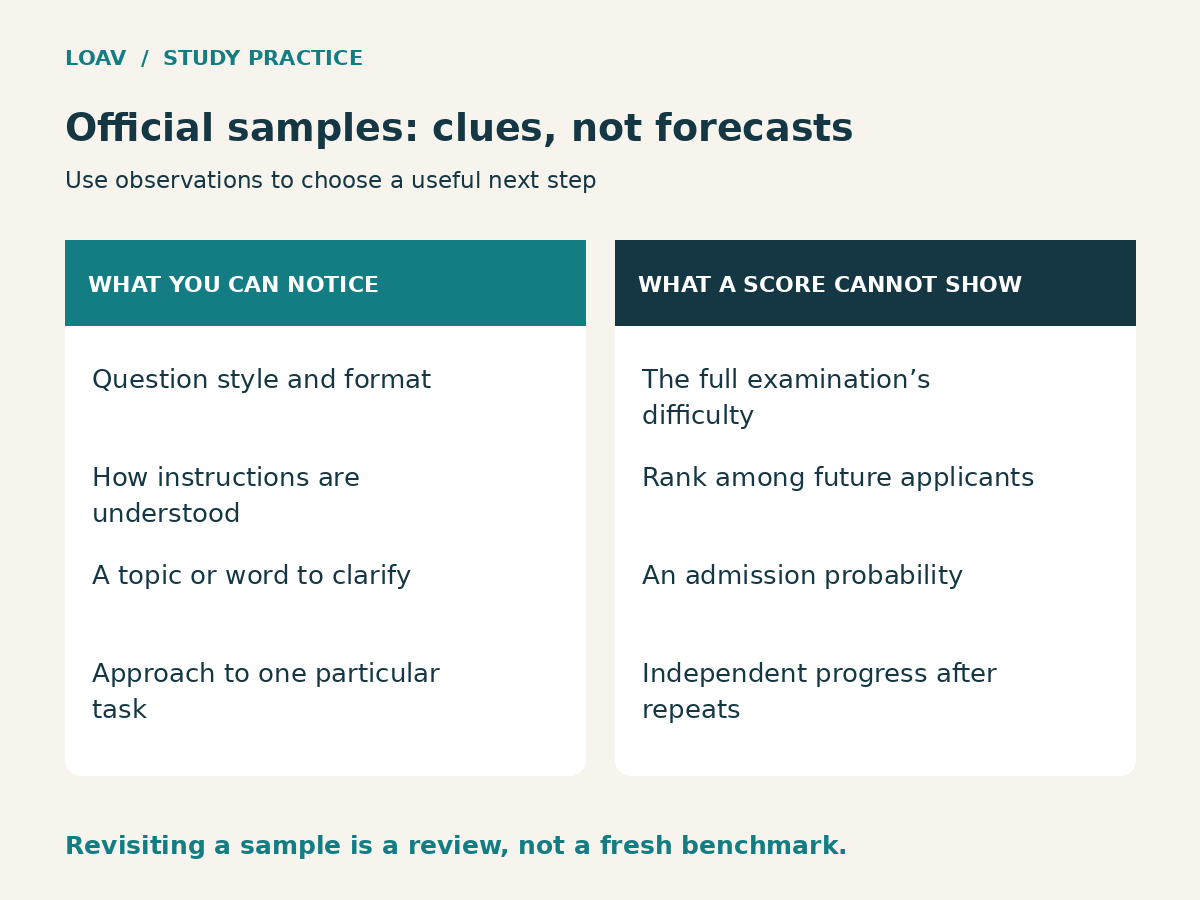
A few missed answers in an official sample can feel worrying. A near-perfect score can feel reassuring. For a Year 7 student exploring Victorian selective entry, neither result tells a family whether a future offer is likely. The useful question is smaller: what did this short encounter reveal about the instructions, the task and the student's approach?
Timing note for 19 October 2026: the examination for Year 9 entry in 2027 was held on 20 June 2026. Families looking ahead should check the Victorian Government's selective entry page for their own entry cycle, rather than reuse those dates.
Start with what ACER actually says
ACER's preparation guidance says children do not need to practise or revise for the examination. Its sample questions are provided to familiarise students with question style and format, and are not necessarily representative of exam difficulty. ACER also describes the value of age-appropriate, engaging learning and thoughtful discussion over time.
That is a useful boundary for families and tutors. Looking at official samples can answer practical questions without becoming a weekly score chase. Paid preparation is not an official requirement, and a sample percentage should not be presented as an admission forecast.
Check that you are using the right samples
The Victorian Government's central Year 9 process covers Melbourne High School, The Mac.Robertson Girls' High School, Nossal High School and Suzanne Cory High School, with ACER managing applications and offers. Start from the official preparation page so that an older downloaded file does not quietly become your reference point.
John Monash Science School is separate. Its official enrolment information describes its own entry process and assessments administered by Edutest. Do not transfer ACER sample guidance or results to JMSS.
For an overview before opening the samples, see our Victorian selective entry exam structure guide. Recheck official information for the intended application year.
Give the first look a modest purpose
Our suggested approach is to treat the first look as an orientation. Ask the student to read the supplied directions and attempt a manageable selection independently. Avoid explaining every unfamiliar phrase immediately; instead, note where they ask for help. Afterwards, invite them to describe what they thought each task required.
Keep three distinctions clear:
- Instructions: Did the student understand what response was requested and how to record it?
- Knowledge: Was a word, mathematical idea or piece of background knowledge unfamiliar?
- Approach: Did they choose a sensible starting point, check the relevant information and notice when they were stuck?
These are observations about particular attempts. A student who misunderstands one instruction has something specific to clarify; they have not demonstrated that they are unsuitable for selective entry. Equally, getting an item right does not establish that every related task will be straightforward.
Keep an observation log, not an admissions estimate
A brief record is more useful when it describes something a teacher, parent or student can revisit. You do not need a spreadsheet or a predicted percentile. Try these example entries:
- Wording: Misread what the question asked; explain the instruction in their own words next time.
- Knowledge: Unsure about an idea not yet covered at school; check when it will be taught before adding extra work.
- Approach: Started calculating before identifying the relevant quantities; discuss the first decision rather than only the final answer.
Record a strength too, such as identifying useful evidence or explaining why an option did not fit. Keep the language descriptive. Labels such as careless, weak or guaranteed entry make a small observation sound much bigger than it is.
Why repeating the same sample changes the meaning
On a second attempt, a student may remember the answer, the wording or a previously explained method. That can be useful learning, but it changes what the result tells you. A higher repeated score cannot, by itself, separate improved understanding from memory for those particular items.
There is a relevant but limited research distinction here. Roediger and Karpicke's 2006 experiments found that university students who recalled studied prose retained more on delayed tests than students who restudied it. The study concerned memory for prose, not Victorian selective entry, coaching effectiveness or admission prediction. It supports taking learning from an activity seriously without treating its score as a validated forecast.
If you revisit a sample, ask the student to explain the reasoning and identify what they remember from last time. Record it as a review, not a fresh benchmark.
Choose the next step from the observation
For Year 7 families, keep ordinary school learning central. One unfamiliar concept may call for a conversation with the classroom teacher. An unclear instruction may need a short explanation. A student who is reading confidently and enjoying challenging problems may simply need room to continue.
For more on organising the mathematics side, our mathematics and quantitative reasoning study plan offers a separate starting point. Choose support around an identified learning need rather than a frightening sample percentage.
If you would like help discussing those observations, contact Loav Tuitions or request a trial class. Bring the student's questions and explanations, not just the total. The aim is a clearer next step, without promises about selection.
