
A tick tells you that an answer was correct. It does not tell you whether you understood the reasoning, narrowed the choices down to two or guessed. A cross also hides useful information: you might have been uncertain, or completely convinced that a mistaken rule was right.
Adding a short confidence check before you look at the answers can make revision more selective. You can revisit correct-but-uncertain work as well as errors, and give confident misconceptions the attention they need.
Use three labels, not a complicated rating system
Choose a small set of questions from content you have already studied. Five is a manageable starting point. After answering each question, but before checking it, add one label:
- Sure: I can explain the reason for my answer.
- Unsure: I have a reason, but there is a step or detail I cannot justify.
- Guess: I selected an answer without enough evidence.
These labels are personal observations, not marks. Do not change them after seeing the solution. “I knew that really” may feel reassuring, but it removes the comparison you are trying to make. If you used notes, record that too rather than treating the attempt as independent.
Check correctness and reasoning separately
Use a reliable worked solution, teacher feedback or the relevant official assessment material. A matching final answer is only the first check. Compare the method, evidence and conditions as well.
For written answers, identify which part is correct instead of forcing the whole response into a tick-or-cross category. For example, you might have recalled the concept accurately but applied it to the wrong detail in the question. Ask your teacher about an ambiguous answer rather than inventing a marking rule.
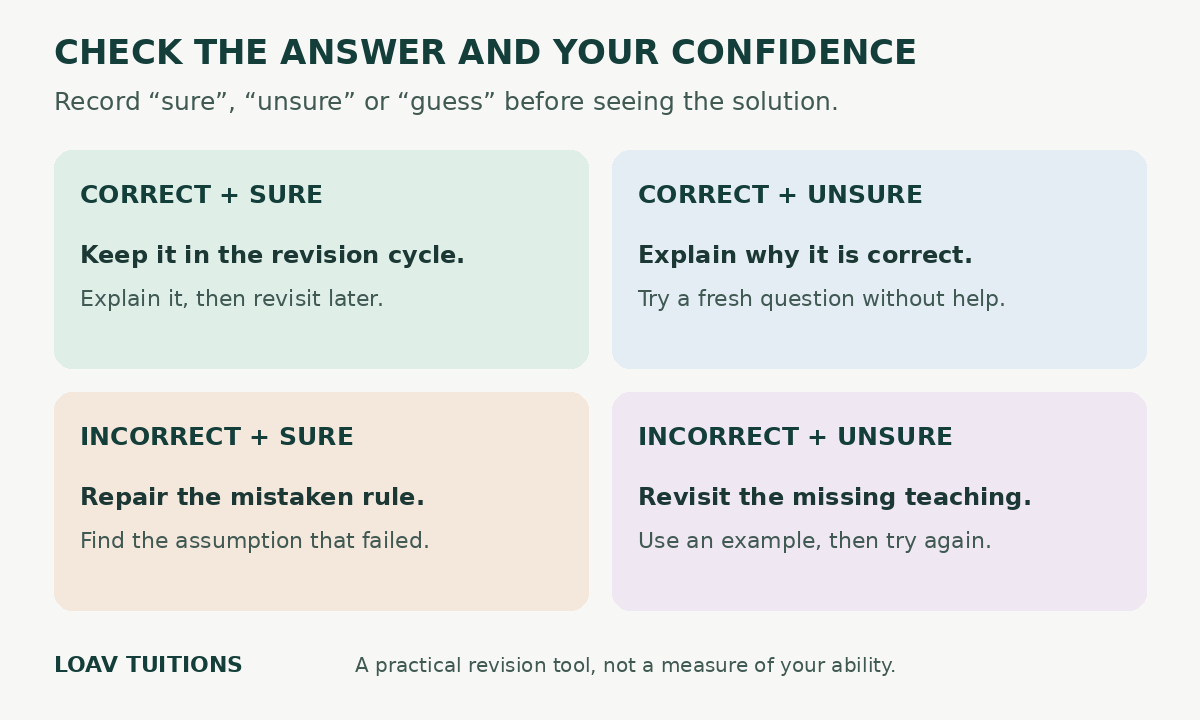
Then choose your next action from the combination:
- Correct and sure: explain the reasoning briefly, then move on. Check it again in a later revision session rather than repeating it several times immediately.
- Correct but unsure or guessed: confirm why it is correct. Identify what made you hesitate, then attempt a similar question without the answer options or notes.
- Incorrect and sure: write the rule or assumption you used. Find precisely where it conflicts with the correct explanation.
- Incorrect and unsure: identify the missing knowledge or step, revisit a short explanation and try again with appropriate support.
Example one: a correct answer that needs another check
Suppose a question asks for the gradient of the line through (2, 3) and (6, 11). You select 2, but label the answer “unsure” because you cannot remember which change belongs on top.
The check is (11 − 3) ÷ (6 − 2) = 8 ÷ 4 = 2. Write why: gradient measures change in the vertical coordinate per unit change in the horizontal coordinate. You now have a specific explanation to test, rather than a vague instruction to “revise gradients”.
For a fresh check, find the gradient through (1, 7) and (4, 1), without answer options. It is (1 − 7) ÷ (4 − 1) = −6 ÷ 3 = −2. Explain the negative sign: as the horizontal coordinate increases, the vertical coordinate decreases. A successful explanation matters more than whether your first answer happened to be right.
Example two: a confident error reveals a rule to repair
You write (a + b)² = a² + b² and mark “sure”. Expanding (a + b)(a + b) gives a² + 2ab + b², so the missing middle term needs attention.
Test your original claim with a = 2 and b = 3: the left side is 25, but a² + b² is 13. This counterexample shows that the original statement is not a valid general identity. Next, expand (x + 4)² independently. Check for x² + 8x + 16, including both cross-products.
Keep the follow-up small
At the end of the set, choose one confident error and one correct-but-uncertain answer, if you have them. Give each a specific follow-up question. This is more useful than rewriting every solution neatly. Try the follow-up later without the correction visible; record whether your reasoning and your confidence now agree.
Why check answers you got right?
In two experiments using general-knowledge multiple-choice questions, Butler, Karpicke and Roediger found that feedback helped later retention of answers initially given correctly with low confidence. The finding is a reason not to ignore uncertain correct responses. It does not prove that this exact three-label routine guarantees improvement in every school subject.
Start today: add “sure”, “unsure” or “guess” beside five answers before checking. Use the comparison to decide what to practise next, not to judge your ability.
Source
Butler, Karpicke and Roediger (2008), Correcting a Metacognitive Error: Feedback Increases Retention of Low-Confidence Correct Responses. The routine and mathematics examples above are original study suggestions, not official exam instructions.
