
Loav reading room · VCE English · 2026
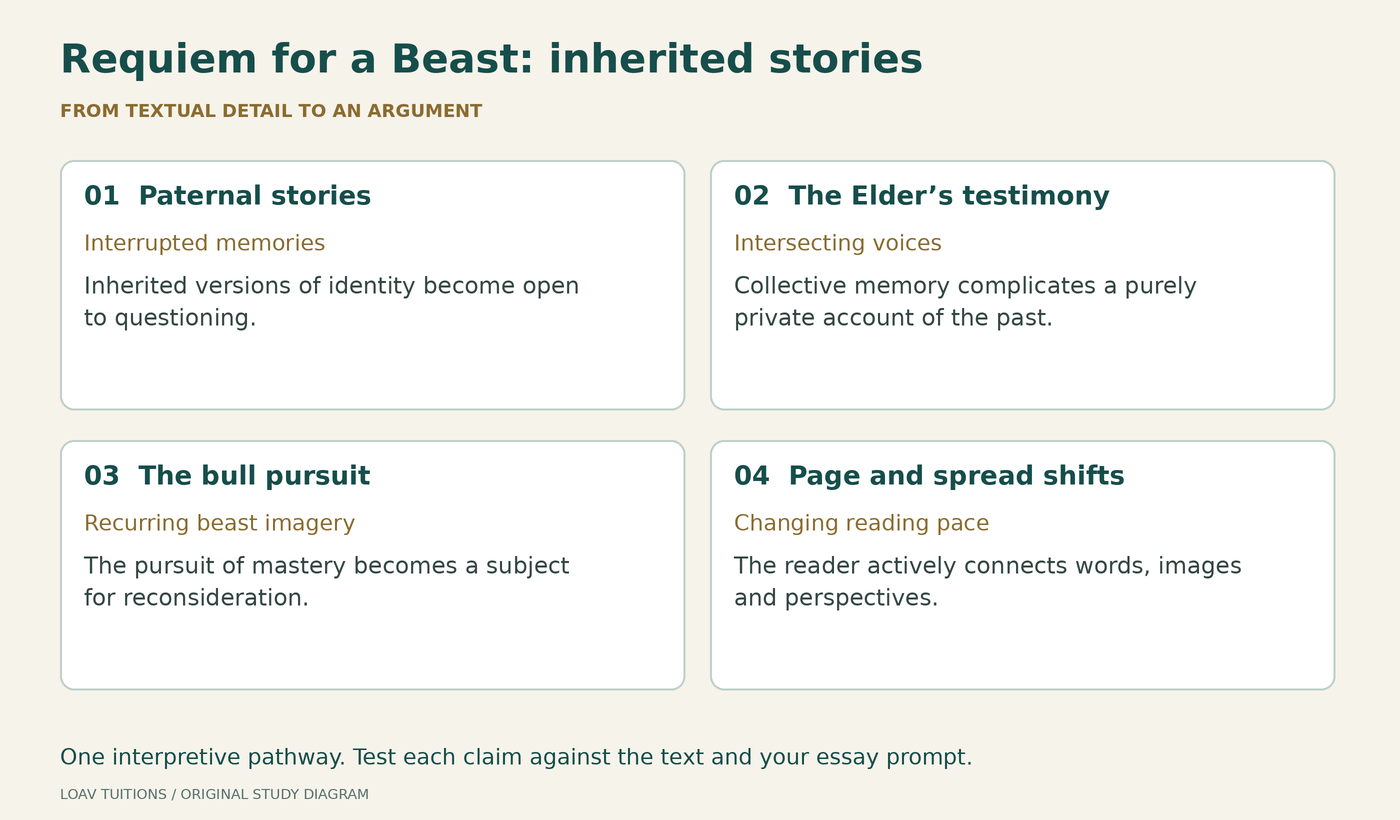
Matt Ottley’s work asks readers to connect what inherited stories separate: private distress, public history, the treatment of other beings and the responsibilities involved in remembering.
2026 scope: an essential distinction
The prescribed edition is Requiem for a Beast, Lothian Children’s Books, 2007, ISBN 9780734407962. Ottley composed a work combining prose, graphic narrative, paintings and music. However, the 2026 VCAA text list explicitly excludes the accompanying music from internal and external assessment. Listening can support understanding, but your assessed evidence must come from the prescribed written and visual text. Do not build an examination argument around an instrumental passage or song.
The book includes colonial violence, the Stolen Generations, psychological distress and attempted suicide. Discuss these sensitively and precisely. An unnamed young stockman’s pursuit of a bull intersects with the testimony of an older Aboriginal woman and with memories that unsettle his understanding of his father. The resulting narrative does not allow personal identity to remain insulated from collective history.
Theme Analysis
Inheritance is not innocence. A person does not choose the history into which they are born, but they can become responsible for how they respond to knowledge of it. This distinction avoids two weak positions: claiming the young man is simply guilty of everything his father did, or claiming the past has no ethical demand on him. Ask what becomes possible once loyalty no longer requires denial.
Memory can disrupt and sustain. Remembering is painful when it exposes violence hidden inside reassuring stories. Yet absence and forced interruption of memory are also forms of harm. The Elder’s narrative prevents the reader from assuming that all losses are equivalent. The young man’s crisis and the removal of children from family and Country intersect within the work, but they have different causes, histories and consequences.
Masculinity is represented as a learned script. The stockman’s relationship with his father and the world of cattle work invites scrutiny of the connection between belonging and displays of toughness. An effective essay asks which actions appear necessary to win acceptance, then examines whether Ottley validates those expectations. The ability to dominate or endure does not automatically establish ethical maturity.
Compassion requires attention. The bull is an actual living creature as well as a figure within the young man’s psychological experience. Do not reduce its suffering to a convenient symbol of his development. Holding literal and metaphorical meanings together strengthens an argument: a capacity to perceive another being’s vulnerability can challenge the impulse to make everything serve one’s own story.
How the multimodal form makes meaning
Juxtaposition. Prose, images and changes in narrative voice interrupt the expectation that one account will supply a complete explanation. When a reader moves between a personal memory and the Elder’s testimony, the relationship between the sections becomes part of the argument. Ask what the placement makes newly visible and what differences must remain intact.
Scale and page design. A large landscape image offers a different reading experience from a sequence of compact panels. The reader may pause over spatial relationships in the former and infer movement or elapsed time between the latter. Avoid treating page size as a fixed code. Establish which figure, object or detail dominates the particular spread before deciding whether its scale suggests vulnerability, absorption or force.
Myth and visual metaphor. References to the Minotaur complicate the boundary between human and beast. Rather than mechanically identifying the bull as a single equivalent of guilt, trace how the recurring imagery changes its associations. Myth can expose the appeal of heroic conquest while allowing the work to question whether killing an apparent monster resolves a deeper problem.
Temporal movement. Memory interrupts the immediate pursuit. This prevents the journey from operating merely as an adventure with an external obstacle. The reader repeatedly reassesses the present through earlier events, just as the protagonist must reassess what he believes about himself. Describe the particular movement between moments before claiming that the structure mirrors a troubled mind.
Title and mourning. A requiem conventionally evokes remembrance of the dead. That frame makes the title more complicated than a celebration of victory over an enemy. Ask who or what deserves mourning, and why acknowledgement may matter more than an uncomplicated triumph. This interpretation concerns the title and textual framing; it does not require treating the excluded soundtrack as assessable evidence.
Quote Bank
Six short, verified quotation fragments are embedded in the full essay below. Each fragment is linked to its use in the essay. The notes identify context and analytical use; always read the surrounding passage as well.
- “father’s stories” — Evidence 1: Narration, disappointed expectations. Possessive phrase. The first fragment locates inherited authority in paternal narration.
- “his own stories” — Evidence 2: Narration, desire for independence. Parallel possessive. The second signals autonomy without proving self-sufficiency.
- “alien” — Evidence 3: Narration, estrangement. Figurative description. The third destabilises the expected belonging.
- “stranger” — Evidence 4: Narration, same passage. Reinforcing description. The fourth continues the disruption of heroic certainty.
- “nurturing thing” — Evidence 5: Concluding storm passage. Unexpected juxtaposition. The fifth connects endurance with care.
- “grow again” — Evidence 6: Concluding storm passage. Regenerative verb. The sixth proposes renewal rather than conquest.
Practice Prompts
- In Requiem for a Beast, understanding the self requires confronting inherited stories. Discuss.
- How does Ottley’s combination of words and images challenge simple ideas of heroism?
- Remembering is both painful and necessary in Requiem for a Beast. To what extent do you agree?
- How does Ottley explore the difference between power and responsibility?
These are original practice topics, not VCAA questions. For prompt one, distinguish confronting a story from rejecting every relationship it contains. A nuanced response can argue that attachment and accountability must coexist, without claiming that acknowledging violence automatically repairs its effects.
Full Annotated Essay
Prompt: How does Ottley question conventional models of masculinity?
Paraphrase of the verified 2025 VCAA English examination, Section A, Question 14(ii). See the official paper. The soundtrack is excluded from the 2026 assessed text.
This complete original model uses BCAS, three TEEAEAL body paragraphs and CAS. These are optional learning scaffolds, not VCAA rules. The separate annotations explain the construction; the essay itself uses continuous prose.
Introduction
Matt Ottley’s Requiem for a Beast interweaves a young stockman’s journey, troubling family memories and an Aboriginal Elder’s testimony through verbal and visual forms. The work questions models of masculinity that equate belonging with imitation, emotional suppression and the mastery of vulnerable beings. Paternal stories are exposed as inadequate foundations for identity, visual and narrative dislocation undermine heroic self-sufficiency, and the possibility of renewal is associated with care rather than invulnerability. Ottley consequently presents ethical maturity as a willingness to confront inheritance and acknowledge relationships beyond the self.
Body 1
Ottley challenges inherited masculinity by separating loyalty to a father from unquestioning acceptance of his stories. The young man’s desire for belonging makes paternal experience attractive as a model, but the narrative prevents imitation from providing a stable moral direction. Becoming a stockman cannot make the past’s unresolved violence disappear. The reference to his “father’s stories” locates the young man’s expectations within an already constructed account. The possessive makes the source of authority clear: these experiences arrive mediated by someone he admires. By interrupting the immediate journey with recollection, Ottley allows the reader to recognise how present aspirations depend on earlier acts of narration. The wish for “his own stories” introduces a competing desire for authorship. This parallel phrasing makes independence imaginable, but the book’s interwoven voices refuse the idea that maturity consists simply of replacing one self-centred narrative with another. The surrounding testimony asks readers to recognise what an inherited ideal can exclude. By withholding a single authoritative account, Ottley makes critical listening part of the reading process itself, rather than merely a lesson delivered to the protagonist. Masculine identity becomes ethically viable only when admiration can coexist with critical accountability.
Body 2
The work’s disruption of heroic self-sufficiency makes uncertainty a challenge to conventional strength rather than proof of personal worthlessness. The stockman’s physical pursuit might initially suggest an adventure resolved through endurance and conquest, yet memories and unsettling imagery repeatedly complicate that pattern. His sense of being an “alien” presents the expected landscape of belonging as unfamiliar. The term unsettles the assumption that adopting his father’s work will produce an immediate fit between person and place. The shift between narrative times makes readers experience a comparable need to revise their expectations rather than follow an uninterrupted heroic advance. The accompanying description of a “stranger” reinforces the failure of effortless identification. Set within a work that repeatedly brings human and beast imagery into contact, this estrangement complicates a simple division between an assured human conqueror and an external monster. The recurring visual motif makes the pursuit a question about the self as well as a physical encounter. The image-and-word relationship also asks readers to resist turning the bull’s actual vulnerability into a mere instrument of human self-improvement. In this reading, the formal complication of heroism has an ethical consequence: the apparent obstacle must remain a living being. Ottley questions a model of masculinity in which uncertainty must be defeated through displays of mastery.
Body 3
Ottley’s concluding language recasts strength as the capacity to endure difficult acknowledgement while remaining open to renewal. Rather than treating emotional exposure as the opposite of resilience, the work suggests that growth requires a willingness to remain in contact with uncomfortable knowledge. The Elder’s framing presence also prevents the young man’s experience from becoming the only measure of what matters. The final storm is described as a “nurturing thing”. The unexpected conjunction of harsh weather and nurture challenges a binary between toughness and care. Its environmental imagery allows pain to be recognised without making injury intrinsically virtuous or promising that it will automatically improve a person. The prospect that land and people can “grow again” gives the ending a conditional movement towards the future. The regenerative verb replaces conquest with continued life, while the connection between people and land resists an isolated ideal of achievement. Read with the title’s mourning frame, the ending redirects an audience’s expectation from triumphant disposal towards remembrance. Renewal becomes a changed way of relating to difficult history, rather than a reward for defeating an external enemy. The alternative masculinity suggested by the work rests on responsibility and responsiveness, not the denial of dependence or vulnerability.
Conclusion
Ultimately, Requiem for a Beast unsettles inherited ideals of masculine mastery without suggesting that uncertainty must end in defeat. Its scrutiny of paternal authority, disruption of heroic certainty and language of renewal associate maturity with accountability and care. The work’s challenge is to become capable of living with difficult truths and other beings, rather than building an identity that can remain secure only by excluding them.
Use the model without memorising it
Plan a response to one of the original practice prompts before rereading the essay. Decide which of its arguments remain relevant and which need to change. A strong response is shaped by the question, not by a prepared sequence of quotations. For each selected example, record its context, a formal choice and the inference that connects it to your contention.
The 2025 VCAA report stresses the need to address relationships and qualifiers in the topic. Keep more than one part of the text in view, use evidence analytically, and make the conclusion resolve the argument. Check quotation wording against your prescribed text or licensed film. These models illustrate a defensible reading rather than an official assessment, a guaranteed mark or the only acceptable interpretation.
Sources and evidence notes
- Matt Ottley’s account of the work: composition and narrative strands.
- National Centre for Australian Children’s Literature: visual and narrative form.
- Erica Hateley, “Productive Anxieties”: independently checked scholarly transcription of the brief quotations, citing Ottley’s pages 20, 65 and 81. Verify pagination in your prescribed copy.
- 2025 VCAA English assessment report: evidence and topic responsiveness.
For help applying this analysis to your own writing, explore Loav’s VCE tutoring or enquire about a trial class.
