
Loav reading room · VCE English · 2026
2026 List 1 novel: Pat Barker, Regeneration, Penguin, 2014, ISBN 9780241970768. This guide contains spoilers and discusses war trauma. The practice topics and model writing are original; only the first novel of the trilogy is the set text.
The contradiction at the centre
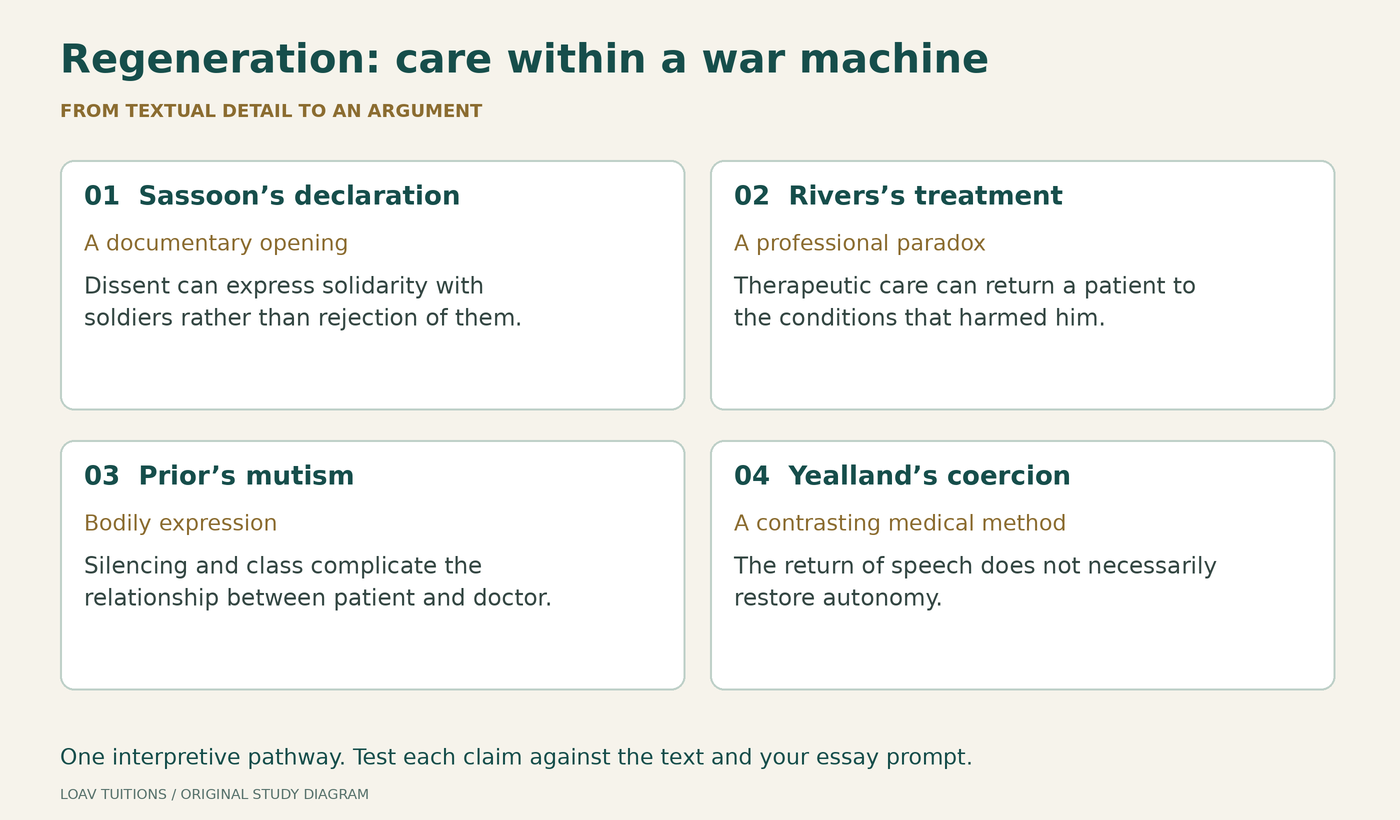
At Craiglockhart War Hospital in 1917, psychiatrist William Rivers treats officers psychologically injured by war. His work is compassionate, but successful treatment may return a man to the conditions that damaged him. This contradiction should organise your reading: healing and military usefulness are not necessarily the same outcome. Barker refuses to resolve it by dividing the world into wholly benevolent doctors and wholly malicious institutions.
Siegfried Sassoon arrives after publicly protesting the continuation of the war. His encounter with Rivers raises questions about conscience, duty and the political uses of psychiatric judgement. Alongside this central relationship, Billy Prior’s difficulties with speech and memory, the suffering of other patients, Wilfred Owen’s developing poetry and Sarah Lumb’s experience of wartime work broaden the novel’s account of damage. The battlefield is repeatedly present through recollection, bodily response and the expectations governing life away from it.
Characters and argumentative functions
Rivers: his capacity to listen distinguishes him from more coercive medical authority. Yet humane methods do not free him from the institution’s objectives. He is most interesting where empathy produces uncertainty. Treat his changing judgement as a process, not a single statement of Barker’s position.
Sassoon: he challenges official authority without losing his attachment to fellow soldiers. His eventual return towards service should not be read as proof that his protest was insincere. Barker makes incompatible loyalties difficult to disentangle. A response about courage can therefore compare moral defiance with the desire not to abandon others.
Prior: his working-class background and position as an officer unsettle assumptions about who is entitled to authority. His mutism gives bodily form to difficulties of expression, while his interactions with Rivers resist easy intimacy. He is not merely a clinical illustration; his anger, desire and intelligence complicate the roles of patient and subordinate.
Owen: his relationship with Sassoon makes writing a collaborative form of witnessing. Poetry offers ways to shape experience without erasing its horror. Sarah: her life outside the hospital reveals changes and constraints in women’s wartime experience. Burns: his severe distress challenges any easy equation between recovery and a return to ordinary functioning. Yealland: his coercive treatment sharpens the question of whether recovered speech necessarily means a restored self.
Language and structure
Historical fiction. Barker combines historical figures with invented characters and scenes. Analyse the novel’s representation of Rivers or Sassoon, rather than treating every line of dialogue as documentary evidence. The historical setting supplies pressures and institutions; fiction allows readers to inhabit contradictions that a list of dates cannot explain.
Multiple viewpoints. Movement among perspectives resists a single authoritative account of the war. The hospital cannot contain every relevant experience, so encounters beyond it widen the social field. This is valuable evidence for questions about whose suffering receives attention and whose voices remain difficult to hear.
Speech and silence. Conversation is central to treatment, but speaking does not have one fixed meaning. A voice may testify, negotiate intimacy, obey an order or be forced into performance. Compare the conditions under which speech occurs. The contrast between listening and coercion matters more than a general claim that all silence is harmful.
Traumatic recollection. Memories interrupt the apparent safety of the present. Barker’s movement between remembered violence and clinical surroundings challenges the boundary between front line and home. The body often registers what orderly explanation cannot. A good paragraph analyses the placement and effects of such an interruption, rather than simply reporting a disturbing memory.
The title. Regeneration suggests repair or renewal, but the novel repeatedly asks what kind of restoration is desirable. Being made fit for an institution may expose a person to renewed injury. Use this irony carefully: it does not mean that care is pointless, only that the ends of treatment require moral scrutiny.
Theme Analysis
Duty to whom? Military obedience, loyalty to comrades, responsibility to patients and fidelity to conscience can compete. Define which duty a paragraph is discussing. A claim that duty always destroys individuals is too blunt when the same sense of obligation can motivate care or dissent.
What counts as masculinity? The novel exposes expectations that men remain controlled, brave and emotionally self-sufficient. Yet soldiers’ dependence on one another and on caregivers complicates that ideal. Do not simply replace a negative stereotype with the claim that sensitivity solves everything. Explore the institutional costs of acknowledging vulnerability.
Can compassionate action serve a damaging system? Rivers provides the strongest test case. His humane practice matters to individual patients, even while his professional role supports military objectives. This tension allows a qualified argument about complicity: recognising structural harm does not automatically tell a person how to act without causing further harm.
Quote Bank
Use these short passages as starting points for analysis, not as fixed answers. Chapter numbers refer only to the first novel, Regeneration, in The Regeneration Trilogy omnibus. No print-edition page equivalence is claimed. Each quotation is continuous, with no silent omissions.
Dissent, duty and loyalty
- “I am making this statement as an act of wilful defiance of military authority,” Sassoon’s declaration; Regeneration, chapter 1. The opening document asserts deliberate resistance before Sassoon enters the hospital. Authorial analysis: Barker’s documentary opening gives readers a political argument before the institution can recategorise it as illness.
- “I am a soldier, convinced that I am acting on behalf of soldiers.” Sassoon’s declaration; Regeneration, chapter 1. Sassoon frames his protest as service to fellow soldiers. Authorial analysis: The repeated identification with soldiers locates loyalty in solidarity rather than automatic obedience.
- “His opposition to the war had not changed. If anything it had hardened.” Narrator, focalised through Rivers; Regeneration, chapter 23. Rivers considers Sassoon’s return to service near the novel’s end. Authorial analysis: The short emphatic sentences prevent the return from being read as a simple repudiation of dissent.
Institutional authority and silencing
- “Mr Sassoon is suffering from a severe mental breakdown, and therefore not responsible for his actions.” Rivers, imagining the minister’s reply; Regeneration, chapter 1. Rivers anticipates how the government will explain the absence of disciplinary proceedings. Authorial analysis: The causal connective turns a diagnostic claim into a denial of political agency; this is a projected official response, not a straightforward clinical verdict.
- “You must speak, but I shall not listen to anything you have to say.” Yealland to Callan; Regeneration, chapter 21. Electrical treatment enforces the return of the patient’s speech. Authorial analysis: The antithesis separates sound from recognition: coercion restores audibility while refusing the speaker’s authority.
- “he’d be a lot less trouble if he were ill.” Narrator, focalised through Rivers; Regeneration, chapter 1. Rivers considers the controversy surrounding Sassoon’s protest. Authorial analysis: The pragmatic idiom exposes the usefulness of diagnosis to institutional convenience without denying the reality of trauma.
Care, courage and compromised recovery
- “feeling almost ashamed of having witnessed that small, private victory over fear.” Narrator, focalised through Rivers; Regeneration, chapter 1. Rivers watches Sassoon overcome his hesitation before entering Craiglockhart. Authorial analysis: The inward focalisation recognises courage outside battle while acknowledging the intrusiveness of observation.
- “Obviously he and Yealland were both in the business of controlling people.” Narrator, focalised through Rivers; Regeneration, chapter 22. After witnessing Yealland, Rivers interprets his own disturbing dream. Authorial analysis: The blunt commercial idiom punctures the comfort of moral superiority; gentler means can still serve the same military end.
- “in present circumstances, recovery meant the resumption of activities that were not merely self-destructive but positively suicidal.” Narrator, focalised through Rivers; Regeneration, chapter 22. Rivers questions the purpose of restoring men to military fitness. Authorial analysis: The escalating contrast destabilises the therapeutic meaning of recovery and sharpens the title’s irony.
Gender, dependence and vulnerability
- “totally responsible for lives they have no power to save.” Narrator, focalised through Rivers; Regeneration, chapter 9. Rivers compares officers’ care for men with impoverished mothers’ work. Authorial analysis: The juxtaposition of responsibility and powerlessness challenges the fantasy that masculine authority guarantees control.
- “They’d been mobilized into holes in the ground so constricted they could hardly move.” Narrator, focalised through Rivers; Regeneration, chapter 9. Rivers contrasts adventure rhetoric with trench confinement. Authorial analysis: The irony in mobilized exposes the gap between promised action and enforced physical passivity.
- “Sometimes his face pops into me mind, like when I’m thinking about something else, but when I want to see it, I can’t.” Sarah to Prior; Regeneration, chapter 8. Sarah describes her difficulty deliberately recalling Johnny. Authorial analysis: The colloquial counterpoint between involuntary and sought memory extends the novel’s account of loss beyond officers and clinical diagnosis.
Practice Prompts
- In Regeneration, loyalty can demand disobedience. Discuss.
- How does Barker question the meaning of recovery?
- Regeneration presents compassion as both necessary and compromised. To what extent do you agree?
- How does Barker use speech and silence to explore power?
Full Annotated Essay: expression and institutional power
Original adapted practice topic: In Regeneration, expression can challenge power, but institutions can also control what a voice means. Discuss.
Regeneration is new to the 2026 list. This is an original cross-text adaptation of the 2025 The Memory Police question about silence, oppression and resistance, Question 18(ii); it is not a past VCAA Regeneration question. Official source paper. The complete model uses optional BCAS, TEEAEAL and CAS scaffolds, not VCAA-mandated formulas.
Introduction
Pat Barker’s Regeneration places traumatised soldiers and their doctors within a military system that depends on the restoration of men to service. Expression can challenge that system, but the novel reveals that speaking does not guarantee authority over the meaning or consequences of one’s words. Public protest redefines loyalty, medical classification can neutralise dissent, and attentive listening offers a more humane relationship to expression without escaping institutional compromise. Barker therefore presents voice as a contested relationship between speaker and listener, rather than a possession that automatically secures freedom.
Body 1
Barker initially establishes public expression as a means of challenging the institution’s claim to define loyalty. A refusal can be dismissed as selfishness when authorities control its interpretation, so the placement of Sassoon’s declaration gives readers access to his reasoning before they encounter its clinical management. The document announces, “I am making this statement as an act of wilful defiance of military authority”. By foregrounding deliberate refusal, Barker directs readers to evaluate a moral argument before accepting an institutional diagnosis. The document’s form claims public accountability, disrupting the expectation that a patient’s words primarily reveal symptoms. Nevertheless, Sassoon insists, “I am a soldier, convinced that I am acting on behalf of soldiers”. The representative claim relocates loyalty in solidarity with suffering men rather than obedience to command. Barker develops another form of such solidarity through the collaboration on Owen’s poetry: literary attention can bear witness where official language makes suffering serviceable to military purpose. The contrast between public declaration and collaborative composition broadens resistance beyond one exceptional protest, inviting readers to judge expression by its accountability to those whose experience it represents. Public speech challenges power by making alternative meanings of duty available, even when the speaker cannot reconcile every obligation that follows.
Body 2
However, Barker shows that institutional classification can preserve a speaker’s physical safety while weakening the authority of his words. The alternative to punishment is not necessarily recognition; a medical explanation can shift attention from the substance of dissent to the supposed incapacity of the dissenter. Rivers imagines the minister declaring that “Mr Sassoon is suffering from a severe mental breakdown, and therefore not responsible for his actions”. By placing this projected official account after the declaration, Barker creates an interpretive conflict: readers can recognise the agency that the institution’s explanation removes. Medical language is thereby exposed as potentially political, rather than automatically neutral. Later, Yealland orders Callan, “You must speak, but I shall not listen to anything you have to say”. The antithetical command makes the recovery of speech conditional upon submission: Callan must produce language without being heard as a person. Barker’s contrast between Prior’s mutism and this coercive treatment prevents a simple equation of audibility with autonomy. At the same time, the genuine suffering of both patients prevents the political use of diagnosis from becoming grounds for dismissing trauma as invented. Expression remains vulnerable because institutions can determine whether it counts as an argument, a symptom or evidence of successful obedience.
Body 3
Finally, Barker locates a qualified alternative in attention that recognises vulnerability without reducing a person to an institutional category. Humane listening requires more than allowing words to be spoken; it involves acknowledging what cannot be safely or completely expressed. This capacity matters even when the listener’s role remains compromised. Watching Sassoon enter the hospital, Rivers finds himself “feeling almost ashamed of having witnessed that small, private victory over fear”. Through focalisation that registers a small action as courage, Barker revises the public criteria of bravery. Readers are positioned to question the moral hierarchy that honours battlefield endurance while devaluing the effort required to confront psychological distress. After witnessing Yealland’s treatment, Rivers recognises, “Obviously he and Yealland were both in the business of controlling people”. The blunt admission subjects humane treatment to self-scrutiny rather than allowing Rivers to remain a comfortable moral exception. Barker places his recognition after the coercive scene so that readers must compare methods and purposes: Rivers’s attentive conversations matter, but their military destination remains compromised. The structural irony of healing men for renewed service therefore prevents responsive care from becoming a position of complete innocence. Barker values listening as a challenge to reductive authority, while keeping its ethical significance separate from any claim that it dissolves structural conflict.
Conclusion
Regeneration represents expression as capable of contesting power but unable to determine its own reception. Sassoon’s protest revises loyalty, institutional diagnosis can contain that revision, and responsive attention opens a more humane understanding of suffering. Ultimately, Barker suggests that freedom depends not simply on recovering a voice, but on the conditions under which another person is prepared to hear it. That demand remains urgent precisely because compassion operates within an imperfect system.
Why this argument works
Structure map: The introduction follows BCAS: background establishes the text’s central tension, the contention gives a qualified answer, the arguments forecast the three body paragraphs, and the summary draws those claims into an authorial perspective. Each body follows TEEAEAL: an idea-led topic sentence and elaboration establish the claim; two evidence-and-analysis movements develop it; the link returns to the prompt. The conclusion follows CAS: it restates the qualified contention, synthesises the arguments and resolves their wider significance. These functions remain within the continuous prose; the labels are teaching tools, not VCAA requirements.
- Argument: the introduction’s three claims are developed in the same order: challenge, containment, qualified alternative.
- Precision: the essay distinguishes the reality of trauma from the political convenience of medical classification.
- Construction: documentary placement, language and focalisation are connected to treatment, coercion and poetic collaboration across the novel.
- Transitions: “However” marks institutional resistance to dissent; “Finally” introduces an ethical alternative with explicit limits.
- Nominalisation: classification, recognition and restoration distinguish processes without replacing people with abstractions.
Verified evidence and sources
The twelve bank passages and six essay quotations use the first novel in the Viking/Penguin ebook omnibus, The Regeneration Trilogy, ISBN 9780241967096. Only Regeneration is analysed; the later novels and the author’s note are not treated as part of its fictional narrative. Locators use the first novel’s chapter numbers, since pagination differs from the prescribed Penguin 2014 standalone edition. Essay passages occur in chapters 1, 1, 1, 21, 1 and 22. The authorised opening excerpt below is supplementary.
- Penguin Random House: authorised opening excerpt.
- Penguin: listed edition.
- VCAA examinations and assessment reports. This guide applies the emphasis on topic-specific, substantiated argument without reproducing assessment examples.
For help applying this analysis to your own writing, explore Loav’s VCE tutoring or enquire about a trial class.
