
Loav reading room · VCE English · 2026
Jane Harrison makes a family’s everyday life politically significant. The play asks who gets to decide what counts as progress, and whether a better future can preserve the relationships that already give life value.
2026 text and orientation
VCAA prescribes Jane Harrison’s Rainbow’s End in Contemporary Indigenous Plays, Currency Press, 2007, ISBN 9780868197951. Study the play, including its stage directions, rather than substituting a particular production’s inventions for Harrison’s script. The central family comprises Nan Dear, her daughter Gladys and granddaughter Dolly. Their lives on the fringes of Shepparton and Mooroopna in the 1950s bring housing, schooling, work and belonging into immediate conflict. Official 2026 list; Australian Plays Transform’s play listing.
The work includes racism, coercive institutional control and sexual violence. Discuss these with precise language and respect. Dolly’s assault should never be treated as her fault or reduced to a convenient device that makes someone else heroic.
Context: history enters the home
Harrison’s 2009 Riverside interview explains that the commission concerned a decade of Victorian Koori history. Her choice to centre women’s daily work broadens the idea of heroism beyond publicly celebrated leaders. Feeding, protecting and educating children become actions that sustain a community under pressure. The play is a fictional family story set against historical conditions, not a documentary transcript of one family’s life. Riverside teacher resource, including Harrison’s interview.
The historical background includes the 1939 Cummeragunja walk-off, a protest against conditions and control, and the later establishment of housing at Rumbalara. These contexts help explain why official promises and supervision might generate suspicion rather than gratitude. Do not mix Victorian and New South Wales legislation or assume one policy operated identically everywhere. Use precise contextual facts only when they illuminate the play’s language or action. Common Ground’s account of the walk-off.
Historical research on Rumbalara describes the tension between improved housing and assimilationist expectations. That distinction supports a central reading of the play: material provision can remain unjust when it comes with intrusive control or assumes that Aboriginal families have no valuable knowledge of home. Better buildings and self-determination are related needs, but one cannot stand in for the other. Historical study of transitional housing.
Three women, different strategies
Nan Dear: Her practical knowledge and suspicion of authority need to be read in relation to remembered dispossession. Calling her merely pessimistic loses the protective logic of her caution. Ask what experience makes a promise dangerous to her. At the same time, avoid making her an unchanging emblem of tradition: her relationships require judgement and responsiveness in the present.
Gladys: Her ambition for Dolly places education and opportunity beside the hurt of exclusion. Her growing public confidence matters because the family’s needs become claims that institutions must hear. Trace how her position changes from imagining recognition to speaking for herself. Optimism can be politically productive, but it can also create tension when a mother’s hopes become expectations imposed upon a daughter. Character evidence and scene references.
Dolly: Her desires cannot be reduced to choosing either her family or a future. Her response to Errol challenges the assumption that romance must rescue her from community. The question is whether love can learn to recognise her existing attachments. Harrison’s interview presents Errol’s development as learning to value the family’s richness rather than judging it only through possessions.
Stagecraft: what audiences see and hear
Dreams and changes of light
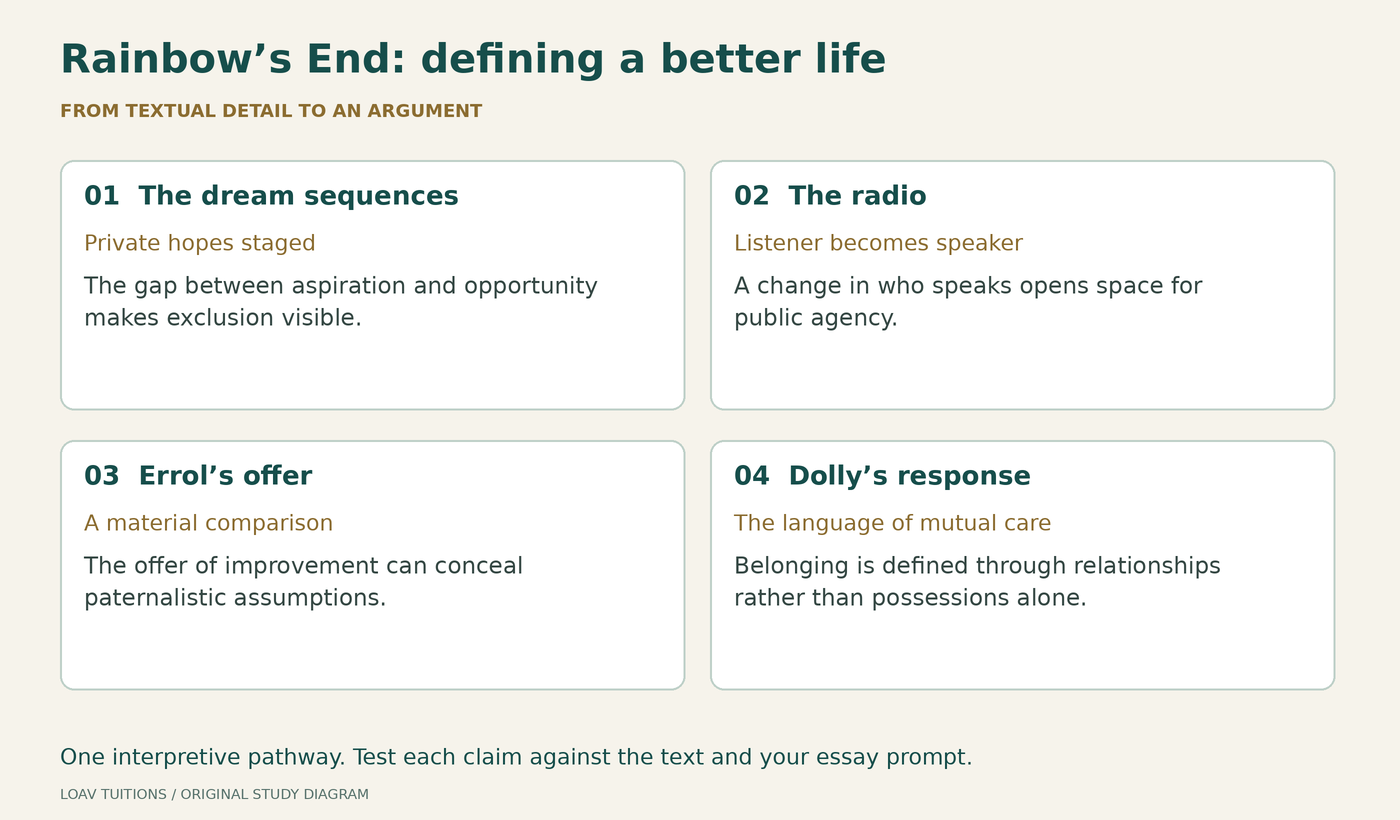
The dream sequences interrupt ordinary action and make private aspirations visible. Gladys’s educational hopes and Dolly’s imagined shopping experience are not simply information conveyed through dialogue: theatrical shifts allow audiences to inhabit their appeal and then experience the return to constraint. This produces a gap between what is possible in imagination and what social conditions permit. Treat that gap as a question. Does a fantasy conceal an obstacle, expose it, or help a character identify what needs to change? Scene evidence for dreams and imagination.
The radio: hearing and being heard
The radio connects the household to public voices, advertisements and national celebration. It also helps organise a contrast between consuming dominant messages and intervening in public discussion. When examining Gladys’s developing voice, track who controls the conversation and who is expected to listen. A change in access to speech can be a dramatic event even without a large change of setting. VCE-oriented overview of the play’s methods.
Domestic objects and unequal standards
Homes, furnishings and educational materials carry more than practical functions. They can represent aspiration, humiliation, institutional judgement or relationships. The analytical task is to establish which meaning operates in a particular scene. Do not give an object one symbolic definition and repeat it everywhere. A desired material improvement may be reasonable even if the standards attached to it are discriminatory. This distinction prevents the mistaken argument that the women should accept poverty because community matters.
Theme Analysis
Improvement and belonging: Errol’s offer of a different life exposes competing definitions of home. Dolly’s response makes care and mutual responsibility decisive. Yet the play’s concern with unsafe housing means that community cannot be used to excuse deprivation. A persuasive argument insists upon both decent conditions and the right to retain valued relationships. Relevant dialogue and family discussion.
Hope and power: Hope becomes meaningful when it changes what a character attempts, says or refuses. Analyse how private desire develops into an assertion of agency. The conclusion need not claim that every structure of discrimination has disappeared. A changed voice or relationship can be consequential without solving the whole political situation. This produces a more defensible reading than declaring the ending either wholly happy or wholly hopeless.
Practice Prompts
- Rainbow’s End suggests that a better life must be defined by those who live it. Discuss.
- How does Harrison make everyday acts of care a form of resistance?
- Dreams become powerful when they lead to action. To what extent is this true of Rainbow’s End?
- How does the play expose the difference between offering assistance and respecting independence?
Full Annotated Essay
Past-paper connection: This original model answers a paraphrase of 2025 VCAA Section A, question 13(i): How far does knowledge empower the women in Rainbow’s End? The original question uses a quotation about knowledge and power. This is a complete teaching essay, not a reproduced or assessed student response. The separate annotations map BCAS, TEEAEAL and CAS functions; these are teaching tools rather than VCAA requirements.
Introduction
Set amid the exclusion experienced by Aboriginal families in 1950s regional Victoria, Jane Harrison’s Rainbow’s End examines how people gain authority over the conditions of their lives. Knowledge can empower its women, but only when it supports their capacity to judge, speak and act rather than reinforcing standards imposed by others. Educational aspiration opens possible futures, knowledge of community enables resistance to paternalistic assumptions, and recognition of institutional control supports defiance. Harrison consequently presents power as a contested use of knowledge, not an automatic reward for acquiring information or conforming to supposedly superior ways of living.
Body 1 — Education and possibility
Harrison presents education as empowering when aspiration becomes a basis for judgement rather than submission to another person’s promise. The encyclopaedia sales encounter and the imagined graduation stage different claims about learning: commercial assurance meets a mother’s desire for opportunity. Errol’s promise of “learning” gives knowledge the attraction of access to a wider world. The sales setting qualifies that promise, positioning audiences to recognise both its appeal under exclusion and the insufficiency of purchasing access. Harrison does not leave the women as passive recipients: the family’s later evaluation of Errol’s proposed future tests the assumptions accompanying his apparent generosity. Gladys’s vision of a “graduate” translates educational possibility into a future for Dolly. The theatrical shift into fantasy makes aspiration emotionally persuasive while preserving the gap between desire and available opportunity. Read against Dolly’s insistence on the value of home, this dream supports advancement without establishing departure as its necessary price. Knowledge empowers insofar as it enlarges choices that the women can evaluate for themselves.
Body 2 — Knowing the value of home
Furthermore, Harrison challenges the hierarchy that privileges outside expertise over the women’s knowledge of care, belonging and historical exclusion. The disagreement over home and the resistance to administrative intrusion both expose the limits of improvement defined without its supposed beneficiaries. Errol’s offer of a “better life” treats departure and material advancement as equivalent. Its comparative language invites audiences to examine whose standard determines betterment. Nan Dear’s resistance to imposed domestic authority extends the same problem beyond courtship: provision of housing does not entitle outsiders to define the whole life within it. Dolly instead values people supporting “each other”. The reciprocal expression locates authority in lived practices of care. Paired with the older woman’s refusal of intrusive management, this definition makes community knowledge a basis for evaluating both personal and institutional offers. Harrison distinguishes inadequate material conditions from an allegedly inadequate culture, allowing improvement to be desirable without making compliance its legitimate cost. Empowerment therefore includes the authority to decide what must be preserved as circumstances change.
Body 3 — Recognising control
Finally, Harrison makes knowledge politically consequential through the movement from recognising control to contesting who may speak and decide. Domestic confrontation and Gladys’s public advocacy give different scales to this process, extending individual insight towards collective visibility. Nan Dear’s description of the rent collector’s “kingdom” exposes possessiveness beneath official management. The metaphor makes supervision look disproportionate rather than naturally protective. Gladys’s movement towards public speech similarly challenges the relegation of Aboriginal women’s experience to private complaint; theatrical attention grants their testimony the prominence institutions deny it. The accusation “Your rules” identifies enforced standards as someone’s choices. This possessive phrasing makes authority contestable, while the play’s broader development of women’s voices shows that defiance can become an assertion of alternative priorities. Audiences are positioned to recognise agency without confusing the opportunity to speak with guaranteed institutional response. Neither outspoken refusal nor public advocacy immediately dissolves structural inequality. Knowledge empowers through the capacity to challenge control, but lasting power also requires conditions in which the women’s judgements can affect decisions.
Conclusion
Rainbow’s End presents knowledge as a resource for empowerment whose effects depend on how it is used and whose authority it serves. Educational possibility, understanding of community and recognition of institutional domination support different forms of agency. Harrison’s qualification is crucial: genuine power requires the women’s knowledge to shape decisions about their lives, rather than merely helping them navigate decisions that others continue to make for them.
Analysis annotations
Structure map: The introduction follows BCAS: background establishes the text’s central tension, the contention gives a qualified answer, the arguments forecast the three body paragraphs, and the summary draws those claims into an authorial perspective. Each body follows TEEAEAL: an idea-led topic sentence and elaboration establish the claim; two evidence-and-analysis movements develop it; the link returns to the prompt. The conclusion follows CAS: it restates the qualified contention, synthesises the arguments and resolves their wider significance. These functions remain within the continuous prose; the labels are teaching tools, not VCAA requirements.
- Cross-evidence synthesis: Each paragraph relates perspectives or scenes: aspiration is tested against self-definition, domestic belonging against administrative control, and private defiance against public advocacy. The women contribute to an argument about authority rather than occupying separate character profiles.
- Argument progression: The essay moves from acquiring knowledge to valuing existing knowledge and then using knowledge to challenge authority. “Furthermore” and “Finally” mark purposeful developments.
- Stagecraft: Body 1 interprets the shift into fantasy, not simply the content of a character’s wish. Bodies 2–3 connect evaluative and possessive language to competing forms of power.
- Nominalisation: Aspiration, evaluation and recognition name processes that support comparison; the concrete scenes explain what those processes involve.
- Qualification: Each body avoids claiming knowledge automatically overcomes racism. The conclusion answers how far empowerment extends without treating continued injustice as proof that resistance is worthless.
Quote Bank
Six short verified fragments with context, method and interpretive significance.
- Education — Evidence 1–2: “learning”; “graduate”. Errol’s sales speech and Gladys’s imagined future for Dolly, Act 1, scene 2(B). Expansive language and a dream sequence stage both attraction and unfulfilled opportunity. Verified quoted dialogue and direction.
- Belonging — Evidence 3–4: “better life”; “each other”. Errol’s proposal and Dolly’s response about home. Comparative judgement meets a definition based on mutual care. Verified quoted dialogue.
- Control — Evidence 5–6: “kingdom”; “Your rules”. Nan Dear confronting the rent collector at Rumbalara. Kingdom metaphor and possessive language challenge administrative intrusion. Verified quoted dialogue.
Turning this into your own response
Begin with the prompt’s relationship between knowledge and power. Test each example against both ideas. A paragraph explaining racism generally may be accurate but insufficiently focused. Prefer a precise account of who judges, what standard is applied and how Harrison contests it. Develop the essay through linked claims rather than three separate character biographies.
The 2025 VCAA report supports close attention to the actual topic, coherent development and interpretation of evidence. For a play, that evidence includes contrast, stage directions, sound and action as well as dialogue. These prompts and models are original practice material, not official examination questions or guaranteed-score answers.
Evidence notes
The six embedded fragments are checked against the public script quotations linked in the Quote Bank. No page numbers are claimed; check the prescribed anthology for your own references. Production resources and historical research provide context, while the dramatic claims should always be tested against Harrison’s script. A director’s particular costume, lighting colour or delivery must not be attributed to Harrison unless the stage directions establish it.
For help applying this analysis to your own writing, explore Loav’s VCE tutoring or enquire about a trial class.
