
Loav reading room · VCE English · 2026
2026 List 1 novel: Samantha Harvey, Orbital, Vintage, 2024, ISBN 9781529922936. Spoilers follow. The analysis, practice topics and model writing below are original teaching material.
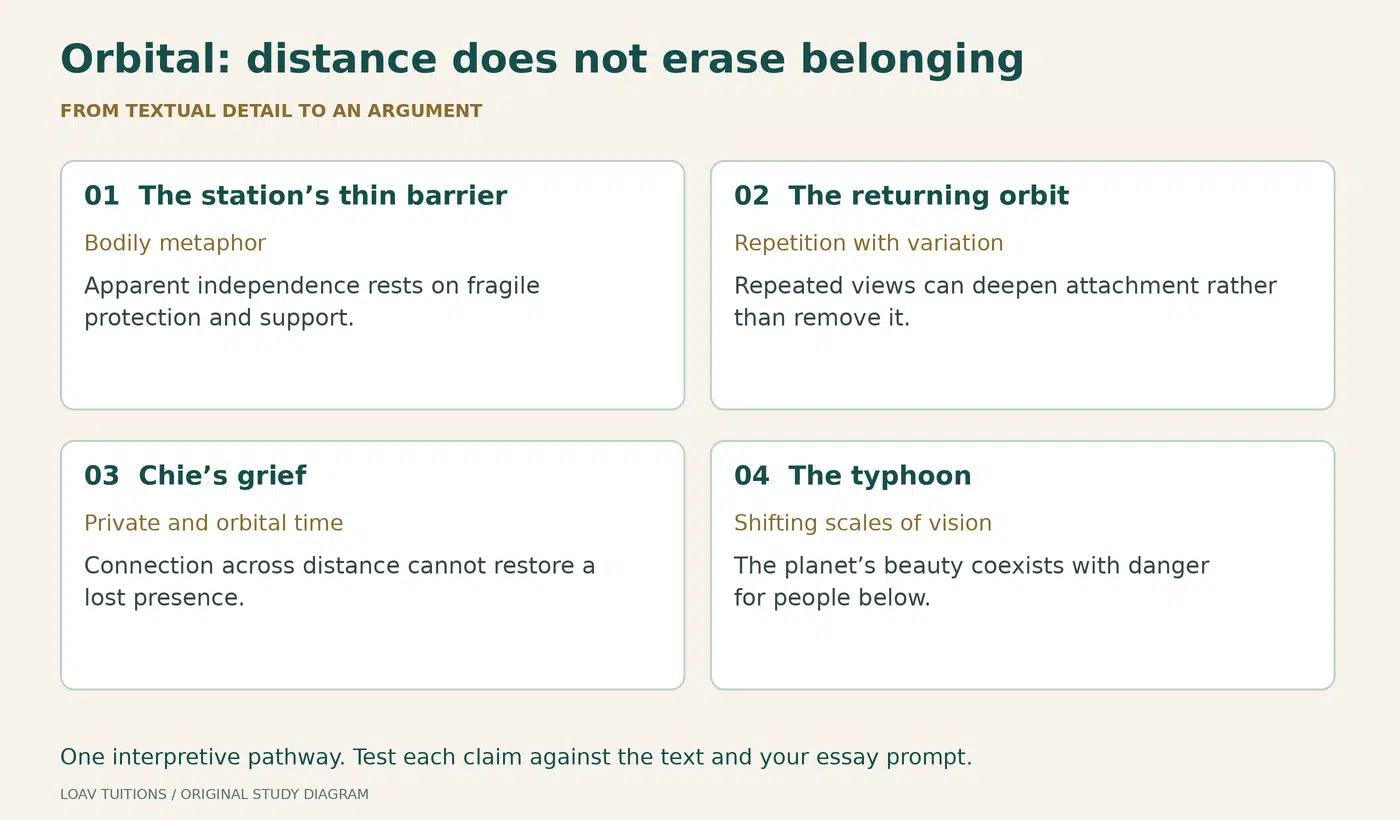
Reading a novel organised by orbit
Orbital asks readers to reconsider what counts as an event. Across a single day, six people circle Earth sixteen times aboard a space station. Their work involves scientific observation, maintenance and care for their own bodies. Meanwhile, a typhoon develops below, news of a death reaches the station, and the crew’s thoughts move between the planet before them and the lives they have temporarily left. These movements of attention are part of the action. Calling the book plotless can obscure its deliberate organisation of change through repeated observation.
The setting creates two scales at once: the closeness of a small shared habitat and the immense reach of its view. Harvey continually places bodily needs beside planetary patterns. The astronauts’ extraordinary vantage does not release them from dependence. It makes that dependence newly visible, inviting the reader to consider whether distance can sharpen responsibility rather than weaken it.
The crew and the limits of collective identity
The six crew members are Roman and Anton from Russia, Shaun from the United States, Chie from Japan, Nell from Britain and Pietro from Italy. Their national identities matter, but do not exhaust who they are. Memories, personal relationships, differing beliefs and professional habits complicate the apparent unity of the group. The station requires cooperation without making the crew interchangeable.
Chie’s grief after her mother’s death brings private time into contact with orbital time. A repeated sunrise cannot undo a singular bereavement. Pietro’s connection to people threatened by the typhoon prevents the storm from remaining only a beautiful formation. Roman’s close accounting of time establishes another response to a setting in which ordinary measures of days have become strange. These differences help the novel avoid treating the planetary perspective as a single revelation experienced identically by everyone.
When analysing a character, ask what particular kind of attention their consciousness introduces. Does the passage foreground attachment, scientific measurement, memory, vulnerability or belief? Then explain how that perspective alters the shared view. A paragraph organised around a relationship between ideas will usually be stronger than a sequence of miniature biographies.
How the writing makes meaning
Repetition with variation. Orbit gives the novel a recurring structure, but recurrence is not stasis. Earth changes beneath the crew; their perceptions change too. The repeated movement encourages comparison between moments rather than a simple expectation of a final dramatic confrontation. A useful essay traces a motif across the novel and identifies what has altered when it returns.
Mobile third-person narration. The narrative can move between individuals, collective experience and broader reflection. This flexibility allows Harvey to imagine a shared human condition without claiming that every person thinks alike. The movement of perspective is especially useful evidence for questions about unity, separation and the relationship between individual lives and larger systems.
Scale and juxtaposition. The mundane objects of life on the station sit beside vast distances and spectacular landscapes. These shifts resist a hierarchy in which only the immense matters. A small bodily action can disclose the conditions that make perception possible. Conversely, the planetary view can expose the provincialism of an apparently enormous earthly conflict. Explain the effect of a particular shift instead of merely writing that Harvey uses contrast.
The vulnerable body. Weightlessness is not effortless liberation. The crew must exercise, work and adapt within a technological environment. Their altered relationship to gravity reveals that the human body belongs to particular conditions. Space travel may display ingenuity, but it also demonstrates how much must be supplied artificially when people leave Earth.
Theme Analysis
Distance can intensify belonging. The station is physically separated from terrestrial life but depends on it. An argument about alienation should therefore distinguish loneliness from absolute disconnection. The novel makes it possible to feel isolated while recognising an increasingly powerful attachment to home.
A shared world does not erase difference. The view from orbit unsettles national divisions, yet the crew retain histories and loyalties. Do not turn the novel into a claim that political conflict has simply vanished. Its collective life offers a challenge to division within a small, highly particular environment, not proof that every terrestrial problem has been solved.
Beauty does not cancel danger. The typhoon can be visually magnificent while threatening lives. Harvey’s perspective complicates the ethics of looking: seeing a pattern clearly is different from experiencing its consequences. A sophisticated response holds aesthetic wonder and human vulnerability together, rather than choosing only one.
Human achievement can coexist with humility. The station embodies skill and ambition, but its dependence qualifies any fantasy of mastery. The novel’s ethical force emerges from this tension. Humanity is capable of astonishing work without becoming self-sufficient or standing outside the world it observes.
Quote Bank by Theme
Ten substantive, source-checked passages. Locations use the novel’s named orbital sections in the Grove 2023 edition; pagination differs between editions. Quotations are continuous extracts, with no silent internal omissions. The six entries marked Essay are embedded in the model response.
Bodies, dependence and exploration
“A hand-span away beyond a skin of metal the universe unfolds in simple eternities.” Essay
Voice: Third-person narrator. Context: The opening places sleeping crew beside the spacecraft’s thin protective boundary. Source: Grove 2023, Orbit minus 1.
Authorial method and use: The bodily metaphor and compressed distance make cosmic freedom depend on fragile enclosure.“But every day the six of them have to fight this urge to dissipate.” Essay
Voice: Third-person narrator, collective focus. Context: The crew undertake exercise to resist muscular and skeletal deterioration. Source: Grove 2023, Orbit 1, into orbit 2.
Authorial method and use: The adversarial verb makes maintenance an active struggle; apparent liberation from weight has material costs.
Connection, difference and grief
“they are so together, and so alone, that even their thoughts, their internal mythologies, at times convene.”
Voice: Third-person narrator. Context: The first sentence frames communal life and individual separateness. Source: Grove 2023, Orbit minus 1.
Authorial method and use: Parallel antithesis preserves solitude within intimacy; the qualified convergence avoids an uncomplicated collective mind.“None of them knows what to say to Chie, what consolation you can offer” Essay
Voice: Third-person narrator, collective focus. Context: Chie’s mother has died while Chie is in orbit. Source: Grove 2023, Orbit 1, ascending.
Authorial method and use: The movement from collective uncertainty to generic second person invites readers into the limits of consolation.“now, out of necessity, they’ve come to see that their family is this one here”
Voice: Third-person narrator, collective focus. Context: The crew adapt to separation from terrestrial families. Source: Grove 2023, Orbit 1, into orbit 2.
Authorial method and use: The qualifying phrase makes substitute kinship a response to need, rather than proof that earlier relationships are dispensable.
Borders, politics and responsibility
“On the craft’s internal cameras mission control watches the crew in flagrant disregard of these edicts” Essay
Voice: Third-person narrator. Context: National space agencies restrict shared toilets and facilities; the crew ignore the instructions. Source: Grove 2023, Orbit 6.
Authorial method and use: Bureaucratic diction is made absurd by bodily necessity; practical cooperation contests imposed division.“You’ll see no countries, just a rolling indivisible globe which knows no possibility of separation, let alone war.”
Voice: Ground-training warning, recalled by collective narration. Context: The narrator recounts the dissonance between the view and known terrestrial conflict. Source: Grove 2023, Orbit 7.
Authorial method and use: Personification unsettles the apparent naturalness of borders, while the warning’s context prevents visual unity from proving that war is unreal.“Every swirling neon or red algal bloom in the polluted, warming, overfished Atlantic”
Voice: Third-person narrator, collective focus. Context: The crew revise their initial belief that political events are irrelevant to Earth’s appearance. Source: Grove 2023, Orbit 7.
Authorial method and use: Accumulated environmental descriptors expose damage beneath spectacle; political responsibility is visible in the beautiful view.
Perspective, vulnerability and home
“But you are not going to flee. Flee to where? It isn’t like that.” Essay
Voice: Narrator using second-person focalisation of the fisherman. Context: The fisherman considers Pietro’s concern but cannot simply abandon his home before the typhoon. Source: Grove 2023, Orbit 4, descending.
Authorial method and use: The abrupt question corrects distant assumptions about mobility; observation and generosity cannot dissolve structural vulnerability.“The earth is a mother waiting for her children to return, full of stories and rapture and longing.” Essay
Voice: Third-person narrator. Context: The opening imagines the astronauts’ eventual return. Source: Grove 2023, Orbit minus 1.
Authorial method and use: Maternal personification makes exploration relational: departure remains shaped by origin and anticipated return.
Practice Prompts
- In Orbital, distance reveals the strength of human connection. Discuss.
- How does Harvey use the ordinary routines of the crew to explore extraordinary questions?
- Orbital celebrates human achievement while questioning human importance. To what extent do you agree?
- How does Harvey complicate the relationship between beauty and vulnerability?
Full Annotated Essay: freedom and dependence
Original adapted practice topic: In Orbital, departure from Earth brings freedom but also reveals dependence. Discuss.
Orbital is new to the 2026 list. This is not a past VCAA question for the novel. It adapts the conceptual tension between freedom and control in the 2025 Ghost Wall topic, Question 6(ii), to Harvey’s different text. Official 2025 source paper. The complete essay uses optional BCAS, TEEAEAL and CAS scaffolds; VCAA does not mandate these labels.
Introduction
Samantha Harvey’s Orbital follows six space travellers through one day of movement, work and reflection beyond Earth’s surface. Their departure creates genuine freedoms of movement and perspective, but the novel presents these freedoms as inseparable from enduring dependence. The body remains reliant on conditions the station must supply; collective life expands connection while retaining individual vulnerability; and the planetary view reveals the limits of human control. Harvey therefore qualifies the dream of escape without dismissing exploration, suggesting that freedom becomes more meaningful when it includes recognition of what sustains it.
Body 1
Harvey first challenges the equation of departure with independence by making bodily vulnerability central to orbital life. The crew can exceed familiar terrestrial limits only because a maintained environment supplies conditions their bodies cannot produce unaided; freedom depends on continuing support. The opening places the sleepers beside a fragile boundary: “A hand-span away beyond a skin of metal the universe unfolds in simple eternities.” The bodily metaphor makes the technological shell protective but penetrable, while the small spatial measure brings cosmic exposure unsettlingly close. Harvey counters heroic fantasies of mastery by locating dependence within the very image of exploration. The exercise sequence subsequently insists, “But every day the six of them have to fight this urge to dissipate.” The adversarial verb turns an apparently effortless existence into a daily contest against physical deterioration. Nell’s effort, Pietro’s music and Chie’s determined cycling give the collective need distinct personal forms. By juxtaposing these ordinary routines with the astonishing velocity of the craft, Harvey makes maintenance part of achievement rather than a distraction from it. The body cannot simply adopt the mind’s freedom to move beyond familiar boundaries. Departure enlarges experience without releasing the explorers from the material conditions and shared labour that make it possible.
Body 2
Moreover, Harvey presents life together as freedom from imposed divisions while preserving dependence on particular relationships. The crew’s cooperation contests the national organisations that regulate their mission, but their shared habitat cannot make personal losses interchangeable or easily repaired. When agencies restrict shared facilities, the narrator observes, “On the craft’s internal cameras mission control watches the crew in flagrant disregard of these edicts”. The official diction makes the regulations seem absurd beside ordinary bodily needs. The crew’s practical disobedience offers a small alternative to antagonistic national identities, although the cameras and continuing edicts show that political authority has not simply vanished. Against this collective possibility, Chie’s bereavement produces another kind of limit: “None of them knows what to say to Chie, what consolation you can offer”. The movement from the group to the generic second person draws readers into the difficulty of offering meaningful comfort. Space travel broadens their view but cannot remove the singularity of the mother Chie has lost. Harvey’s mobile narration consequently joins political cooperation to individual vulnerability without equating them: the freedom to share a home in orbit does not cancel attachment to people elsewhere. Freedom from division is valuable precisely because connection matters, yet no collective arrangement can make the crew independent of their particular human bonds.
Body 3
Finally, Harvey uses the planetary view to distinguish expanded perception from the power to secure everyone’s safety. The station offers an extraordinary view of Earth, but the freedom to move above it is unequally available and cannot be transferred to those facing danger below. As Pietro worries about the typhoon, the narrator enters the fisherman’s situation through the second person: “But you are not going to flee. Flee to where? It isn’t like that.” The abrupt question punctures an observer’s apparently simple solution. The fisherman’s constrained choices bring social and material vulnerability into a novel otherwise capable of presenting the storm as a magnificent pattern. Shifting focalisation makes distance ethically productive only when it includes attention to lives that cannot readily move. The opening’s image that “The earth is a mother waiting for her children to return, full of stories and rapture and longing” likewise qualifies the fantasy of absolute escape. Maternal personification gives departure a continuing relation to origin and return. Read beside the storm and the fisherman’s family, however, the image cannot guarantee that home will always be safe. Harvey asks readers to hold attachment and danger together: the astronauts’ wider view reveals a shared dependence without erasing the unequal conditions through which people experience it. Their achievement offers perspective, not exemption from the world’s demands. The freedom to see more becomes a reason to recognise responsibility and dependence rather than a warrant to imagine humanity beyond Earth’s power.
Conclusion
Orbital portrays departure as an enlargement of experience whose possibilities remain grounded in dependence. Bodily maintenance, the coexistence of cooperation and grief, and the limits of distant observation all qualify the dream of self-sufficient freedom. Rather than diminishing exploration, this qualification gives it ethical direction: seeing beyond ordinary boundaries should sharpen attention to the conditions and relationships that make life possible.
Why this argument works
Structure map: The introduction follows BCAS: background establishes the text’s central tension, the contention gives a qualified answer, the arguments forecast the three body paragraphs, and the summary draws those claims into an authorial perspective. Each body follows TEEAEAL: an idea-led topic sentence and elaboration establish the claim; two evidence-and-analysis movements develop it; the link returns to the prompt. The conclusion follows CAS: it restates the qualified contention, synthesises the arguments and resolves their wider significance. These functions remain within the continuous prose; the labels are teaching tools, not VCAA requirements.
- Progression: physical dependence leads to relational dependence and then to planetary dependence.
- Qualification: each paragraph acknowledges a real freedom before testing its limits.
- Authorial method: metaphor, parallel phrasing, viewpoint and juxtaposition connect language to the novel’s larger design.
- Whole-text development: substantive passages from the opening, exercise routine, Chie’s grief, national edicts and the fisherman’s situation develop a whole-text argument.
- Transitions and nominalisation: “Moreover” extends the framework; “Finally” changes scale. Maintenance, cooperation and perception make the three arguments distinct without inflated vocabulary.
Verified evidence and sources
The quotation bank and six model-essay passages were checked against the Grove Press first edition, December 2023 (eISBN 9780802161550), rather than the listed Vintage 2024 printing. Use the named orbital sections and scene descriptions to locate passages in other editions. No printed-page equivalence is claimed. The fisherman passage is second-person narration focalised through his circumstances, not dialogue spoken by Pietro. This independent essay and adapted topic are not VCAA-graded material.
- Vintage publisher sample, ISBN 9781529922936.
- Publisher’s edition and synopsis.
- Booker Prizes reading guide and character overview.
- Grove Atlantic publication page.
- VCAA English examinations and assessment reports. The 2024 report’s emphasis on connected, substantiated reasoning informs the teaching approach; its student essays are not reproduced.
For help applying this analysis to your own writing, explore Loav’s VCE tutoring or enquire about a trial class.
