
Loav reading room · Sophocles · VCE English
A king sets out to save his city. Every answer brings him closer to a truth that will destroy his understanding of himself.
Oedipus the King rewards a second reading. Once you know the ending, the opening promises, confident judgements and attempts at reassurance become unsettling. This guide helps you move from knowing what happens to explaining how Sophocles makes it matter.
Full plot spoilers follow. The play includes incest, suicide and self-inflicted injury. This is an independent study aid, not a VCAA publication. Read the complete play and follow your teacher’s task instructions.
Jump to: VCE focus · Plot and structure · Characters · Theme Analysis · Dramatic methods · Quote Bank · Full Annotated Essay · Practice Prompts
01 / What should a VCE response do?
Oedipus the King appears on the 2026 VCE English and EAL text list. The listed edition is Robert Fagles’ translation in The Three Theban Plays (Penguin Classics, 1984). Check your school’s edition before collecting quotations: wording, line numbers and stage directions vary between translations.
This guide supports Reading and responding to texts in Units 3–4. Follow your teacher’s SAC instructions. The useful study question is: how do the play’s choices shape an interpretation? A strong response connects an argument about ideas and values to specific evidence, language, characterisation and structure. Knowing a theme such as fate is a starting point; explaining how the messenger’s intended reassurance exposes his uncertain parentage develops analysis. Answer the particular prompt rather than reproducing a memorised essay.
This guide focuses on English text-response skills. English and EAL have distinct assessment requirements, so use the relevant course documents. Text lists change: the 2026 listing is not a promise about every future year.
02 / The story happens before the discovery
Two timelines matter. In the earlier story, Laius and Jocasta try to prevent a prophecy concerning their child. The infant survives and grows up in Corinth, believing Polybus and Merope are his parents. After hearing a prophecy that he will kill his father and marry his mother, Oedipus leaves Corinth. At a crossroads he kills a stranger who is actually Laius. He later saves Thebes from the Sphinx and marries the widowed queen, Jocasta.
The play begins years later, when a plague afflicts Thebes. Oedipus promises to discover and punish Laius’s murderer. His investigation gradually exposes his own history:
- The city appeals to its saviour. Oedipus takes responsibility for ending the crisis.
- Tiresias identifies the hidden danger. Oedipus treats the prophet’s accusation as evidence of a conspiracy.
- Jocasta tries to reassure him. Her account of Laius’s death makes Oedipus fear that he was the killer.
- A messenger brings apparently good news. Polybus’s death seems to weaken the prophecy, but the messenger reveals that Oedipus was adopted.
- The shepherd completes the evidence. Oedipus discovers his birth and the full meaning of his marriage and actions.
- The royal household collapses. Jocasta dies by suicide; Oedipus blinds himself. He seeks exile, while Creon takes control and insists on consulting the gods.
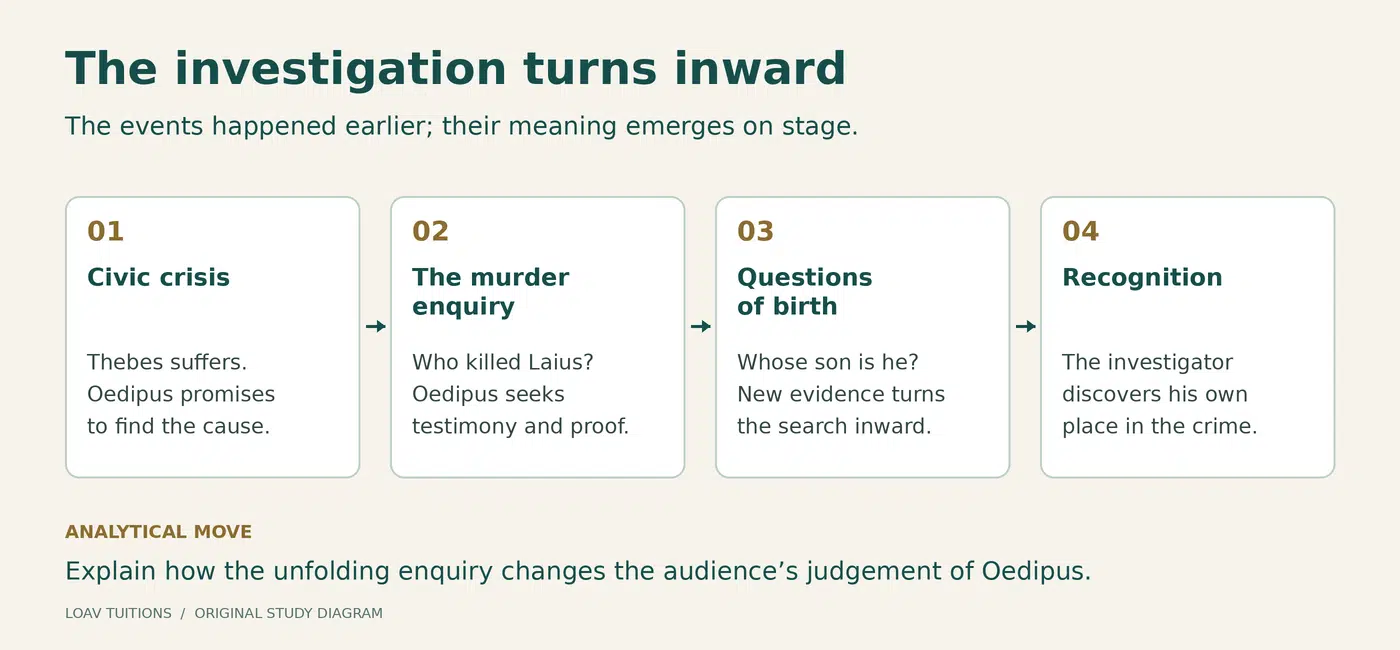
Why structure matters: the investigation transforms a public emergency into a crisis of identity. Sophocles repeatedly makes attempted reassurance produce new fear. Discuss the sequence of revelations, not just the final revelation.
Quick vocabulary: an oracle is a divine pronouncement; the Chorus is the group of Theban elders; dramatic irony is a gap between what an audience and a character understand.
03 / Characters as competing responses to truth
Oedipus: intelligent, energetic and committed to Thebes, but quick to turn uncertainty into accusation. His determination deserves attention alongside his anger. The qualities that once made him a successful problem-solver also drive an inquiry he cannot safely complete.
Jocasta: initially challenges confidence in prophecy and tries to calm the conflict. As the evidence converges, her desire to stop the inquiry becomes more urgent. Consider the difference between dismissing a threat and recognising a truth that one cannot bear to hear spoken.
Tiresias: possesses knowledge that the king lacks. His reluctance to speak complicates the assumption that truth is always straightforwardly beneficial. The confrontation also exposes the difference between holding political authority and knowing what is true.
Creon: resists Oedipus’s suspicions and later exercises authority over him. Avoid treating the king’s accusation as proof of a real conspiracy. Ask how Creon’s arguments and restraint contrast with Oedipus’s behaviour.
The Chorus: the Theban elders express communal fear, hope, religious concern and uncertainty. Their changing responses make the crisis public. They do not supply a single, infallible interpretation of every event.
04 / Theme Analysis
Fate and responsibility
The prophecy places limits on human control, yet the drama gives weight to choices. Oedipus decides how to respond to Tiresias, how to treat Creon and whether to pursue further evidence. Avoid the shortcut that fate makes every action meaningless. Distinguish what he cannot know about his origins from conduct that the audience can still judge.
Question to test: does the play’s force come from the inevitability of the outcome, the way Oedipus responds, or the tension between both?
Knowledge and its cost
Oedipus’s inquiry serves a genuine civic need. It also destroys the identity on which his authority rests. Jocasta’s attempt to halt the search offers a competing response to painful knowledge. Sophocles makes discovery both necessary and devastating; an essay that praises truth without acknowledging its consequences misses this difficulty.
Leadership, confidence and suspicion
The opening presents a ruler who responds to suffering. Later confrontations reveal how readily confidence can become hostility when his judgement is challenged. His movement from rescuer to suspected source of pollution destabilises the boundary between a city’s protector and its danger. Analyse the changes instead of labelling him proud in every scene.
Identity and human vulnerability
Oedipus’s status rests on achievements, family relationships and assumptions about his past. The investigation overturns those assumptions without erasing his earlier effort to protect Thebes. The ending invites reflection on how fragile success can be when people lack full knowledge of their own lives. Keep this interpretation grounded in the play rather than making sweeping claims about what every ancient Greek believed.
05 / Dramatic methods: move beyond spotting devices
Dramatic irony: an audience familiar with the myth can recognise meanings that Oedipus cannot. His commitment to punish the murderer implicates himself. Explain how this gap in knowledge creates tension and changes the audience’s response to his certainty.
Sight and blindness: Tiresias’s physical blindness contrasts with his insight; the sighted king fails to understand his position. Oedipus’s later self-blinding gives the pattern a terrible physical consequence. The motif invites questions about understanding, shame and the limits of perception.
Reversal and recognition: reversal is a change in a character’s situation; recognition is a movement into knowledge. The messenger’s intended reassurance helps undo Oedipus’s security. These terms matter when you explain how a specific scene changes the direction of the inquiry.
Choral odes and offstage action: the Chorus interrupts individual conflict with communal reflection. Reports of events inside the palace make listeners confront suffering through narration before seeing Oedipus’s altered appearance. Attend to what is heard, seen and withheld in a staged tragedy.
Choose one moment → identify a precise dramatic or language choice → explain its effect → connect it to an interpretation → return to the prompt. This is a thinking aid, not a compulsory paragraph formula.
06 / Quote Bank
Twelve brief passages from Sophocles’ Oedipus the King, translated by Robert Fagles in The Three Theban Plays (Penguin). A slash marks a verse line break; no words have been omitted within these passages. Apostrophes are typographically normalised. Read each passage in its scene before adapting the analytical possibility to a prompt.
Public duty and the vulnerable city
- Q1: “But my spirit / grieves for the city, for myself and all of you.”
Oedipus; Opening response to the supplicants. Fagles, printed p. 162. The widening sequence links private distress with civic obligation. Sophocles makes the ruler’s compassion genuine before revealing the danger within his identity.
- Q2: “But once he returns, then, then I’ll be a traitor / if I do not do all the god makes clear.”
Oedipus; Awaiting Creon’s return from Delphi. Fagles, printed p. 162. The repeated then anticipates action; the moral accusation makes inaction a betrayal. Divine authority and the city’s need together give inquiry an ethical urgency.
- Q7: “Ship and towered city are nothing, stripped of men / alive within it, living all as one.”
Priest; The opening petition. Fagles, printed p. 161. The ship and city images make people the substance of political power. The Priest’s appeal tests kingship by communal survival rather than a ruler’s reputation.
Authority and the limits of judgement
- Q3: “Come here, you pious fraud. Tell me, / when did you ever prove yourself a prophet?”
Oedipus; Confrontation with Tiresias. Fagles, printed p. 182. The accusatory address and rhetorical question replace investigation with discrediting the witness. Dramatic irony exposes how a defence of authority can become resistance to knowledge.
- Q4: “I stopped the Sphinx! With no help from the birds, / the flight of my own intelligence hit the mark.”
Oedipus; Defending his intelligence against Tiresias. Fagles, printed p. 182. The flight metaphor appropriates the birds associated with divination to celebrate human reasoning. Sophocles sets a real past achievement against a disastrous present misreading.
- Q8: “Time alone can bring the just man to light— / the criminal you can spot in one short day.”
Creon; Defence against the conspiracy accusation. Fagles, printed p. 194. The opposition between time and one short day challenges hasty judgement. Creon’s defence offers a procedural alternative to the king’s urge to act against an imagined enemy.
Knowledge and protective concealment
- Q5: “Listen to you? No more. I must know it all, / must see the truth at last.”
Oedipus; Rejecting Jocasta’s appeal to stop the inquiry. Fagles, printed p. 222. The repeated must gives inquiry an imperative force. The sight metaphor is ironic: his determination to see coexists with his failure to understand Jocasta’s recognition.
- Q9: “You with your precious eyes, / you’re blind to the corruption of your life,”
Tiresias; Reply to the king’s insult. Fagles, printed p. 183. The inversion of sight and blindness separates physical perception from self-knowledge. The prophet’s accusation makes the audience confront the gulf between royal confidence and understanding.
- Q10: “Stop—in the name of god, / if you love your own life, call off this search! / My suffering is enough.”
Jocasta; Recognition before Oedipus understands his origins. Fagles, printed p. 222. The imperative and appeal to life make concealment an attempt to protect as well as suppress. Unequal knowledge complicates any simple opposition between courageous inquiry and cowardly evasion.
Fate, response and unstable fortune
- Q6: “But the hand that struck my eyes was mine, / mine alone—no one else— / I did it all myself!”
Oedipus; After the self-blinding, immediately after naming Apollo. Fagles, printed p. 241. The repeated first-person claims distinguish his act from the agonies he attributes to Apollo. Sophocles preserves human response within catastrophe without presenting self-injury as an ethical prescription.
- Q11: “Pride breeds the tyrant / violent pride, gorging, crammed to bursting / with all that is overripe and rich with ruin—”
Chorus; Choral reflection after the account of Laius’s death. Fagles, printed p. 209. The images of consuming and over-ripeness make excess self-destructive. Treat the ode as the Chorus’s anxious moral reflection, not an infallible diagnosis of every cause of the tragedy.
- Q12: “Now as we keep our watch and wait the final day, / count no man happy till he dies, free of pain at last.”
Chorus; Final address to the audience. Fagles, printed p. 251. The movement from the king to no man broadens the reversal into a warning against premature judgements of happiness. The closing perspective does not erase the distinct choices made within the play.
Edition note: Quotations use Robert Fagles’ translation in Penguin’s The Three Theban Plays. The printed page references identify passages in that volume; pagination may differ between printings, so also use the named scenes to locate them in your classroom copy. The printing date of the reference volume is not established. Do not substitute wording from another translation. The ending takes Oedipus into the palace: his request for exile is not an enacted departure from Thebes.
07 / Full Annotated Essay
Past-exam connection: this original essay responds to the issue of danger in the pursuit of truth, paraphrasing 2025 VCE English, Section A, Question 12(i), page 6. Read the exact question in the official paper. The essay develops a qualified discussion rather than treating danger as a reason to abandon inquiry.
BCAS, TEEAEAL and CAS are teaching scaffolds, not VCAA rules. The separate annotations make the construction visible while the essay reads as continuous prose. This is an independent teaching example, not an assessed student script or a guaranteed grade.
Introduction
In Oedipus the King, Sophocles transforms an investigation intended to rescue a plague-stricken city into the exposure of its ruler’s devastating history. The pursuit of truth is dangerous because it threatens political authority, intimate relationships and the investigator’s understanding of himself; nevertheless, the tragedy does not establish ignorance as an ethically adequate refuge. First, the civic emergency makes inquiry a responsibility. Subsequently, the defence of authority turns the search into a source of conflict. Finally, recognition destroys personal security while creating the possibility of acknowledging responsibility. Sophocles therefore separates the value of discovering the truth from any promise that discovery will protect those who undertake it.
Body 1: the responsibility to investigate
Sophocles initially grounds the search for knowledge in communal obligation, making its abandonment morally troubling before its personal dangers become clear. The Priest speaks for a suffering community whose dependence on its celebrated ruler makes knowledge a public necessity. By staging the supplicants before the palace, Sophocles makes political authority answerable to needs it did not create and cannot ignore. Addressing the petitioners, Oedipus declares, “But my spirit / grieves for the city, for myself and all of you”, presenting authority through shared suffering. The widening sequence of city, self and people binds private feeling to a public obligation. Yet the Priest’s appeal prevents compassion from defining duty on the ruler’s terms alone: the audience sees vulnerable people demanding relief, not merely a leader displaying virtue. Moreover, the king anticipates Creon’s return: “But once he returns, then, then I’ll be a traitor / if I do not do all the god makes clear.” The accusation he imagines against himself makes passivity a betrayal, not a neutral alternative. By setting that commitment beside the supplicants’ dependence, Sophocles makes dramatic irony ethically complex: spectators can anticipate personal disaster while recognising the community’s legitimate claim to investigation. Thus, the danger of discovery cannot settle whether truth should be sought: refusing the search would also abandon a suffering community.
Body 2: the defence of authority
However, Sophocles reveals that the defence of established authority can make inquiry destructive even before its conclusions are understood. The confrontation with Tiresias turns an attempt to obtain knowledge into a struggle over who deserves to be believed. Political power supplies no guarantee of interpretive accuracy, yet the king treats contradiction as an attack requiring retaliation. His challenge to the prophet, “Come here, you pious fraud. Tell me, / when did you ever prove yourself a prophet?”, converts unwelcome testimony into an accusation of calculated deception. The insult and rhetorical question permit the speaker to attack the source rather than examine the claim. For an audience aware of the myth, the misidentification is especially painful: the ruler’s defence of truth becomes a means of resisting it. Furthermore, his recollection of defeating the Sphinx celebrates his competence: “I stopped the Sphinx! With no help from the birds, / the flight of my own intelligence hit the mark.” The possessive emphasis turns genuine achievement into an apparently sufficient warrant for present certainty; the flight metaphor even appropriates the birds associated with divination to assert intellectual independence. Sophocles juxtaposes successful interpretation in the past with misunderstanding in the present, exposing the limits of competence when it hardens into self-exemption from scrutiny. Creon’s subsequent defence offers a contrasting model: he reasons that influence without kingship’s burdens already satisfies him. By placing this calculation against accusations of conspiracy, Sophocles invites audiences to compare an explanation tested through argument with certainty protected through force. Accordingly, the search becomes dangerous not only because truth hurts, but because threatened authority mistakes its own preservation for the defence of knowledge.
Body 3: recognition without reassurance
Ultimately, Sophocles makes recognition devastating without allowing devastation to erase the distinction between fate and human response. The messenger’s intended reassurance instead reveals adoption, while Jocasta’s recognition prompts an attempt to stop disclosure. Sophocles contrasts helpful intention, protective concealment and relentless inquiry, denying audiences a simple division between truthful heroes and deceptive villains. Against Jocasta’s pleas, Oedipus insists, “Listen to you? No more. I must know it all, / must see the truth at last.” The repeated modal pressure and sight metaphor express an uncompromising commitment to discovery, but his mistaken belief that she fears low birth prevents this determination from becoming uncomplicated heroism. Jocasta understands the danger before he does; this unequal distribution of knowledge makes spectators judge persistence alongside the protective impulse it overrides. Sophocles thus makes competing responses intelligible without making concealment a remedy for the city’s unresolved pollution. Nevertheless, after his self-blinding, Oedipus identifies his own action: “But the hand that struck my eyes was mine, / mine alone—no one else— / I did it all myself!” Although he also attributes his suffering to Apollo, the repeated first-person acknowledgement preserves a distinction between what has befallen him and what he has done. Creon’s insistence on divine clarification before granting exile then checks the former ruler’s attempt to dictate the response. Through this transfer of authority, Sophocles keeps acknowledgement distinct from mastery: neither knowledge nor suffering grants complete control over what follows. The final stage direction takes him into the palace, not into an already enacted exile. Truth therefore removes comforting illusions without removing every possibility of accountable response.
Conclusion
Sophocles presents the pursuit of truth as profoundly dangerous, yet its danger does not make concealment a satisfactory moral solution. Civic obligation necessitates inquiry, defensive authority intensifies its conflicts, and recognition exposes the painful limits within which responsibility must operate. The tragedy’s challenge is consequently more demanding than a warning against curiosity: knowledge offers no immunity from suffering, but avoiding knowledge cannot by itself make a life just.
Analysis annotations: how the essay develops
Structure map: The introduction follows BCAS: background establishes the text’s central tension, the contention gives a qualified answer, the arguments forecast the three body paragraphs, and the summary draws those claims into an authorial perspective. Each body follows TEEAEAL: an idea-led topic sentence and elaboration establish the claim; two evidence-and-analysis movements develop it; the link returns to the prompt. The conclusion follows CAS: it restates the qualified contention, synthesises the arguments and resolves their wider significance. These functions remain within the continuous prose; the labels are teaching tools, not VCAA requirements.
- Argument progression: the introduction forecasts obligation, defensive authority and recognition in the same order as the three bodies. Each paragraph contributes a different reason for the qualified contention.
- Idea-led topic sentences: each begins with Sophocles’ construction of an idea. Characters become evidence within that argument rather than substitutes for it.
- Purposeful transitions: the opening movement establishes necessity; the second introduces a complication; the final body tests the argument against recognition. Connectors mark actual logical relationships rather than decorate a list.
- Authorial purpose and audience: the Priest’s communal claim, Creon’s reasoned defence, Jocasta’s concealment and the messenger’s reassurance are brought into the same conceptual arguments as the ruler’s words. Staging, dramatic irony, juxtaposition and reversal explain how the play invites judgement. Claims concern the work’s effects and values, not unsupported certainty about the playwright’s private intentions.
- Appropriate nominalisation: nouns such as investigation, defence and recognition condense actions into concepts that can be compared. Active verbs still identify who acts and how the dramatic choices work.
- Evidence and qualification: each body integrates two substantial brief passages, explains their language and relates them to a wider scene. The final body distinguishes acknowledging agency from endorsing self-punishment.
- Synthesis: the conclusion returns to danger while refining its ethical significance. It neither introduces a fourth argument nor promises that suffering is redeemed.
08 / Practice Prompts
These are original Loav practice prompts, not VCAA examination questions or predictions:
- To what extent does knowledge give characters power in Oedipus the King?
- “The play invites sympathy for Oedipus without excusing all his actions.” Discuss.
- How does Sophocles explore the relationship between private identity and public responsibility?
- “Attempts to escape suffering only deepen it.” Discuss with reference to the play.
For one prompt, spend ten minutes planning three connected claims. Find a moment that supports each claim and one that complicates your overall view. Then write one paragraph and check whether every sentence helps answer that prompt. A useful counterargument should change or refine your interpretation, rather than appear as a token disagreement at the end.
Your next reading session
- Mark where each character knows more or less than Oedipus.
- Track one motif across three different moments.
- Record the speaker and context beside every quotation.
- Replace a broad label such as “arrogant” with an explanation of an action.
- Ask whether your paragraph analyses the play or retells its events.
If you need help turning a reading into a clear argument, explore Loav’s VCE tutoring or enquire about a trial class. Bring your school text, task and one paragraph you would like to improve.
Sources and further reading
Curriculum and text-list details checked for 2026. Use current VCAA documents and your teacher’s instructions for assessment requirements.
- VCAA: 2026 English and EAL text list (Word document).
- VCAA: English and EAL study design (Word document).
- VCAA: 2025 English examination, including Section A assessment guidance.
- State Library Victoria: VCE English and EAL plays.
Further orientation: LitCharts, SparkNotes and KIS Academics offer other study approaches. This guide’s analysis, model essay and practice prompts are original. Study guides support, rather than replace, reading Sophocles.
