
Loav reading room · VCE English · 2026
Miles Franklin’s novel makes ambition difficult to separate from disappointment. Sybylla Melvyn wants a life large enough for her intelligence and imagination, but poverty, gender expectations and her own uncertainties restrict the available paths. The important question is not simply whether she becomes successful. It is who gets to decide what success means. Spoilers follow.
Course and edition
My Brilliant Career is a 2026 VCAA English and EAL List 1 novel and meets the Australian text requirement. The nominated edition is Text Classics, 2012, ISBN 9781921922190. Quotations are referenced to the Broadview 2008 review proof edited by Bruce K. Martin, with Project Gutenberg providing an additional text for comparison. The expanded bank uses Franklin’s novel only, excluding the editor’s introduction, footnotes and appendices. Printed references below apply only to that Broadview proof, not the nominated Text Classics edition. This guide supports analytical text response, not a substitute for reading the novel.
Plot as a pattern of unequal opportunities
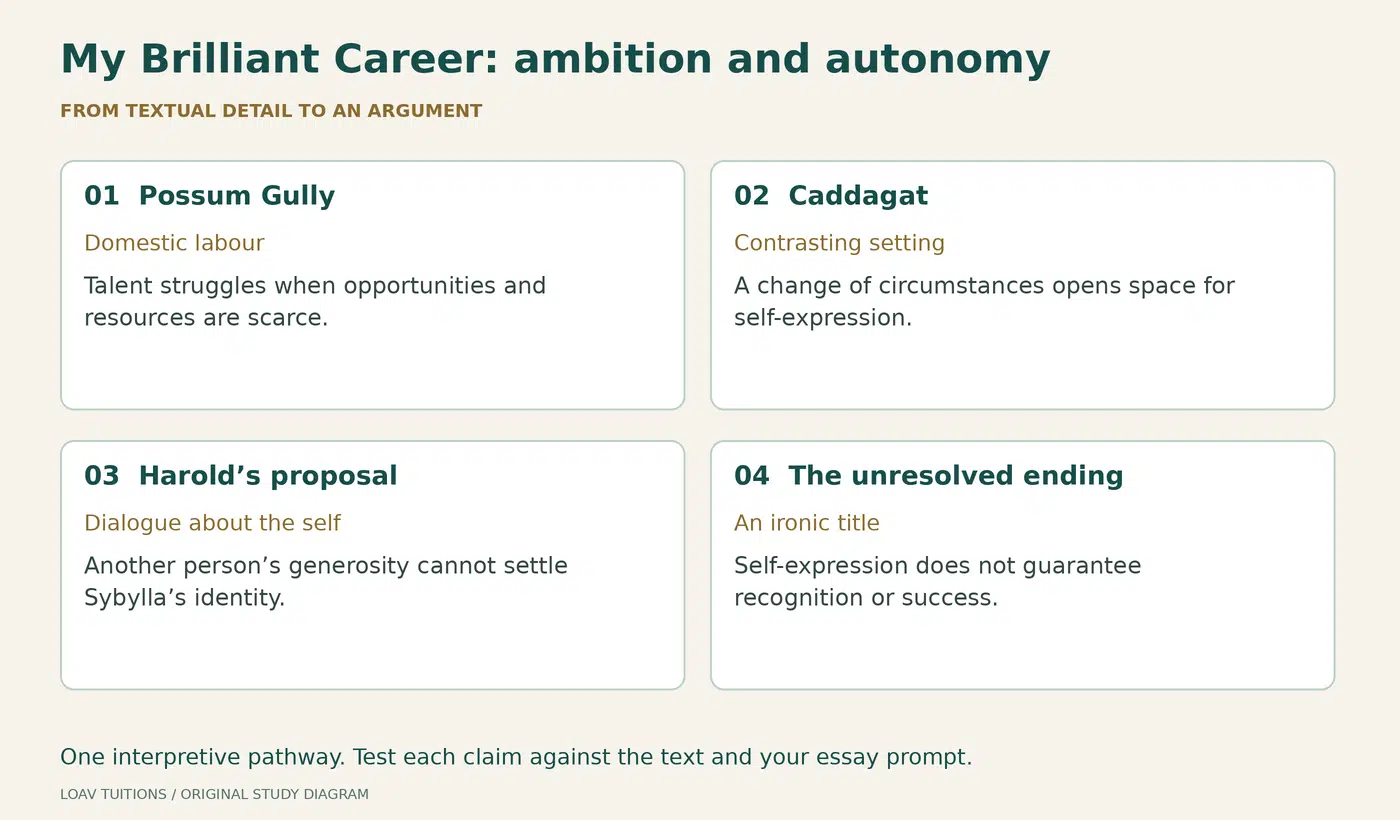
Sybylla’s early life is transformed by her family’s declining circumstances. At Possum Gully, exhausting labour and her father’s drinking narrow the space available for music, reading and imaginative development. Her distress is partly adolescent volatility, but Franklin makes its material conditions unmistakable. A gifted person cannot develop freely if survival consumes the day.
A stay with her grandmother at Caddagat gives Sybylla access to comfort, cultivated company and artistic pleasures. The contrast changes more than her surroundings: it demonstrates how readily qualities dismissed as troublesome can flourish when someone has leisure and encouragement. Yet refinement brings its own disciplines. Female attractiveness, manners and marriageability remain measures through which others evaluate her.
Her relationship with Harold Beecham offers companionship and the possibility of security. His changing financial circumstances complicate any simple claim that she pursues wealth. When he becomes poor, Sybylla can imagine supporting him; when he later renews his proposal from a stronger position, she still refuses. She also spends an unhappy period working for the M’Swats because of her father’s financial obligations. The arrangement makes visible how family debts can claim a daughter’s labour.
The ending does not give Sybylla the conventional reward of marriage or an established literary career within the narrated action. Instead, the narrative itself exists as evidence of her expressive capacity. That tension is central: her circumstances remain constrained while her voice has reached a reader. The title can therefore suggest irony, aspiration and a kind of achievement that social measures fail to recognise.
Characters and interpretive tensions
Sybylla: Her lively first-person voice invites sympathy without requiring agreement with every judgment. She moves between defiance and self-disgust, generosity and contempt, confidence and despair. These shifts reveal the pressure of standards she resists but has also absorbed. Distinguish Franklin’s construction of this narrator from Sybylla’s immediate opinions.
Harold: He is neither a complete solution nor merely a villain blocking ambition. His kindness matters because refusing a wholly cruel suitor would present a much simpler choice. He offers practical support for writing, but he does not always grasp why Sybylla experiences the decision as a question of identity.
Sybylla’s parents: The father’s failures harm the household; the mother’s bitterness also develops under exhausting conditions. Analyse the unequal distribution of consequences rather than treating poverty as proof of defective character. Grandmother and Aunt Helen: They provide affection and guidance while transmitting expectations about suitable femininity. The M’Swat household, meanwhile, exposes Sybylla’s vulnerability and the class prejudices within her own gaze.
Theme Analysis
Freedom and security can conflict. Marriage promises resources that Sybylla lacks, but resources are not identical to a life she can call her own. A strong essay acknowledges what she relinquishes. Her refusal matters because the alternative contains genuine attractions.
Talent needs conditions in which to grow. Compare the availability of music and conversation at Caddagat with domestic labour elsewhere. Setting becomes an argument about opportunity. Avoid suggesting that ambition alone can defeat every structural barrier.
Gender expectations become internal voices. Sybylla measures herself against beauty and conventional goodness even while rejecting them as adequate definitions of worth. Her self-criticism illustrates how social judgment can survive inside resistance.
Belonging does not eliminate criticism. Sybylla’s attachment to rural Australia coexists with anger at its limitations. The novel’s sympathy for struggling people should be considered alongside the narrator’s exclusions and period prejudices. Loving a community is not the same as endorsing every value it holds.
Form: why the voice matters
The first-person autobiographical form gives narrative space to a young woman whom other people often misunderstand. It should not be treated as a transparent record of Franklin’s own life. Exclamations, direct address, tonal changes and comic exaggeration make the narration energetic and sometimes unstable. The reader must evaluate the distance between a momentary judgment and the larger pattern of events. Contrasting households organise the novel as a repeated experiment: what happens to the same person under different conditions? The unresolved ending also resists the marriage plot’s promise that a woman’s life becomes complete once she chooses a husband.
Quote Bank by Theme
Grouped by theme for planning, with short contextualised extracts from the text. Chapter or section references are the stable locators. Any printed page numbers apply only to the identified edition, never automatically to a different school edition. Read each passage in context before adapting it.
Class, poverty and unequal opportunity
“Hopeless, homeless, aimless, shameless souls, tramping on from north to south”
Voice and location: Sybylla. Chapter 14; Broadview proof printed p. 128.
Context: She describes the itinerant workers she feeds at Caddagat.
Authorial analysis: Accumulating adjectives join deprivation to damaged purpose, while judgmental diction exposes prejudice within her sympathy.
“the iron ungodly hand of class distinction has settled surely down upon Australian society”
Voice and location: Sybylla. Chapter 5; Broadview proof printed p. 62.
Context: Her parents’ exhausting work coincides with abandonment by former acquaintances.
Authorial analysis: Personification gives social hierarchy a crushing physical force and challenges its assumed moral legitimacy.
“I borrowed every book in the neighbourhood and stole hours from rest to read them.”
Voice and location: Sybylla. Chapter 5; Broadview proof printed p. 62.
Context: She describes pursuing the arts amid dairying labour.
Authorial analysis: The verb stole makes cultural development seem illicit and costly: gaining intellectual nourishment consumes already inadequate rest.
Gender, identity and marriage
“forced to sit with tied hands and patiently suffer”
Voice and location: Sybylla. Chapter 7; Broadview proof printed p. 78.
Context: Her self-analysis contrasts imagined masculine freedom with feminine endurance.
Authorial analysis: The bodily metaphor exposes gendered restriction, while the narrator’s bitterness should not be mistaken for a universal factual verdict.
“hide your brains, cramp your mind, study to appear unintellectual”
Voice and location: Sybylla addressing girls. Chapter 7; Broadview proof printed p. 78.
Context: She ironically advises girls how to preserve their marriage prospects.
Authorial analysis: Accumulating imperatives make social acceptance depend on deliberate intellectual self-reduction.
“I am given to writing stories, and literary people predict I will yet be an authoress.”
Voice and location: Sybylla speaking to Harold. Chapter 36; Broadview proof printed p. 250.
Context: During his renewed proposal, she presents her writing as a supposed obstacle to marriage.
Authorial analysis: The language of confession dramatises gendered expectations, while Harold’s supportive response complicates a simple opposition between husband and art.
“you can write as many yarns as you like”
Voice and location: Harold. Chapter 36; Broadview proof printed p. 250.
Context: He responds to Sybylla’s confession about writing and offers practical resources.
Authorial analysis: The offer provides genuine support, but the casual noun and permissive phrasing invite scrutiny of how far he understands her vocation.
Compassion, solidarity and qualified hope
“A man was never refused a bit to eat at Caddagat”
Voice and location: Sybylla. Chapter 14; Broadview proof printed p. 128.
Context: She introduces the household’s regular feeding of travelling workers.
Authorial analysis: Categorical phrasing makes hospitality habitual; the surrounding judgments also show that generosity need not erase class prejudice.
“extend your hands and hearts in true sympathy to a brother in misfortune”
Voice and location: Sybylla addressing working Australian men. Chapter 38; Broadview proof printed p. 259.
Context: The closing address praises solidarity despite repeated hardship.
Authorial analysis: Paired bodily imagery joins practical aid and fellow feeling, locating ethical worth among workers without promising their escape.
“Bravely you jog along with the rope of class distinction drawing closer, closer, tighter, tighter around you”
Voice and location: Sybylla addressing working Australians. Chapter 38; Broadview proof printed p. 259.
Context: The ending turns from admiration to a warning about entrenched hierarchy.
Authorial analysis: Repetition enacts tightening constraint: affection for the community coexists with anger at the social order limiting it.
Practice Prompts
- Sybylla’s refusal to marry is an assertion of identity rather than a rejection of affection. Discuss.
- How does Franklin show that opportunity shapes the expression of talent?
- To what extent does Sybylla escape the judgments she criticises?
- My Brilliant Career offers hope without offering certainty. Discuss.
Full Annotated Essay
Past-exam basis: Adapted from the 2025 VCAA question about the extent to which the novel’s world is unforgiving, accompanied by a quotation describing itinerant workers. Read the official 2025 examination. Adapted practice wording: How far does Franklin present a world that offers little forgiveness or relief to vulnerable people?
This complete original essay uses BCAS, three TEEAEAL paragraphs and CAS as teaching scaffolds, not official VCAA formulas.
Introduction
Miles Franklin’s My Brilliant Career places a young woman’s ambitions within a rural society that distributes security and opportunity unevenly. The novel largely presents an unforgiving world, but distinguishes restrictive social arrangements from the compassion individuals can still offer within them. Economic hardship makes vulnerability self-perpetuating, gender expectations turn individuality into a source of punishment, and acts of hospitality and solidarity offer genuine though limited relief. Franklin’s criticism is therefore directed less at an absolute absence of kindness than at a social order that leaves kindness insufficient.
Body 1: economic exclusion
Franklin presents economic exclusion as unforgiving because hardship damages the very capacities through which people might escape it. The narrative places Sybylla’s exhausting domestic work beside the movement of unemployed men, connecting private frustration with a broader failure to provide secure livelihoods. Sybylla describes Caddagat’s itinerant workers as “Hopeless, homeless, aimless, shameless souls, tramping on from north to south”. The repeated ending makes deprivation cumulative: the loss of a home becomes associated with the loss of confidence in a future. Her language includes judgments that are not free of prejudice, yet its rhythm refuses to present poverty as a single temporary inconvenience. After describing her parents’ labour and lost social connections, Sybylla identifies “the iron ungodly hand of class distinction”. The personification gives hierarchy a crushing physical presence, while the moral adjective challenges a society that treats inherited advantage as legitimate. This image also connects the family’s decline with the exhaustion that leaves little energy for intellectual cultivation. Poverty is not simply the backdrop to personal disappointment; it can reproduce the conditions that prevent recovery. Franklin thus depicts a world whose economic arrangements punish need rather than reliably helping people overcome it.
Body 2: gendered punishment
Moreover, Franklin shows that gender expectations make the expression of difference especially costly for women. Contrasting the mother’s exhausted domestic labour, Aunt Helen’s disappointed romantic history and the narrator’s literary aspirations, Franklin shows that conventional womanhood supplies no dependable protection. The problem extends beyond one rebellious individual to the limited futures society makes available. Reflecting on the unequal expectations placed on women, Sybylla imagines women “forced to sit with tied hands and patiently suffer” while men can supposedly conquer fate. The bodily metaphor makes restriction visible: women are expected to endure forces they cannot meet with the freedom attributed to men. Its emphasis on helplessness also reveals the bleakness of Sybylla’s perspective, rather than providing a detached description of every woman’s possibilities. Her advice to her imagined female readers, “hide your brains, cramp your mind, study to appear unintellectual”, turns intelligence into something that must be concealed. The accumulating imperatives are bitterly ironic because the narrator’s own lively expression demonstrates the value of the capacity she claims must be suppressed. Concealment becomes active mental restriction, showing how marriageability can require more than outward politeness. Franklin thereby makes social approval seem dependent on self-reduction. The mother’s insistence on practical conformity also shows how restrictive expectations can be transmitted by women whose own circumstances have taught them to fear alternatives. The harshness of this world lies not only in open rejection but in the apparent rewards offered for becoming smaller and less demanding. Gendered judgment extends economic exclusion by making a woman’s distinctive abilities themselves potential liabilities.
Body 3: compassion within constraint
Nevertheless, Franklin qualifies this bleakness by representing compassion as a real, if structurally limited, counterforce. The contrast between hostile circumstances and particular acts of support prevents the novel from reducing its entire social world to cruelty. Affection and practical assistance matter even when they cannot permanently transform a life. Describing her duties, Sybylla states, “A man was never refused a bit to eat at Caddagat”. The categorical phrasing establishes a practice of hospitality rather than an isolated sentimental gesture. Yet the household’s accompanying judgments about the unemployed expose a boundary: generosity can relieve hunger while leaving its causes misunderstood. In her closing address, Sybylla turns to struggling workers who “extend your hands and hearts in true sympathy to a brother in misfortune”. The paired hands and hearts unite practical assistance with emotional generosity, placing ethical value among people who possess little material power and challenging any equation of social status with worth. Her admiration does not cancel the continuing constraints on their lives; instead, it reveals capacities for care that the surrounding order fails to match. Franklin therefore preserves humane possibilities without pretending that individual goodwill makes the world reliably forgiving.
Conclusion
The novel’s world is consequently harsh without being uniformly heartless. Economic exclusion and gendered judgment restrict the vulnerable, while hospitality and solidarity demonstrate that other responses remain possible. Franklin’s most searching criticism emerges from this contrast: a society becomes unforgiving when the care people can offer each other cannot overcome the arrangements that repeatedly diminish them.
Analysis annotations
Structure map: The introduction follows BCAS: background establishes the text’s central tension, the contention gives a qualified answer, the arguments forecast the three body paragraphs, and the summary draws those claims into an authorial perspective. Each body follows TEEAEAL: an idea-led topic sentence and elaboration establish the claim; two evidence-and-analysis movements develop it; the link returns to the prompt. The conclusion follows CAS: it restates the qualified contention, synthesises the arguments and resolves their wider significance. These functions remain within the continuous prose; the labels are teaching tools, not VCAA requirements.
Transitions should name a logical movement, not merely announce another paragraph. Nominalisations such as refusal, possession and reconstruction help track concepts, but keep the author and textual action clear.
- Scope: The contention separates structural harshness from individual kindness, answering the extent of the proposition instead of simply agreeing.
- Progression: Economic exclusion establishes a broad pattern; “Moreover” extends it through gender; “Nevertheless” introduces a qualified alternative.
- Evidence: Each contextualised quotation is integrated into a sentence and followed by analysis of diction, metaphor or narrative perspective.
- Nominalisation: Exclusion, deprivation and recognition turn observations into connected concepts while Franklin remains the agent of textual construction.
- Resolution: The conclusion explains why kindness and harshness can coexist, rather than listing three unrelated themes.
Sources and quotation checks
- VCAA 2026 text list: status and edition.
- Complete primary text, Project Gutenberg: the model’s quotations occur in Chapter 5 (labour and class), Chapter 7 (self-analysis), Chapter 14 (Caddagat and itinerant workers), and Chapter 38 (the closing address to working Australians). No page numbers are assigned.
- VCAA assessment resources.
- Learning Hive text-response guidance: supplementary structural advice, not the source of these original models.
For help applying this analysis to your own writing, explore Loav’s VCE tutoring or enquire about a trial class.
