
Loav reading room · VCE English · 2026
Oliver’s accessible voice can conceal the difficulty of her questions. Her poems ask how to live in a world that offers beauty without guaranteeing safety, and how to love mortal things without possessing them.
The exact 2026 selection
For New and Selected Poems, Volume One, study all poems included in the Dream Work (1986) and American Primitive (1983) sections. This does not mean every poem in the two original standalone books. The nominated edition is Beacon Press, 2004, ISBN 9780807068779. VCAA also explicitly permits Penguin’s August 2026 Selected Poems 1965–2005, ISBN 9780241810187: its two relevant sections contain the same poems. Other sections remain outside this prescribed selection. In particular, familiar poems such as “The Summer Day” and “When Death Comes” are not substitutes for prescribed evidence. Official amended text list; publisher contents.
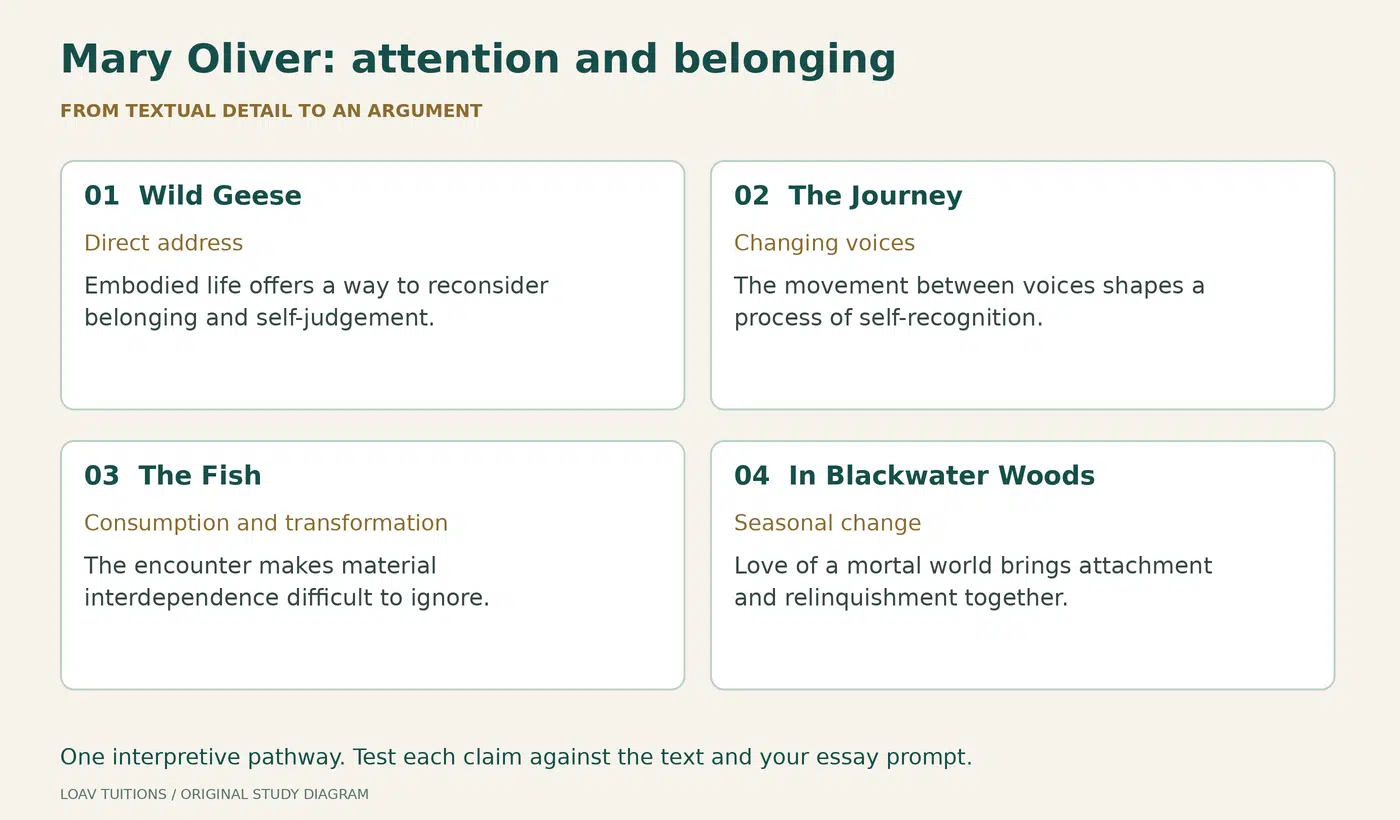
This guide closely considers “Wild Geese” and “The Journey” from Dream Work, and “The Fish” and “In Blackwater Woods” from American Primitive. Broaden revision across the remaining prescribed poems. VCAA advises that “Rage” references sexual abuse and schools may choose to remove it from classroom study. Discuss sensitive material respectfully and follow your teacher’s guidance.
Context without reducing poetry to biography
Oliver’s sustained observation of the natural world, including the landscapes around Provincetown, informs a poetry of encounters: a creature, a plant, an action or a change in weather becomes the occasion for rethinking human life. Her work belongs in conversation with traditions of American nature writing, but identifying that tradition is not an interpretation by itself. Explain what the particular poem does with an encounter. Poetry Foundation biography and critical overview.
Do not turn every speaker into Oliver or every landscape into a coded autobiography. Equally, avoid calling nature automatically peaceful. Bodily vulnerability, death and difficulty complicate the possibility of renewal. A useful guiding question is whether a poem offers escape from human experience or a different way of remaining within it. Often, the most interesting answer is qualified: attention changes the speaker’s relationship to suffering without removing suffering from the world.
Theme Analysis
“Wild Geese”: belonging before perfection
The poem’s address to an unspecified second person makes the invitation intimate without restricting it to a named character. It moves from rejecting punitive self-demand towards a larger world of creaturely life. This change of scale matters: the isolated individual is repositioned within an existence that continues beyond personal distress. Do not read its release from self-punishment as a command to disregard other people. Its language offers recognition and companionship, rather than an argument that actions have no consequences. Published excerpt; Oliver’s own reading.
Oliver explained that the poem began as an exercise demonstrating line endings. That account is a useful reminder that apparent conversational ease is crafted. Compare sentences that settle at a line ending with those that move onward. Describe the specific changes in pacing rather than claiming that all free verse simply represents freedom. Oliver discussing the poem’s construction.
“The Journey”: self-recognition requires departure
The second-person traveller begins moving despite insistent voices and unstable surroundings. External demands initially occupy the soundscape; a recognisable personal voice becomes available through continuing the journey. The poem’s direction is into the world, so independence should not be confused with permanent withdrawal from it. The extended journey metaphor converts an inward decision into movement, resistance and changing perception. A useful comparison with “Wild Geese” is that one poem offers belonging while the other dramatises a necessary separation. Both challenge identities imposed by demands that the individual cannot endlessly satisfy. Poetry Foundation discussion.
“The Fish”: connection includes dependence and death
The catching, killing and eating of a fish makes embodiment central. Human intimacy with nature is not only appreciative looking; it includes consumption. The poem moves from the fish as a separate creature to an account of shared material life. Its repeated attention to pain resists a comfortable version of ecological harmony. Reading the identification as a complete erasure of suffering would flatten the tension. The speaker’s nourishment and the creature’s death belong to the same experience. Poem text; Williams College resource, including Oliver reading.
“In Blackwater Woods”: loving without securing permanence
The opening directs attention towards a transforming landscape. Sensory description gradually becomes a reflection on loss, then an instruction about living. Short lines slow the reader’s movement and distribute weight across ordinary words. The ending sets attachment beside relinquishment: these are difficult companion obligations, not opposites that can be solved by choosing one. Observe also the poem’s acknowledgement that the meaning of loss remains unknowable. Consolation does not depend upon explaining everything. Poem text; published opening excerpt.
From observation to interpretation
A useful annotation sequence is encounter, shift, implication. First identify the concrete situation. Next locate the point where the speaker’s attention, pronouns, imagery or tone changes. Finally explain what that change suggests about living. This keeps the argument anchored in the poem instead of replacing it with general advice about being positive.
Compare poems around a problem. For belonging, ask when connection restores the self and when separation protects it. For nature, distinguish sensory attention from material dependence. For mortality, distinguish recognising limits from surrendering to hopelessness. These distinctions generate paragraphs with internal development. They also prevent a collection essay from becoming four independent summaries joined by the author’s name.
Practice Prompts
- Oliver presents attention to the natural world as a way of confronting difficulty rather than escaping it. Discuss.
- How do the prescribed poems explore the relationship between independence and belonging?
- Oliver’s celebrations of life depend upon an awareness of loss. To what extent do you agree?
- How does Oliver transform ordinary encounters into challenges to the reader’s assumptions?
Full Annotated Essay
Past-paper connection: This original essay responds to a clearly labelled paraphrase of the 2025 VCAA question about overlooking what is important: In Oliver’s poetry, people can fail to recognise what matters. Discuss. Consult the official 2025 examination for the original question. This is an original teaching model, not a reproduced or assessed student essay. BCAS, TEEAEAL and CAS identify functions; they are not VCAA rules.
Introduction
In the prescribed selections from Dream Work and American Primitive, Mary Oliver presents recognition as a demanding activity rather than an automatic consequence of being alive. Her poems suggest that habitual self-judgement and the desire for certainty can obscure what matters, although renewed attention can challenge these habits. Oliver restores value to embodied belonging, distinguishes a personal voice from competing demands, and makes mortality essential to an understanding of love. What people overlook is therefore not simply the beauty around them, but the forms of participation and responsibility that such beauty makes possible.
Body 1 — Embodied belonging
Oliver challenges punitive ideas of worth by making embodied participation, rather than moral perfection, the basis of belonging. Across “Wild Geese” and “The Fish”, creaturely imagery unsettles the separation through which people judge themselves against an imagined superior existence. The “soft animal” in “Wild Geese” grants tenderness to a body that self-condemnation might dismiss as inadequate. Its intimate direct address invites readers to recognise vulnerability as a shared condition. “The Fish” makes that participation more unsettling: catching and eating another creature implicates the speaker in nature’s transformations rather than allowing detached admiration. Together, reassurance and bodily incorporation challenge the fantasy of standing outside life. The directive to “love what it loves” consequently makes bodily inclination worthy of attention. Read alongside the fish’s incorporation into the speaker, this permission implies participation with consequences, not unrestricted gratification. Oliver’s contrasting encounters position readers to value their creaturely existence without imagining it innocent of dependence. What punitive self-judgement overlooks is the meaningful, vulnerable participation already available.
Body 2 — An independent voice
Nevertheless, Oliver complicates belonging by making discernment, rather than unlimited availability to others, essential to recognition. The welcoming address of “Wild Geese” contrasts with the demanding voices in “The Journey”, preventing connection from becoming an unconditional obligation. The latter poem’s traveller gradually recognises a voice as their “own”. By allowing this voice to emerge through movement, Oliver constructs self-knowledge as an achievement of action rather than an original certainty. Where “Wild Geese” loosens the demand to earn acceptance, “The Journey” dramatises the difficulty of refusing demands that erase individuality. Readers must distinguish forms of relationship by their effects. The concluding emphasis on what one can “save” limits achievable responsibility. This narrowing challenges the fantasy of repairing every surrounding life, while the continuing journey resists permanent withdrawal. The poems’ different uses of address therefore make acceptance compatible with boundaries: participation need not entail self-abandonment. People overlook what matters when either self-rejection or indiscriminate obligation prevents them from recognising a sustainable place in the world.
Body 3 — Mortal love
Ultimately, Oliver makes the recognition of mortality necessary to love that does not mistake attachment for possession. “In Blackwater Woods” and “The Fish” both connect beauty with transformation, refusing a comforting division between meaningful life and material loss. The instruction to love what is “mortal” makes vulnerability part of affection’s object. The woodland poem moves from sensory observation to instruction, asking readers to carry the landscape’s impermanence into human relationships. By contrast, the fish’s passage into the speaker’s body renders transformation materially intimate: continued life depends upon another life’s ending. Neither perspective permits nature to remain an untouched decorative refuge. The requirement to “let it go” consequently challenges the assumption that devotion secures permanence. Its plain phrasing makes relinquishment conceptually clear without making it emotionally easy. Set beside the fish’s incorporation, release emerges as an acknowledgement of life’s changing relations rather than a repudiation of care. Oliver exposes the wish to protect love from mortality as a failure to recognise the conditions that make attentive love necessary.
Conclusion
Oliver’s poems present overlooked value as recoverable through difficult changes of attention. Embodied acceptance counters punitive judgement, self-recognition limits impossible obligations, and awareness of mortality reshapes attachment. The poems’ reassurance therefore depends upon a challenge: to notice what matters is to relinquish some comforting assumptions about worth, responsibility and permanence, and to participate more fully in an uncertain world.
Analysis annotations
Structure map: The introduction follows BCAS: background establishes the text’s central tension, the contention gives a qualified answer, the arguments forecast the three body paragraphs, and the summary draws those claims into an authorial perspective. Each body follows TEEAEAL: an idea-led topic sentence and elaboration establish the claim; two evidence-and-analysis movements develop it; the link returns to the prompt. The conclusion follows CAS: it restates the qualified contention, synthesises the arguments and resolves their wider significance. These functions remain within the continuous prose; the labels are teaching tools, not VCAA requirements.
- Cross-evidence synthesis: Each paragraph compares the work of different poems: creaturely participation, discriminating connection and mortal transformation. The second poem changes the interpretation of the first rather than serving as an appended example.
- Progression: “Nevertheless” complicates belonging through necessary separation; “Ultimately” brings both into the larger problem of mortality. The three arguments develop rather than repeat.
- Authorial construction: Metaphor, second-person address and movement from observation to instruction explain how Oliver shapes the reader’s thinking. The essay discusses suggested values without pretending to know private intentions.
- Integrated evidence: Six short fragments sit within grammatical sentences. Each is followed by interpretation; no quotation is left to explain itself.
- Nominalisation: Recognition, separation and relinquishment turn actions into concepts that can be compared. Concrete descriptions of the poems keep these nouns from becoming vague abstraction.
Quote Bank
- Belonging — Evidence 1–2: “soft animal”; “love what it loves”. “Wild Geese”; speaker addresses an unspecified listener. Creature metaphor and directive language challenge punitive self-assessment. Verify wording.
- Independence — Evidence 3–4: “own”; “save”. “The Journey”; speaker describes a second-person traveller’s emerging voice and achievable responsibility. Journey metaphor and narrowing focus frame self-recognition. Poetry Foundation discussion; verify the final verb in your prescribed edition.
- Mortality — Evidence 5–6: “mortal”; “let it go”. “In Blackwater Woods”; speaker turns from landscape to instruction. Imperatives connect attachment with release. Verify wording.
Revision checklist and sources
Check that every example falls within the prescribed sections, and that every claim distinguishes the speaker from the author. Read lineation as carefully as imagery. If an interpretation relies on a change, show what changes and where. A short quotation is useful only when its particular language helps establish the argument. Paraphrased movement, contrast and structure can also be precise textual evidence.
The 2025 VCAA assessment report emphasises answering the actual topic and connecting ideas, rather than offering disconnected poem discussions. Its student examples are not corrected for all factual or language errors. Use them to study analytical function, not as authority for quotations. Our prompts and models are original practice material and carry no guaranteed assessment result.
Evidence notes: The model’s six short fragments are checked against the texts linked in its thematic evidence bank. No page references are asserted. The prose discussions above paraphrase and interpret; poem titles identify works rather than supply evidence. Verify typography and lineation against your approved classroom edition when preparing your own quotation bank.
For help applying this analysis to your own writing, explore Loav’s VCE tutoring or enquire about a trial class.
