
Loav reading room · VCE English · 2026
Hughes makes poetry a place where excluded people can speak, remember and imagine. A strong response explains how that achievement coexists with anger, uncertainty and the repeated postponement of equality.
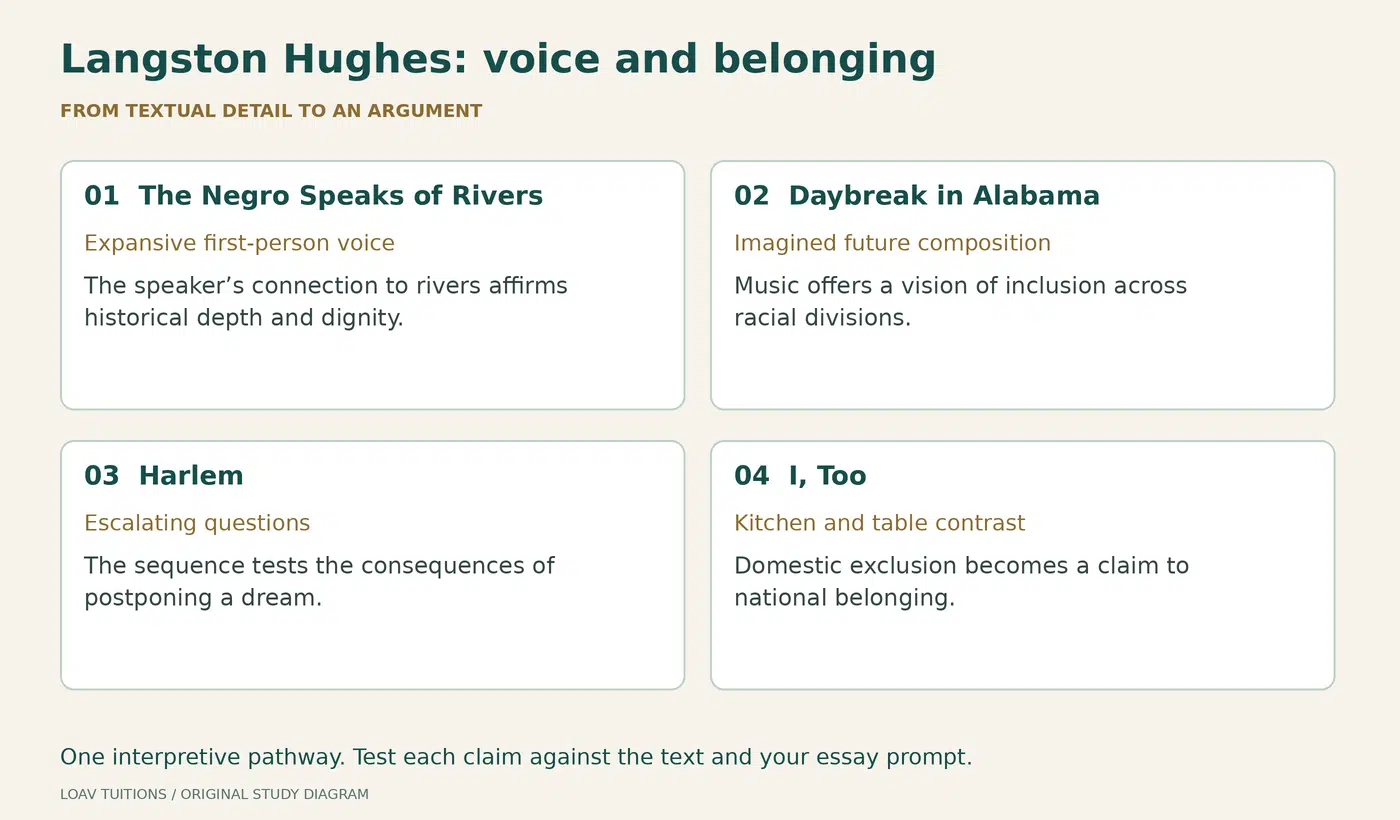
2026 scope: four sections, many poems
VCAA prescribes Selected Poems, introduction by Kayo Chingonyi, Serpent’s Tail, 2020, ISBN 9781788164511. Study all poems in the sections Afro-American fragments, Magnolia Flowers, Montage of a Dream Deferred and Words Like Freedom. These are section headings, not a list of four individual poems. This guide develops examples from all four; it does not replace reading every prescribed poem. Do not build your assessed response around familiar but unprescribed pieces such as “Mother to Son” or “The Weary Blues”. Check your edition’s contents before adding evidence. Official 2026 text list.
Context and a productive central tension
Hughes writes from the histories of slavery, racial segregation and Black cultural creativity in the United States. The Harlem Renaissance matters because artistic representation itself becomes a struggle over who can define American life. Yet the prescribed writing spans more than a single movement or mood. Jazz-inflected urban voices, reflective historical speakers and direct political assertions produce different ways of resisting exclusion. Avoid treating each poetic speaker as an unmediated transcript of Hughes’s own feelings. Ask who speaks, to whom, and with what authority. Poetry Foundation’s contextual introduction.
The useful tension is between belonging as an existing truth and belonging as an unrealised social condition. A speaker may already know their dignity while institutions refuse to recognise it. Consequently, confidence does not demonstrate that injustice has ended. Equally, despair does not prove that imaginative resistance has failed. Essays become more persuasive when they trace how these positions interact rather than dividing the poems into simplistic positive and negative categories.
Theme Analysis
“The Negro Speaks of Rivers”: identity exceeds the present
In Afro-American fragments, the river poem gives its first-person speaker an impossible historical reach across continents and ages. The voice is therefore larger than an individual biography. Repetition, geographically expansive references and flowing syntax create continuity against historical attempts to reduce Black identity to enslavement. The comparison between spiritual depth and rivers presents identity as accumulated experience. Notice that water carries movement as well as endurance: inheritance is not simply a museum object. A qualified argument can recognise both the dignity of this collective identification and the poem’s compression of different histories into a deliberately unified voice. Read the poem.
“Daybreak in Alabama”: imagining another social order
In Magnolia Flowers, the prospective composer imagines music that joins landscape, human bodies and varied colours. The projected future matters: the harmonious society is being composed rather than reported as accomplished. Sensory imagery gives that future physical substance, while the repeated intention to create insists on artistic agency. The hands suggest contact across divisions, making music an imaginative social practice. Rather than merely stating that the poem is hopeful, explain how its future orientation preserves awareness of what the present lacks. The Poetry Foundation’s teaching resource usefully encourages attention to the relationship between earth imagery and human inclusion. Poem; teaching resource.
“Harlem”: delay has consequences
Within Montage of a Dream Deferred, “Harlem” asks what deferred aspiration does to people and communities. Its succession of sensory comparisons makes postponement unpleasantly material. The ending changes the pressure of the question: suppressed energy may become disruptive rather than merely diminished. Analyse the progression, not an isolated device. This is the short poem beginning with a question about a deferred dream; Hughes wrote another poem with the same title, so verify the opening when using online sources. Correct poem text.
Read it within the montage as well as alone. The sequence’s changing speakers and brief scenes resist the fiction that one individual can stand for every Black experience. Connections can emerge through recurring aspirations, sonic patterns and abrupt contrasts. When preparing evidence, choose another prescribed passage from your copy of the sequence and explain how juxtaposition changes the effect of “Harlem”; do not label every short line “jazz” without identifying an audible or structural feature.
“I, Too”: the nation’s household challenged
In Words Like Freedom, domestic space becomes a model of national exclusion. The shift from kitchen to table imagines participation rather than mere proximity. The speaker’s movement between present treatment and future recognition makes the poem both accusation and declaration. Its final assertion changes the relationship between singing about the nation and constituting it. This is an argument about who America already includes, even when its social practices deny that inclusion. Read or hear Hughes’s poem.
Build an argument across poems
Organise paragraphs around claims, not a compulsory one-poem-per-paragraph procession. For a question about hope, distinguish cultural self-recognition, imagined equality and the cost of delay. A paragraph can bring two poems together if the relationship advances its claim. Difference is valuable: declarative confidence and unresolved interrogation need not cancel each other out. They can expose different pressures operating within the same struggle.
Use precise verbs: Hughes enlarges, juxtaposes, interrupts, withholds, personifies or asserts. Follow each verb with an effect on meaning. Naming repetition is only the first step; explain what the repetition sustains or changes. Likewise, distinguish the reader’s experience of a question from a speaker’s statement. A question can refuse easy closure without implying that the poet has no position.
Practice Prompts
- Hughes presents hope as an act of resistance rather than an escape from injustice. Discuss.
- How does Hughes use different poetic voices to challenge exclusion?
- In the prescribed poems, belonging is both inherited and fought for. To what extent do you agree?
- How do rhythm, imagery and structure reveal the consequences of deferred freedom?
Full Annotated Essay
Adapted past-paper approach: The original practice prompt below adapts the concern with overlooked importance in 2025 VCAA Section A, question 11(i), on Mary Oliver, to Hughes: Hughes’s poetry challenges society’s failure to recognise what matters. Discuss. This is explicitly a cross-text adaptation, not a past VCAA Hughes question. The essay is original learning material, not an assessed response. BCAS, TEEAEAL and CAS are flexible teaching scaffolds.
Introduction
Across the prescribed sections of Selected Poems, Langston Hughes explores the disparity between the richness of Black experience and its treatment within an unequal society. His poems challenge failures of recognition by making neglected histories, imagined possibilities and frustrated aspirations central to their accounts of human value. Historical identification establishes dignity beyond prevailing prejudice, artistic imagination presents inclusion as a meaningful alternative, and contrasting accounts of the future expose the consequences of postponing equality. Recognition consequently requires more than acknowledging that suffering exists; it demands a revision of who and what society allows to shape its understanding of itself.
Body 1 — Historical dignity
Hughes challenges the narrowness of racist judgement by giving Black identity a historical scale that exceeds present exclusion. Across “The Negro Speaks of Rivers” and “I, Too”, first-person voices challenge the authority of exclusion to determine collective identity. The former claims a vast historical inheritance, while the latter asserts membership within a nation that withholds equal recognition. In “The Negro Speaks of Rivers”, the assertion “known rivers” presents that relationship as intimate knowledge. Geography becomes an archive of lived connection, suggesting that an identity dismissed by the present is inseparable from the wider human past. The recurring description “grown deep” gives this inheritance an inward dimension. Depth counters superficial judgement: what matters is an accumulated spiritual and historical life that external classifications cannot adequately measure. The expansive movement prevents the confinement of Black identity to a single episode of suffering. The domestic exclusion in “I, Too” sharpens this distinction between imposed status and enduring worth: removal from public view cannot erase membership or dignity. Hughes thus restores historical continuity to the centre of recognition, challenging a society that reduces people to the status it presently assigns them.
Body 2 — Imaginative inclusion
Moreover, Hughes presents imaginative creation as a means of recognising possibilities that unequal social arrangements suppress. Both the musical project in “Daybreak in Alabama” and the anticipated shared table in “I, Too” imagine relationships that existing hierarchies suppress. Artistic creation and domestic participation become ways of making equality perceptible. In “Daybreak in Alabama”, the repeated colloquial intention “gonna” gives the projected work a determined, personal voice. Its future orientation distinguishes the desired harmony from present conditions; the poem does not claim that imagining equality has already achieved it. Nevertheless, the act of composition gives the speaker agency in determining what deserves representation. The image of “kind fingers” then makes inclusion bodily and reciprocal. Human contact joins the poem’s varied colours and natural imagery, suggesting that difference need not prevent intimacy. The reader encounters an alternative order through sensation rather than abstract declaration. The shared meal anticipated in “I, Too” similarly locates equality in ordinary proximity, connecting the musical vision of harmony with the concrete redistribution of social space. Hughes therefore makes artistic imagination a challenge to social limitation, revealing that society can overlook not only existing worth but also unrealised ways of living together.
Body 3 — The costs of delay
Yet Hughes’s recognition of possibility acquires urgency through his contrasting representations of deferred equality. Confidence in a different future does not remove the damage caused by continued exclusion, and the prescribed poems refuse to let hope become a justification for waiting. In “I, Too”, the speaker’s identity as a “darker brother” establishes a shared national household before that household acknowledges his place. The movement from marginalised domestic space towards anticipated participation makes recognition overdue rather than charitable. By contrast, “Harlem” ends its examination of frustrated aspiration with the possibility “explode”. The sudden escalation changes the stakes from diminished private satisfaction to potentially disruptive pressure. Its unresolved question resists a reassuring timetable for justice. Read together, the poems make futurity both an assertion of dignity and a warning about the cost of denial. Society’s failure to recognise what matters therefore carries consequences that confident declarations alone cannot dissolve.
Conclusion
Hughes challenges the restrictions through which society fails to recognise Black life and possibility. Collective history, imaginative inclusion and the scrutiny of deferred aspiration expose the inadequacy of prevailing measures of worth. His poetry ultimately makes recognition an active responsibility: a society must change how it understands its past and shares its future if acknowledgement is to become more than another postponement of equality.
Analysis annotations
Structure map: The introduction follows BCAS: background establishes the text’s central tension, the contention gives a qualified answer, the arguments forecast the three body paragraphs, and the summary draws those claims into an authorial perspective. Each body follows TEEAEAL: an idea-led topic sentence and elaboration establish the claim; two evidence-and-analysis movements develop it; the link returns to the prompt. The conclusion follows CAS: it restates the qualified contention, synthesises the arguments and resolves their wider significance. These functions remain within the continuous prose; the labels are teaching tools, not VCAA requirements.
- Progression: “Moreover” develops historical recognition into creative agency; “Yet” qualifies imagined possibility through the consequences of delay. The paragraphs form an argument rather than four poem summaries.
- Authorial choices: Collective voice, colloquial futurity, bodily imagery and tonal escalation explain how Hughes constructs meaning and positions readers.
- Nominalisation: Identification, inclusion and postponement name processes so the essay can compare them; close references to rivers, hands and domestic space preserve clarity.
- Integrated quotations: The fragments are short because the analysis concerns particular choices. Evidence 5–6 links two poems through a tension rather than treating them as interchangeable proof.
Quote Bank
Six short verified fragments, grouped by theme, with context and analytical uses.
- History — Evidence 1–2: “known rivers”; “grown deep”. “The Negro Speaks of Rivers”, collective first-person speaker. Repeated assertion and depth imagery establish continuity and dignity. Verified text.
- Possibility — Evidence 3–4: “gonna”; “kind fingers”. “Daybreak in Alabama”, prospective composer. Colloquial future tense and tactile imagery construct an inclusive alternative. Verified text.
- Belonging — Evidence 5: “darker brother”. “I, Too”, excluded speaker asserting kinship. Household metaphor challenges segregation. Verified text.
- Delay — Evidence 6: “explode”. “Harlem”, questioning speaker, final possibility. Escalation and interrogative closure expose pressure. Verified text.
Revision and evidence notes
Test the model against the prompt’s concern with recognition and overlooked worth. Check that each paragraph develops a distinct mechanism, rather than repeating that recognition is important. Revise by underlining your interpretive claim, circling the textual method and checking the evidence against the prescribed edition. Remove biography that does not clarify the language. Read the paragraph aloud to catch chains of abstract nouns that obscure a simple point.
VCAA’s assessment guidance foregrounds analysis supported by how language and structure make meaning. Consult its examination materials and reports for official expectations. These practice prompts and models are original learning material, not official questions or a promised score.
Evidence notes: The six fragments in the essay are verified against the primary poem texts linked in the Quote Bank. No page numbers are asserted. Section membership was cross-checked against the published collection contents; the official VCAA edition and scope govern study.
For help applying this analysis to your own writing, explore Loav’s VCE tutoring or enquire about a trial class.
