
Loav reading room · VCE English · 2026
Charlotte Brontë’s novel asks a difficult question: how can a person belong to others without surrendering herself? Jane’s story is a romance, but its most important decisions involve refusing relationships that would make love dependent on obedience. This guide contains spoilers and original practice material.
Course and edition
Jane Eyre appears on the 2026 VCAA English and EAL List 1. The listed edition is Penguin Classics, 2006, ISBN 9780141441146. VCAA permits complete editions; the short quotations below were checked against Project Gutenberg’s complete text. Chapter references are more transferable than page numbers. English and EAL have separate assessment arrangements: follow your teacher’s current requirements.
The journey: five settings, five tests
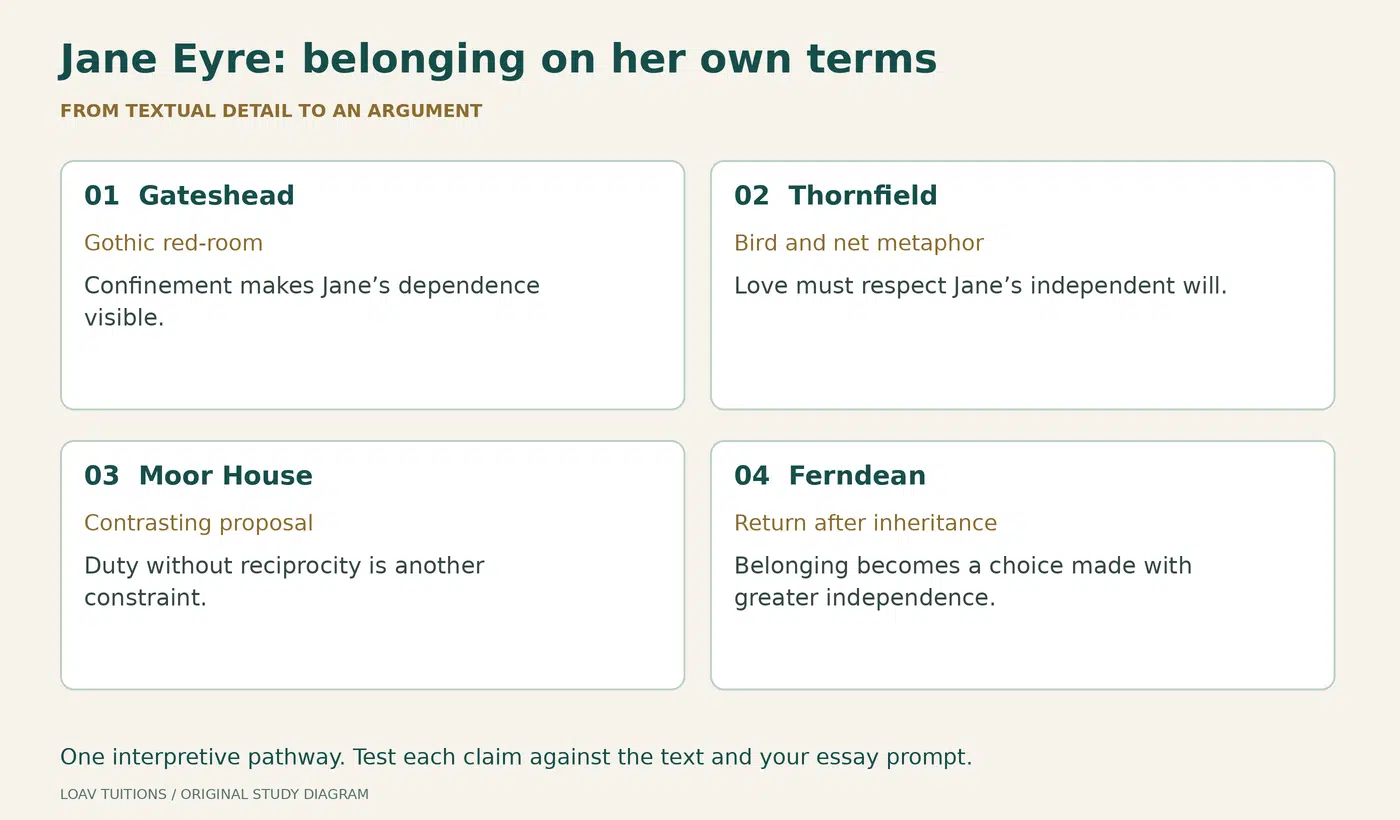
At Gateshead, the orphaned Jane experiences dependence as humiliation. Her punishment in the red-room gives the respectable family home the atmosphere of Gothic imprisonment. Her anger is a response to injustice, although the narrative also investigates how anger can be expressed effectively. Moving to Lowood does not immediately release her: Brocklehurst transforms religious authority into a justification for deprivation. Helen Burns and Miss Temple, however, offer forms of moral education grounded in affection rather than public shame.
At Thornfield, Jane’s work as a governess places her in an uneasy class position. She is educated and indispensable but neither a family member nor a social equal. Her intellectual intimacy with Rochester challenges that hierarchy. The interrupted wedding exposes the limits of intimacy built on concealment: Rochester already has a living wife, Bertha Mason. Jane’s departure makes moral independence materially costly. She risks destitution rather than simply exchanging one comfortable arrangement for another.
At Moor House, rescue becomes kinship when Jane discovers her relationship to the Rivers family. Her inheritance gives independence an economic basis; sharing it gives that independence a social purpose. St John’s proposed missionary marriage offers usefulness without the reciprocal affection Jane needs. Finally, at Ferndean, she returns to Rochester after Bertha’s death and the destruction of Thornfield. The marriage is represented as chosen from a stronger position, although its happiness does not remove every troubling feature of the narrative that produces it.
Characters as competing models of authority
Jane is both the experiencing heroine and the older narrator who orders her experiences. That distinction matters: a frightened child cannot interpret everything, while the adult storyteller controls the reader’s access to the past. Rochester combines emotional responsiveness with manipulation. His willingness to recognise Jane’s mind does not excuse his concealment of Bertha. St John represents another danger: treating a person’s capacities as resources for a supposedly higher mission.
Helen’s patience and Miss Temple’s care challenge Brocklehurst’s punitive religion. Avoid claiming that the novel simply rejects Christianity; Jane repeatedly frames conscience through religious language. Bertha presents a harder interpretive problem. Readers encounter her primarily through Jane and Rochester rather than through her own sustained speech. Her confinement and the racialised descriptions surrounding her invite scrutiny of whose freedom the novel imagines fully. This critical qualification strengthens, rather than cancels, an argument about Jane’s emancipation.
Theme Analysis
Independence requires more than confidence. Jane speaks forcefully before she has money, but poverty restricts what her choices can safely achieve. Compare the early assertion of equality with the later inheritance. Brontë makes independence psychological, ethical and material.
Love must acknowledge another person’s will. Rochester’s passionate offers and St John’s disciplined demands differ in tone, yet both can become coercive. Jane’s refusals create a standard for the marriage she eventually accepts. Do not reduce this to a choice between emotion and reason: her achievement is to insist that both matter.
Institutions can disguise cruelty as virtue. Gateshead’s charity and Lowood’s religious discipline claim moral legitimacy. Their treatment of the vulnerable exposes the gap between reputation and conduct. Set Brocklehurst beside Miss Temple to show that the novel tests authority by its effects.
Belonging is valuable but unevenly distributed. Jane desires affection, work and family. Her return is not a rejection of independence. Yet Bertha’s silenced experience complicates any claim that the ending establishes universal justice.
How the novel constructs meaning
The autobiographical first-person form makes private suffering publicly intelligible. Direct addresses to the reader create intimacy and invite judgment. Gothic disturbances at Thornfield give physical form to concealed histories; the eventual explanation does not make the earlier fear meaningless. The sequence of houses turns geographical movement into a series of ethical experiments. Repeated images of enclosure, flight, fire and cold connect external settings to arguments about restraint and desire. Analyse a specific image in its scene before extending it across the novel.
Quote Bank
Each quotation is paired with its speaker or narrator, location, immediate circumstances and analytical use. The same evidence is developed in the full essay; chapter and act–scene references avoid edition-dependent page numbers.
- “I am no bird; and no net ensnares me”: Jane to Rochester, Chapter 23, during the orchard confrontation before his proposal. Answering his comparison of her to a frantic bird, she rejects both restraint and his authority to define her as a dependent creature.
- “I care for myself. … the more I will respect myself”: Jane’s inward reply to the temptation to stay with Rochester, Chapter 27, after the interrupted wedding reveals his existing marriage. The ellipsis omits her list of isolation and deprivation; self-respect grows more necessary precisely when she lacks protection.
- “you are formed for labour, not for love”: St John to Jane, Chapter 34, as he demands that she become his missionary wife. The antithesis makes her usefulness seem incompatible with her emotional needs, presenting his preferred role as her natural purpose.
- “a man who regarded one but as a useful tool”: Jane to Diana, Chapter 35, explaining why she cannot accept St John’s proposed marriage. The instrumental metaphor makes the ethical cost of lifelong service explicit: a wife would be valued as a means to his mission.
- “No, sir! I am an independent woman now”: Jane to Rochester at Ferndean, Chapter 37. He asks whether she is still a destitute outcast; she immediately explains her inheritance. The temporal emphasis connects changed material circumstances with freedom of choice.
- “Reader, I married him. A quiet wedding we had”: Jane as retrospective narrator, Chapter 38, announcing their private wedding. First-person agency and direct address make her the author of both the decision and its telling; the quiet ceremony contrasts with Thornfield’s interrupted wedding.
Practice Prompts
- In Jane Eyre, belonging is only valuable when it preserves independence. Discuss.
- How does Brontë expose the difference between moral authority and social power?
- Jane’s strongest decisions arise from conflict between feeling and principle. To what extent do you agree?
- Does the ending resolve the novel’s concerns about inequality?
Full Annotated Essay
Past-exam basis: This model answers an adaptation of the 2025 VCAA question about whether the pursuit of personal freedom is the novel’s principal concern. The original includes Jane’s bird-and-net declaration. Read the official 2025 examination. Adapted practice wording: To what extent is the pursuit of personal freedom the central concern of Jane Eyre?
The following complete original essay uses BCAS, three TEEAEAL paragraphs and CAS. These are teaching scaffolds, not VCAA requirements. The separate annotations explain these functions without interrupting the essay’s prose.
Introduction
Charlotte Brontë’s Jane Eyre follows an orphan whose search for a sustaining home repeatedly exposes the unequal conditions on which belonging is offered. Personal freedom is central to this journey, but Brontë defines it as the capacity to enter relationships without surrendering conscience or identity, rather than as permanent separation from others. The novel first establishes freedom through resistance to romantic possession, then extends that resistance to the coercive use of religious duty, before making material independence the basis of chosen attachment. Brontë thus unites self-government with the possibility of reciprocal love.
Body 1: freedom from possession
Brontë presents the refusal of possession as the first condition of meaningful personal freedom. Across Gateshead and Thornfield, Brontë exposes households that offer protection while reserving the power to define a dependent person’s worth. The Reeds enforce exclusion through rank, while Rochester’s romantic generosity can also become a claim to ownership. In the orchard confrontation, Jane declares, “I am no bird; and no net ensnares me”, rejecting Rochester’s image of her as a struggling bird. The negative statement refuses both physical restraint and the assumptions of weakness attached to that comparison. Brontë gives the socially subordinate speaker the language with which to redefine their relationship, so freedom begins as a claim that existing hierarchies cannot adequately recognise. After the failed wedding, Jane’s inward resolution, “I care for myself. … the more I will respect myself”, makes that claim consequential. The repeated first-person emphasis places responsibility within her when affection and security pull in another direction. Her recognition of solitude and lack of support makes vulnerability a reason for greater self-respect rather than submission. The anguish of departure demonstrates the cost of refusing to let love excuse self-abandonment. Bertha’s confinement exposes a more brutal denial of autonomy within the same household; the contrast prevents Rochester’s affection from functioning as sufficient evidence of freedom. Freedom consequently becomes an ethical practice, established through difficult choices rather than simply asserted in defiant speech.
Body 2: freedom from prescribed duty
Brontë further defends personal freedom by exposing the coercion possible within apparently virtuous service. The contrast between Brocklehurst’s punitive public religion, Helen’s compassionate faith and St John’s demanding missionary purpose prevents religious commitment itself from becoming the target. Brontë instead questions the appropriation of moral authority to control another person’s life. Demanding a missionary marriage, St John tells Jane, “you are formed for labour, not for love”, making her emotional capacities irrelevant to the role he assigns. The antithesis separates service from affection as though the exclusion were natural rather than his own interpretation. His religious authority intensifies this pressure by presenting a personal demand as a higher obligation. Explaining her refusal to Diana, Jane imagines marriage to “a man who regarded one but as a useful tool”. This metaphor strips the proposed marriage of reciprocity: an instrument is valued for what it accomplishes, not for an independent will. Her objection challenges goodness purchased through self-erasure. Read beside Helen’s generosity and Brocklehurst’s hypocrisy, the proposal reveals why claims to moral authority must be tested by their treatment of vulnerable people. Brontë makes the freedom to refuse an admirable purpose essential when its terms deny full humanity.
Body 3: freedom for chosen attachment
Nevertheless, Brontë’s conclusion presents freedom as enabling connection rather than requiring isolation. Jane’s inheritance changes the practical conditions of her return, while sharing it with her cousins shows that independence need not mean exclusive self-interest. Economic security makes her capable of giving without depending on romantic rescue. At Ferndean, Jane answers Rochester’s fear that she remains an outcast: “No, sir! I am an independent woman now”. Independence is now more than an inward conviction: she possesses resources that make departure possible even as she chooses to remain. The return therefore revises the earlier imbalance rather than merely reinstating it. The final chapter opens, “Reader, I married him. A quiet wedding we had”, giving Jane grammatical control over the marriage statement. Direct address also reminds readers that she controls the telling of her history, while the quiet ceremony replaces the earlier public interruption with a mutually chosen union. Although Bertha’s silenced experience complicates any universal claim of liberation, Jane’s own narrative culminates in an attachment represented as her decision. Freedom remains central because it changes what belonging can mean.
Conclusion
Brontë therefore makes personal freedom the organising condition of Jane’s fulfilment, rather than its sole emotional destination. Resistance to possession, refusal of instrumental duty and the acquisition of material independence progressively establish her authority over her life. The final relationship matters because freedom allows Jane to choose affection without disappearing inside another person’s design.
Analysis annotations
Structure map: The introduction follows BCAS: background establishes the text’s central tension, the contention gives a qualified answer, the arguments forecast the three body paragraphs, and the summary draws those claims into an authorial perspective. Each body follows TEEAEAL: an idea-led topic sentence and elaboration establish the claim; two evidence-and-analysis movements develop it; the link returns to the prompt. The conclusion follows CAS: it restates the qualified contention, synthesises the arguments and resolves their wider significance. These functions remain within the continuous prose; the labels are teaching tools, not VCAA requirements.
Transitions should name a logical movement, not merely announce another paragraph. Nominalisations such as refusal, possession and reconstruction help track concepts, but keep the author and textual action clear.
- Introduction: The qualification distinguishes freedom from isolation and signposts the three arguments in their eventual order.
- Body 1: The idea-led topic sentence names Brontë’s construction, and the second example tests whether the earlier declaration survives real cost.
- Body 2: The contrasting forms of faith represented by Brocklehurst, Helen and St John distinguish compassionate service from instrumental duty. Antithesis and metaphor substantiate that authorial judgment.
- Body 3: Material circumstances and narrative grammar connect the ending to freedom. The Bertha qualification limits the claim without abandoning the prompt.
- Conclusion: The final sentence resolves the distinction introduced at the start: freedom makes chosen affection possible.
Sources and quotation checks
- VCAA 2026 text list: prescribed status and nominated edition.
- Complete primary text, Project Gutenberg: body 1 quotations, Chapters 23 and 27; body 2, Chapters 34 and 35; body 3, Chapters 37 and 38. No page numbers are implied.
- VCAA English examinations and reports: official assessment resources.
- Learning Hive text-response guide: supplementary discussion of prompt-responsive analysis; models here are original Loav teaching examples.
For help applying this analysis to your own writing, explore Loav’s VCE tutoring or enquire about a trial class.
