
Loav reading room · VCE English · 2026
Stephen Johnson’s film makes the ability to see from above a troubling metaphor for the ability to dominate. A strong response asks whether commanding a landscape can ever confer moral authority over its people.
2026 scope and starting point
The prescribed work is Stephen Johnson’s High Ground (2020), a List 1 film in the 2026 VCE English and EAL text list. Its Australian cinema release was in 2021; use the prescribed 2020 date when identifying it. It is not another film with the same title. The film contains confronting racial and physical violence. This guide discusses that violence without reproducing it graphically.
Set in Arnhem Land after World War I, the narrative connects the survivor Gutjuk with Travis, a former soldier implicated in the policing operation that destroyed Gutjuk’s family. Their later journey to find Baywara brings competing versions of justice into contact. The film’s question is larger than whether these two men can trust each other: can individual decency repair harm maintained by institutions, unequal power and official stories?
Theme Analysis
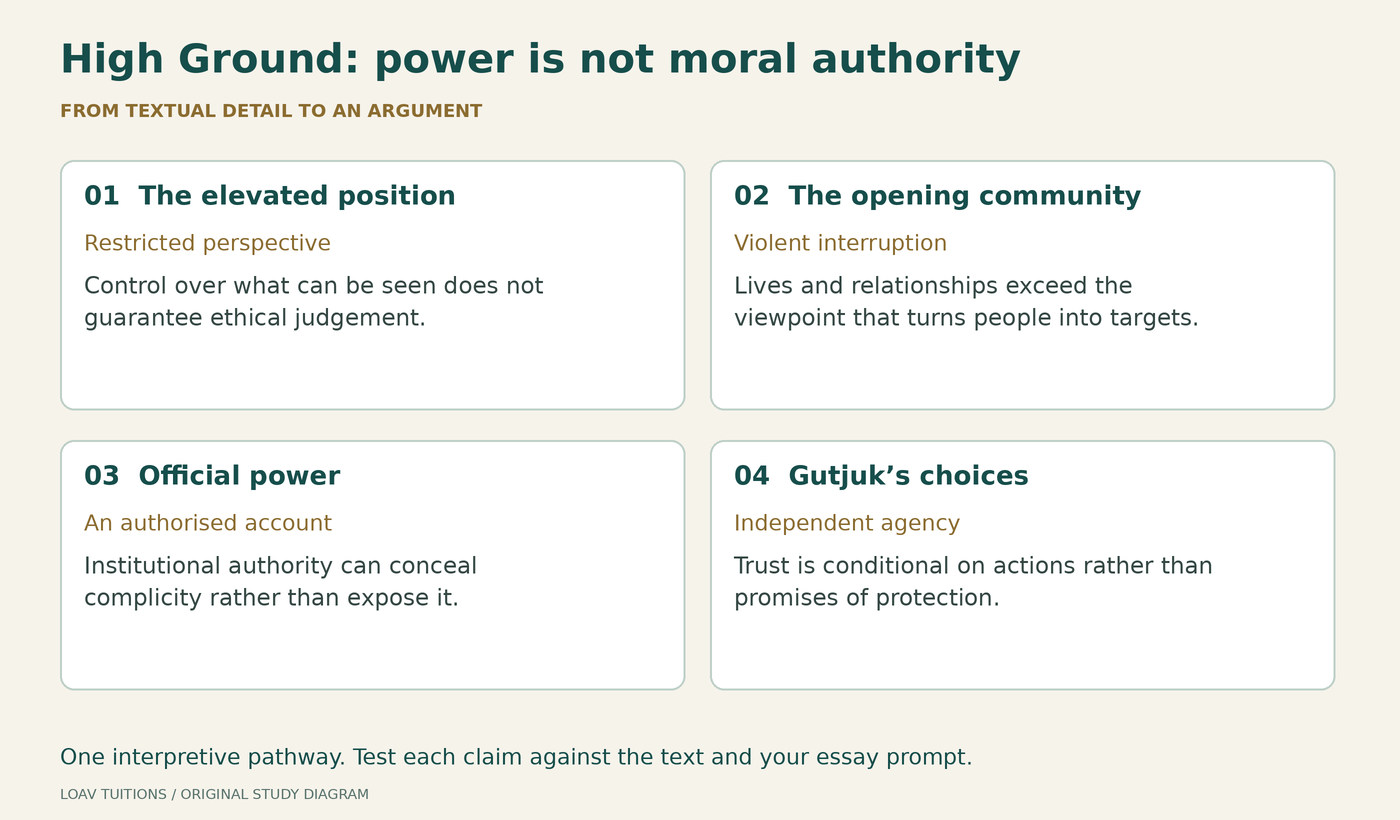
Power and moral authority. The elevated position associated with Travis’s marksmanship offers visual mastery but no guarantee of ethical understanding. Looking down can make other people visible as targets while making their experiences harder to recognise. Read the title as an unresolved tension between tactical superiority and the moral high ground. Do not assume these meanings coincide.
Truth and complicity. Travis is disturbed by the massacre, but distress is different from preventing violence or establishing accountability. His position permits a qualified argument: he can resist the colonial order while remaining shaped by it. Moran’s institutional authority matters because official power can make its account of an event seem more legitimate than the testimony of those harmed. The film therefore asks who has the means to turn an account into accepted history.
Identity and responsibility. Gutjuk’s relationships cannot be reduced to a simple choice between two interchangeable cultures. His family connections and knowledge of Country have survived a violent intervention. His relationship with Travis is also affected by need, unequal information and the possibility of care. Consider moments when Gutjuk observes, interprets or acts independently; these prevent an essay from presenting him merely as the instrument of Travis’s redemption.
Justice and retaliation. Baywara’s violence is situated within an earlier massacre. That causal relationship explains anger without obliging the viewer to approve every action arising from it. Distinguish recognition of colonial injustice from a claim that retaliatory violence inevitably restores justice. Likewise, avoid describing everyone as equally responsible: the film establishes an unequal historical and institutional situation.
Form: how to write about a film
The opening’s movement from community life into armed violence is an essential structural choice. Johnson first makes a lived world available to the viewer, then exposes its vulnerability. The contrast means the massacre cannot responsibly be described as a self-contained action sequence. Discuss how the sequence changes what viewers understand the landscape to contain: relationships and livelihoods, rather than an empty frontier.
Wide landscape framing and the shooter’s restricted field of vision invite different kinds of looking. The former can place human conflict within a world exceeding the characters’ claims; the latter can reduce that world to surveillance and targets. Avoid the automatic formula that a wide shot always means freedom. Ask who is looking, what becomes visible, and what knowledge the position excludes.
Editing is an argument about relationships. When a scene moves between an observer and someone being observed, the cut can establish vulnerability and unequal access to information. In your own viewing notes, identify the exact cut before assigning an effect. Sound likewise deserves specific attention: contrast ordinary environmental sound, dialogue and gunfire where they occur. Do not label every silence peaceful or every musical cue ominous. Describe what is audible and how the change reorganises attention.
Performance provides evidence without quotation. Compare the restraint of an exchange with an overt threat, or the distance between characters with an apparent moment of trust. Gesture, posture and placement can qualify dialogue. A character may speak the language of order while the armed bodies around him reveal coercion. Use cinematography, editing, sound and performance together when they support the same interpretation, rather than listing four techniques.
Quote Bank
Six short, verified quotation fragments are embedded in the full essay below. Each fragment is linked to its use in the essay. The notes identify context and analytical use; always read the surrounding passage as well.
- “king” — Evidence 1: Moran, badge explanation. Symbolic costume and imperial authority. The first fragment locates official power in the Crown, making its claims to legitimacy visible.
- “officer” — Evidence 2: Moran, negotiation. Institutional self-description. The second fragment narrows personal accountability even as official power remains extensive.
- “high ground” — Evidence 3: Travis, tactical lesson. Spatial metaphor. The third fragment separates elevated position from ethical authority.
- “control everything” — Evidence 4: Travis, tactical lesson. Absolute language. The fourth fragment suggests the temptation and limits of domination.
- “balance” — Evidence 5: Negotiation, translated law. Relational language. The fifth fragment names a standard beyond capture and punishment.
- “our justice” — Evidence 6: Gutjuk, demand for redress. Plural possessive. The sixth fragment insists that his community’s injuries enter the discussion.
Practice Prompts
- In High Ground, control is repeatedly mistaken for moral authority. Discuss.
- How does Johnson explore the difficulty of breaking inherited cycles of violence?
- Trust in High Ground requires more than good intentions. To what extent do you agree?
- How does the film’s representation of Country challenge colonial claims to ownership?
These are original practice prompts, not VCAA questions or predictions. Underline the proposition and its qualifying words before choosing evidence. For prompt one, an essay about power alone is incomplete: each paragraph needs to address the mistake that confuses power with legitimacy.
Full Annotated Essay
Prompt: To what extent does the film present revenge as justice?
Based on the verified 2025 VCAA English examination, Section A, Question 8(ii). The question is paraphrased here; consult the official paper for its exact wording.
This complete original model uses BCAS, three TEEAEAL body paragraphs and CAS. These are optional learning scaffolds, not VCAA rules. The separate annotations explain the construction; the essay itself uses continuous prose.
Introduction
Stephen Johnson’s High Ground places retaliatory violence within the continuing consequences of a massacre in colonial Arnhem Land. Although revenge becomes understandable when official justice protects its own perpetrators, the film ultimately questions whether retaliation can produce the recognition and accountability that justice requires. Colonial authority makes lawful redress unequal, the pursuit of control reproduces the logic of domination, and demands for reciprocal accountability offer a more substantial ethical alternative. Johnson therefore distinguishes acknowledging the legitimacy of grievance from endorsing every action undertaken in its name.
Body 1
Johnson exposes the inequality of official justice to explain why revenge acquires an apparent moral legitimacy. When the authority judging violence is also implicated in its origins, obedience cannot automatically be equated with fairness. The later negotiation must be understood against the opening massacre, which gives the audience knowledge that official reassurance cannot erase. Moran grounds his authority in the “king”, using the badge as a visible sign of distant imperial power. The costume detail converts political hierarchy into an apparently self-evident entitlement to judge. Yet its placement within a confrontation over Country reveals a competing authority that the uniform cannot simply invalidate. Moran subsequently describes himself as an “officer” when confronted with the demand for accountability. This narrowing of responsibility is revealing: institutional membership authorises command but becomes a limitation when redress is requested. By making command and evasion audible within the same exchange, Johnson positions viewers to question the institution’s self-description as impartial. The contrast exposes an imbalance between the ability to impose consequences and the willingness to answer for them. Revenge consequently appears intelligible as a response to denied justice, although this explanation does not settle whether retaliation can become just.
Body 2
Johnson nevertheless challenges revenge when it reproduces the assumption that superior force confers moral authority. The film’s tactical language makes domination appear comprehensible and achievable, but its visual organisation continually places that confidence beside vulnerable lives. Travis’s lesson associates advantage with the “high ground”. The spatial metaphor supplies a literal method of controlling an encounter while raising the separate question of ethical superiority. Expansive landscape framing complicates the rifleman’s instrumental perspective: Country contains relationships and histories that cannot be reduced to a useful position. The accompanying promise that one can “control everything” makes the temptation more absolute. The totalising claim suggests why violence can appear to offer resolution to people whose lives have been determined by others. However, the opening’s movement from community life into gunfire has already exposed what such control can destroy. Johnson’s sequencing asks viewers to judge the later pursuit by a standard broader than whether it reverses who holds the weapon. A changed distribution of force does not necessarily produce a changed ethics. Revenge falls short of justice when its desired outcome is mastery rather than a transformed relationship.
Body 3
Through the negotiation sequence, Johnson presents reciprocal accountability as a more demanding alternative to unilateral punishment. The scene allows competing conceptions of authority to become audible rather than reducing the conflict to an exchange of threats. Gutjuk’s role in translation also makes him an active participant in defining what redress would require. The appeal to “balance” introduces a standard different from the mere capture of Baywara. Its relational meaning directs attention towards an order damaged by the original violence. The demand does not require viewers to imagine that every party has suffered identically; it requires the initiating harm to remain part of the judgement. Gutjuk’s insistence on “our justice” refuses an arrangement in which only one community’s injuries matter. The plural possessive asserts standing within the discussion, challenging the assumption that colonial authority alone may define legitimate grievance. By staging the demand as an answer to the institution’s own claim of fairness, Johnson makes reciprocity a test the audience can apply to official language. The ethical possibility remains precarious because the conversation does not redistribute coercive power. Johnson locates justice in recognition and accountability, exposing the insufficiency of revenge without dismissing the suffering that produces it.
Conclusion
Ultimately, High Ground makes revenge understandable but insufficient as a form of justice. Unequal law creates its appeal, the desire for control limits its moral claims, and reciprocal accountability establishes a more substantial standard. The film’s difficult implication is that condemning retaliation without confronting original and continuing injustice merely preserves the conditions in which revenge becomes imaginable.
Use the model without memorising it
Plan a response to one of the original practice prompts before rereading the essay. Decide which of its arguments remain relevant and which need to change. A strong response is shaped by the question, not by a prepared sequence of quotations. For each selected example, record its context, a formal choice and the inference that connects it to your contention.
The 2025 VCAA report stresses the need to address relationships and qualifiers in the topic. Keep more than one part of the text in view, use evidence analytically, and make the conclusion resolve the argument. Check quotation wording against your prescribed text or licensed film. These models illustrate a defensible reading rather than an official assessment, a guaranteed mark or the only acceptable interpretation.
Sources and evidence notes
The negotiation fragments are checked against this public dialogue transcription; confirm speaker attribution and subtitle punctuation in the licensed film used in class. The tactical lesson is independently corroborated by the review below.
- Distributor production record: director, year and release details.
- Cinephilia review: corroboration of the tactical lesson and film context.
- 2025 VCAA English assessment report: official assessment reference; the model here is independently written.
Evidence notes: The tactical lesson is corroborated in the linked review. Confirm punctuation against the licensed film/subtitles used in class.
For help applying this analysis to your own writing, explore Loav’s VCE tutoring or enquire about a trial class.
