
Loav reading room · VCE English · 2026
2026 List 1 novel: Sarah Moss, Ghost Wall, Granta Books, 2021, ISBN 9781783787852. This guide discusses family violence and contains spoilers. Interpretations, practice topics and model writing are original teaching material.
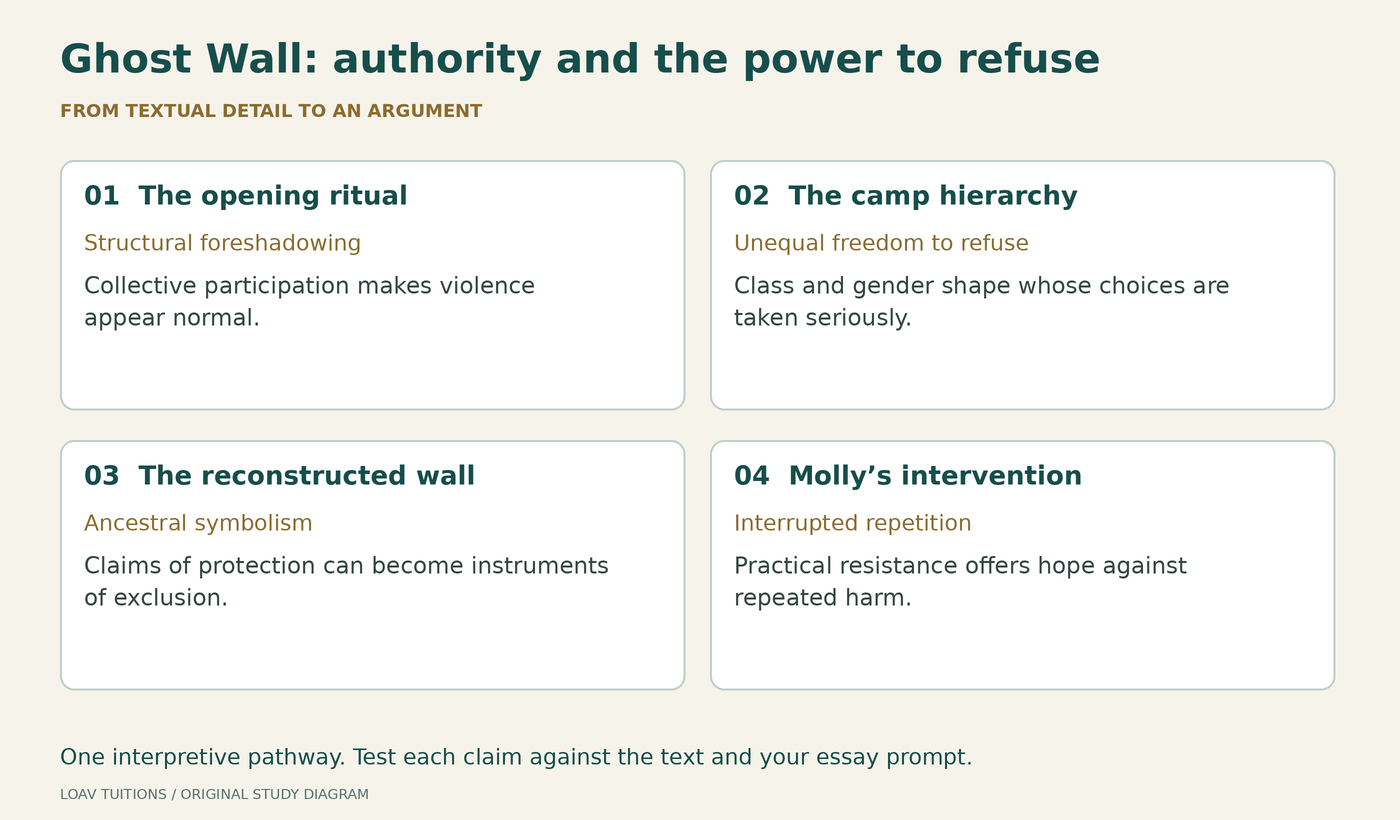
The past as a present danger
Seventeen-year-old Silvie accompanies her parents on an archaeological re-enactment in Northumberland. Her father Bill’s enthusiasm for ancient life joins the authority of an academic expedition, but the apparent escape from modernity becomes a setting in which existing inequalities intensify. Silvie’s encounter with university student Molly offers an alternative to the restrictions she has learned to anticipate. The camp’s reconstruction of ritual moves towards an assault on Silvie, interrupted when outside help arrives.
The central question is not whether ancient people were violent. Moss asks how modern people select stories about the past to legitimise present conduct. Bill’s investment in hardship, obedience and an imagined national inheritance is therefore part of the novel’s immediate power struggle. Historical knowledge can enrich an understanding of place; it becomes dangerous when it is turned into a licence to control other people.
A character map built around power
Silvie is both knowledgeable and vulnerable. Her practical understanding of the landscape complicates any suggestion that she is simply ignorant or passive. The first-person narration gives readers access to judgements she cannot always safely express aloud. Distinguish her constrained behaviour from her inner capacities: silence under threat is not proof of consent.
Bill turns personal authority into an apparently historical obligation. His commitment to authenticity is selective, particularly when discomfort or submission falls on the women around him. Analyse the relationship between ideology and action rather than reducing him to a label such as evil. The novel asks how an abusive position acquires reinforcement from a wider group.
Alison, Silvie’s mother, reveals the costs of long-term intimidation. Her efforts to manage daily demands show how coercion reorganises ordinary behaviour. Avoid blaming her with the same certainty you apply to the abuser. A useful response considers what her accommodation achieves in the immediate moment and what it cannot prevent.
The Professor supplies intellectual legitimacy and institutional standing. His participation complicates a simple opposition between education and brutality. Expertise does not automatically produce ethical judgement. Molly offers practical resistance and a different model of female agency, recognising that an activity presented as a game or experiment can cause real harm.
Form and method: where the argument lives
The opening ritual. Before the main first-person narrative, an unnamed female victim is exposed to collective violence. The scene creates a pattern through which readers apprehend later events. Its significance is structural as well as atmospheric: the apparent distance between ancient ritual and modern recreation becomes unstable. Do not identify the opening victim as Silvie or claim that the sequence establishes an exact historical event.
Silvie’s perspective. Her account places intimate knowledge beside limited freedom. Readers can notice dangers that she has learned to normalise, producing a gap between habitual acceptance and external judgement. The narrative does not require Silvie to possess a complete explanation of abuse before her experience can matter. Her attention to food, bodies and practical tasks makes power tangible.
The landscape. Northumberland is more than an ominous backdrop. It is a source of pleasure, knowledge, nourishment and competing claims to belonging. Bill’s possessive account of inheritance should not be confused with the novel’s full representation of place. Silvie’s observations can support a less coercive connection to the environment, grounded in attention rather than exclusion.
The wall and the ritual. The reconstructed barrier promises protection by invoking ancestral presence. It also concentrates the group’s fear of outsiders and its desire for collective identity. Analyse what the participants imagine the wall can defend, and whose safety is sacrificed in that imagination. Its symbolic force develops through what people do around it, not simply because a wall conventionally means division.
Theme Analysis
Tradition versus accountability. A practice’s age does not settle its legitimacy. Moss exposes the danger of replacing judgement with imitation. However, the target is not all interest in history. The more precise distinction is between investigating the past and using a preferred version of it to close down present objections.
Class and the freedom to choose. University students can treat aspects of the experience as temporary, while Silvie’s obligations are bound to family authority. The same activity therefore means different things to different participants. Ask who can leave, refuse, eat differently or imagine another future. A claim about universal freedom becomes unconvincing when it ignores those unequal options.
Gender and collective complicity. The novel links private domination with public endorsement. Bill’s violence is crucial, but the group’s deference and participation allow his preferences to become more dangerous. This creates room for an argument about bystanders without erasing the primary perpetrator’s responsibility.
Hope through intervention. The ending interrupts the developing pattern of sacrifice. It does not demonstrate that the effects of violence have instantly disappeared. Hope is practical and relational: someone recognises harm, contests its normalisation and brings help. This is stronger than a vague conclusion that friendship solves everything.
Quote Bank by Theme
Ten substantive, source-checked passages. Scene descriptions locate each passage; page numbers vary between editions. Quotations are continuous extracts, with no silent internal omissions. The six entries marked Essay are embedded in the model response.
Tradition and collective responsibility
“No need to be rough, everyone knows what is coming.” Essay
Voice: External third-person prologue narrator. Context: The community leads the unnamed woman to ritual killing.
Authorial method and use: The chilling causal juxtaposition makes familiar procedure conceal coercion; apparent order intensifies the horror.“You lead her, Bill, said the Professor, after all I suppose she’s your sacrifice.”
Voice: Professor Slade, speech reported by Silvie. Context: Bill leads his bound daughter towards the reconstructed ritual.
Authorial method and use: The possessive pronoun endorses paternal ownership; academic authority collaborates with domestic abuse.
Power, bodily autonomy and complicity
“Dad didn’t want privacy, he wanted to be able to see what I was up to.” Essay
Voice: Silvie, first-person narrator. Context: Her request to sleep apart from her parents is refused.
Authorial method and use: The corrective syntax exposes surveillance beneath Bill’s appeal to authentic communal living.“Because I was the scapegoat, the sacrifice, the thing Dad wanted to keep.”
Voice: Silvie, first-person narrator. Context: Silvie understands why she, rather than Molly, is selected for the ritual.
Authorial method and use: The accumulating nouns culminate in objectification; possession and supposed protection become inseparable from violence.“I can’t ask Molly, she’s a student and frankly her marks aren’t great” Essay
Voice: Professor Slade, speech reported by Silvie. Context: The Professor explains why he avoids making his student the sacrificial victim.
Authorial method and use: His concern about academic coercion exposes selective ethical recognition: Silvie receives less protection precisely because she lacks institutional standing.
Belonging, knowledge and internalised fear
“You can imagine how a person might learn a landscape with her feet.”
Voice: Silvie, first-person narrator. Context: Walking in moccasins alters Silvie’s physical perception of the terrain.
Authorial method and use: Embodied knowledge offers an alternative to nationalist possession: historical curiosity can deepen attention without requiring domination.“Haven’t you been listening, people don’t bother to hurt what they don’t love.” Essay
Voice: Silvie’s unspoken first-person reflection, not dialogue spoken to Molly. Context: Molly recognises bruises; Silvie mentally rationalises paternal violence through sacrifice.
Authorial method and use: The rhetorical question reveals learned coercive logic; readers are positioned to reject the equivalence of love and injury.
Intervention, care and freedom
“Your dad’s not God, she said, he can’t do anything he likes to you.” Essay
Voice: Molly, speech reported by Silvie. Context: Molly challenges Silvie’s conviction that refusal is impossible.
Authorial method and use: The colloquial denial dismantles the sacred or absolute status that paternal authority has acquired.“It’s over, Silvie, said Molly, we’re looking after you now.” Essay
Voice: Molly, speech reported by Silvie. Context: After police arrive, Molly and Trudi untie and lead Silvie away.
Authorial method and use: The change to a caring collective reverses the ritual community, though Silvie’s continuing anxiety prevents a simplistic claim of instant recovery.“But there is something wrong. It’s not OK for someone to hit you.”
Voice: Molly, speech reported by Silvie. Context: Molly responds when Silvie denies that the bruises matter.
Authorial method and use: Direct declaratives counter the normalisation of abuse without demanding that the victim first supply a complete account.
Practice Prompts
- In Ghost Wall, the greatest danger comes from treating cruelty as normal. Discuss.
- How does Moss challenge the use of the past to justify power in the present?
- Silvie’s knowledge is a source of strength, but not a guarantee of freedom. To what extent do you agree?
- How does Ghost Wall explore the responsibility of those who witness violence?
Full Annotated Essay: the glorification of the past
Past VCAA topic, 2025, Question 6: Evaluate the proposition that Ghost Wall warns against idealising the past. This is a paraphrase of the official topic. Read the official paper.
This complete original essay uses BCAS, three TEEAEAL paragraphs and CAS as teaching scaffolds, not VCAA requirements. The separate annotations explain the structure of the fluent response below.
Introduction
In Sarah Moss’s Ghost Wall, an archaeological re-enactment brings an imagined ancient order into contact with the inequalities of a modern family. The novel warns that glorifying the past becomes dangerous when admiration displaces ethical judgement, although it distinguishes this misuse from a thoughtful engagement with history and place. Historical idealisation makes cruelty appear inevitable, grants present domination an apparently inherited legitimacy, and suppresses the responsibility to intervene. Through the contrast between ritual repetition and its eventual interruption, Moss suggests that knowledge of the past must remain answerable to the needs of living people.
Body 1
Moss exposes the danger of idealising the past by showing how shared procedure can displace ethical judgement. When an inherited pattern is treated as sufficient justification, familiarity with cruelty becomes a reason to repeat it rather than a warning to stop. The external narrator introduces the ancient victim’s procession with “No need to be rough, everyone knows what is coming.” The apparent reassurance makes collective knowledge more disturbing: force need not be ostentatious when the community already accepts its outcome. By placing this scene before Silvie’s narration, Moss supplies a pattern against which readers can test modern claims to harmless reconstruction. Later, Slade explains his choice of Silvie by admitting “I can’t ask Molly, she’s a student and frankly her marks aren’t great”. His recognition that a student could be pressured exposes the ethical selectivity of the experiment. He safeguards his professional position while accepting a father’s permission as a substitute for Silvie’s consent. The modern episode therefore intensifies rather than merely repeats the prologue: educated participants possess a language of responsibility but apply it only where they may face consequences. Moss challenges the reader to distinguish historical investigation from the institutional endorsement of harm. Idealisation becomes dangerous when ritual authenticity and professional self-protection take priority over the person made to embody the past.
Body 2
Furthermore, Moss reveals that nostalgic authority works by turning possession into an apparent form of love and protection. Bill’s version of ancient life consolidates restrictions already operating within his family, while Silvie’s inner voice reveals both critical intelligence and the damage inflicted by dependence. After her request for a separate sleeping place is rejected, Silvie recognises that “Dad didn’t want privacy, he wanted to be able to see what I was up to.” The corrective syntax strips communal authenticity of its idealised explanation and exposes surveillance. Silvie can identify coercion even when she cannot safely resist it; her narration prevents readers from mistaking obedience for intellectual passivity. Yet when Molly notices her injuries, Silvie’s unspoken reasoning insists, “Haven’t you been listening, people don’t bother to hurt what they don’t love.” The rhetorical question shows the abusive explanation working inside the victim’s own judgement. Its fusion of attachment and injury makes the proposed sacrifice an escalation of domestic logic, not an isolated historical game. Molly’s objections and the Professor’s endorsement place contrasting social responses around Silvie: other people can either disturb or reinforce the meaning Bill assigns to suffering. Moss’s first-person perspective asks readers to recognise this contradiction without blaming Silvie for the habits that fear has taught her. The novel consequently locates the danger of glorification in the present relations of power that selected stories about the past help to preserve.
Body 3
Ultimately, Moss presents practical intervention as the alternative to treating reconstructed violence as inevitable. The prologue’s apparently settled sequence establishes a grim expectation, but the modern narrative allows people outside the ritual’s authority to break it. When Silvie cannot imagine refusing her father, Molly insists, “Your dad’s not God, she said, he can’t do anything he likes to you.” The colloquial challenge denies paternal authority a divine exemption from ordinary limits. However, Silvie’s repeated inability to refuse demonstrates that naming a right does not immediately create the material freedom to exercise it. Moss therefore moves the argument beyond inspirational speech toward assistance that changes the situation. After Molly brings police and Trudi, she tells Silvie, “It’s over, Silvie, said Molly, we’re looking after you now.” The shift to a protective collective reverses the community that prepares a victim for harm. Untying the ropes gives the promise practical substance, while Silvie’s continuing concern about her father prevents the rescue from becoming a fantasy of instant psychological recovery. The structural interruption also refutes the ritual’s claim to inevitability: repetition depends on human participation and can be stopped by human decisions. Readers are positioned to value a vulnerable person’s future over the prestige of an imagined ancestral order. Moss’s warning against glorifying the past thus culminates in an ethic of care that recognises danger and acts on that recognition.
Conclusion
Ghost Wall warns against an admiration of history that excuses the abandonment of ethical responsibility. The normalisation of cruelty, the legitimisation of unequal power and the temptation to remain a spectator all emerge when reconstruction takes precedence over human safety. Nevertheless, the interruption of the ritual leaves room for a different relationship with the past: one that learns from its violence instead of treating its repetition as proof of belonging.
Why this argument works
Structure map: The introduction follows BCAS: background establishes the text’s central tension, the contention gives a qualified answer, the arguments forecast the three body paragraphs, and the summary draws those claims into an authorial perspective. Each body follows TEEAEAL: an idea-led topic sentence and elaboration establish the claim; two evidence-and-analysis movements develop it; the link returns to the prompt. The conclusion follows CAS: it restates the qualified contention, synthesises the arguments and resolves their wider significance. These functions remain within the continuous prose; the labels are teaching tools, not VCAA requirements.
- Progression: the three arguments move from shared assumptions, to unequal authority, to the responsibility to act.
- Prompt precision: each paragraph explains a danger of glorification; it does not drift into a general discussion of history.
- Construction: close analysis of the opening is connected to the camp’s hierarchy and the interrupted ending.
- Qualification: Silvie’s knowledge distinguishes historical attention from oppressive nostalgia.
- Nominalisation and transitions: normalisation and legitimisation name different processes; “Furthermore” extends the explanation and “Ultimately” introduces its ethical consequence.
Evidence and source notes
The quotation bank and six model-essay passages use the Granta 2018 eBook text (eISBN 9781783784479), whose publication details differ from the listed 2021 classroom edition. Scene descriptions locate passages without assuming equivalent print pagination. Speech is presented without quotation marks in Moss’s original typography; the bank preserves its words, including reporting clauses. The prologue’s external narrator is distinguished from Silvie’s first-person voice, and Silvie’s unspoken rationalisation is not attributed to Molly or to Moss as an endorsed belief.
- Granta: authorised opening excerpt.
- Granta: publisher description and editions.
- Sarah Moss interview on violence and social structures.
- VCAA English examinations and reports. Read the published expectations alongside your teacher’s guidance; this article is an independent study resource.
For help applying this analysis to your own writing, explore Loav’s VCE tutoring or enquire about a trial class.
