
Loav reading room · VCE English · 2026
Malouf makes small encounters carry large uncertainties. His characters want connection, yet their memories, silences and private expectations prevent any easy claim that knowing someone means understanding everything about them.
2026 scope: seven stories only
The nominated edition is The Complete Stories, Penguin, 2018, ISBN 9780143790853. VCAA prescribes only the seven stories in its Every Move You Make section: “The Valley of Lagoons”, “Every Move You Make”, “War Baby”, “Towards Midnight”, “Elsewhere”, “Mrs Porter and the Rock” and “The Domestic Cantata”. The volume’s other stories are not prescribed evidence for this selection. Many online resources discuss the whole book, so check scope before importing their examples. Official text list.
Context: private experience within larger histories
Australian towns, landscapes and social expectations shape these stories, but the Tuscan setting of “Towards Midnight” also resists treating the selection as a single regional portrait. War, masculinity, class, migration and mortality enter through the way individuals perceive their surroundings and one another. Context should help explain a detail rather than replace textual analysis with a historical introduction.
In an interview, Malouf discusses his interest in how young people learn to inhabit the world and in correspondences across his writing. He also places humour and lightness beside mortality. This helps frame a useful interpretive question: how can an encounter enlarge someone’s life without solving its underlying difficulties? Do not turn the interview into an instruction that every story must mean the same thing. The works remain the evidence for your argument. Malouf interviewed by Publishers Weekly.
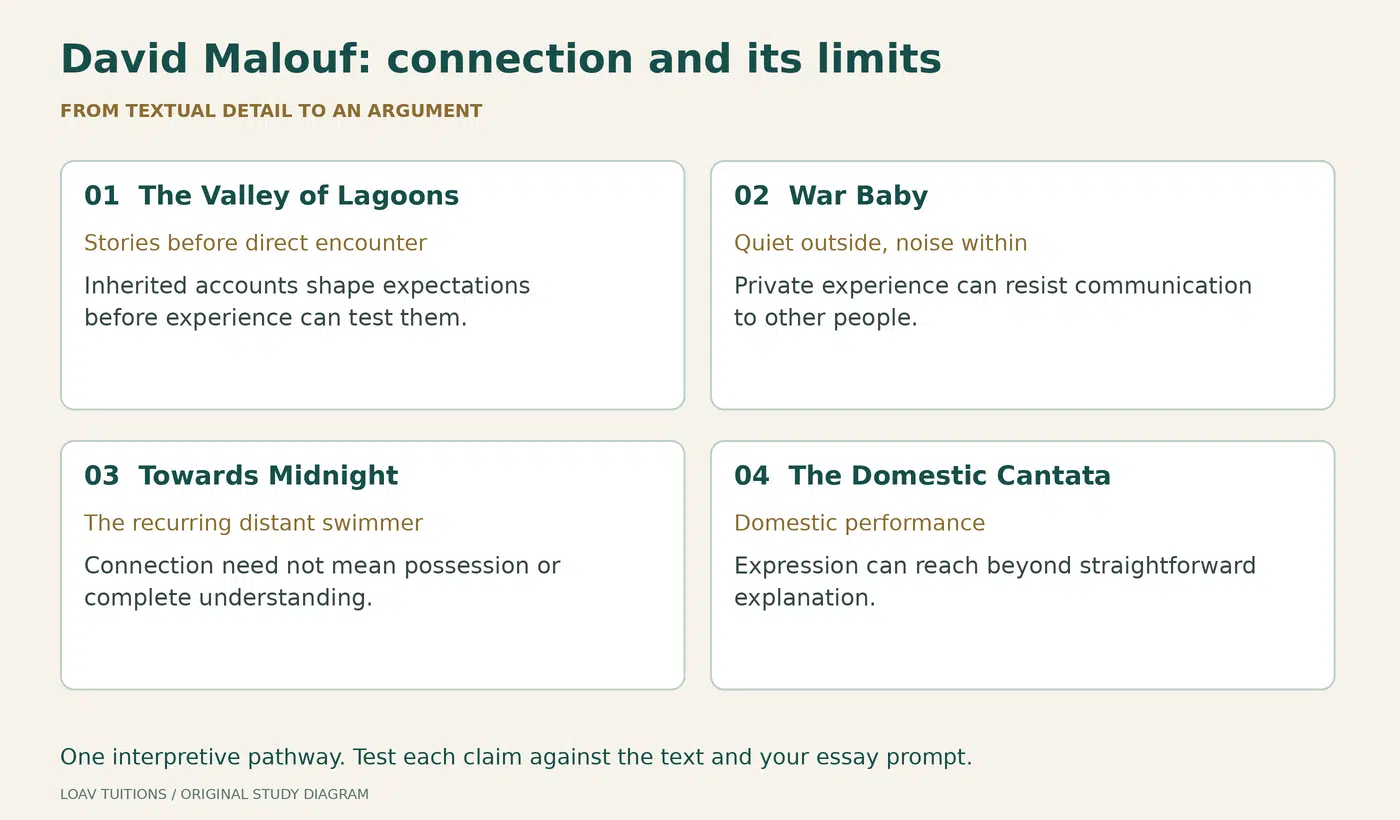
A map of the seven prescribed stories
“The Valley of Lagoons”
The narrator’s childhood fascination with a hunting destination is formed through other people’s stories before he reaches it. In the opening, the place’s absence from maps increases its imaginative authority. The hunt is therefore a social initiation as well as a physical journey. Read the narrative’s retrospective voice carefully: the child’s expectation and the act of remembering need not have identical understanding. The landscape can expose the limits of the masculine stories used to explain it. Publisher’s opening extract.
“Every Move You Make”
Jo’s relationship with Mitchell raises questions about the difference between intimacy and complete knowledge. The published opening introduces him through the houses associated with his name and the familiarity of a social circle. Reputation reaches Jo before personal understanding does. This is a useful entry into the story’s wider examination of projected identities: what people appear to represent can guide desire before their private histories become accessible. Original Granta publication and opening.
“War Baby”
Charlie’s experience places inherited expectations of war against the difficulty of communicating what war becomes. Reading Australia reproduces a passage in which his apparent silence contains overwhelming remembered sound. That contrast is especially useful: external quiet does not establish internal emptiness. Distinguish a character’s inability or refusal to explain from the narrator’s ability to make readers imagine the pressures behind it. Reading Australia’s teaching resource and verified extract.
“Towards Midnight”
A woman watches a man swim at night in a Tuscan pool. The recurring encounter matters without becoming a fully explained relationship. Visibility, distance and darkness allow connection to coexist with withheld knowledge. Patrick Holland’s discussion in Griffith Review draws attention to this experience of a familiar yet unknown presence. Ask whether demanding an explanation would strengthen the encounter or alter the kind of consolation it offers. Griffith Review essay.
“Elsewhere”
The journey associated with a daughter’s death brings family relationship into contact with a life lived beyond familiar surroundings. Consider the gap between kinship and access: being related does not guarantee that someone’s other social world is known. Read the title as a question about emotional as well as geographical distance. The critical overview at eNotes distinguishes Harry’s experience from Andy’s shifting perception, a reminder not to collapse their responses into one account of grief. Critical overview.
“Mrs Porter and the Rock”
A widow’s journey with her son to Uluru places ordinary expectations alongside an encounter with a landscape that exceeds the visitor’s personal scale. Avoid reducing the rock to a decorative symbol or making unsupported claims about Indigenous perspectives. Ask instead how the story represents this particular visitor’s way of seeing, and what changes in her sense of self. Place and mortality can be connected without claiming that a landscape magically erases grief. Contemporary review.
“The Domestic Cantata”
A composer’s music and his wife’s singing make artistic activity part of domestic relationship. The title places musical form beside household life; that combination invites attention to how ordinary experience is reshaped through expression. Compare the possibility of sharing through art with the limits of direct explanation elsewhere in the selection. The comparison should preserve differences: performance can mediate experience without transferring one consciousness completely into another. Contemporary review.
Theme Analysis
Begin with perspective. Identify whose perception controls a passage and how much that person knows. Then examine the relationship between physical detail and interpretation. A sound, object or movement can anchor memory without announcing its importance in abstract terms. Third, attend to time: anticipation, recollection and present action can occupy different emotional worlds even when they concern the same person.
Finally, read silence actively. A pause can suggest restraint, isolation, respect or the inadequacy of available language. It cannot automatically prove any one of them. Establish the surrounding situation, the narrative access provided and the contrast with what is spoken. Malouf’s restrained exchanges often make readers infer connections, so distinguish a defensible inference from a fact the narration explicitly supplies.
Build a collection-wide argument
The story map above is for revision, not an essay structure to reproduce. For a prompt about understanding, organise the response around imperfect social scripts, the privacy of experience and forms of connection that do not require complete disclosure. Bring stories together when they clarify or complicate a shared claim. One paragraph might distinguish a damaging silence from a respectful distance; another might examine how remembered experience changes present perception.
Do not use seven stories merely to display coverage. Select precise evidence that lets the argument develop, then ensure the response’s overall range supports claims about the prescribed selection. The 2025 VCAA report warns against disconnected discussions of individual collection pieces and against insufficient breadth. A smaller number of well-explained connections is more useful than an unsupported title catalogue.
Practice Prompts
- Malouf suggests that connection is possible even when complete understanding is not. Discuss.
- How do the prescribed stories challenge the identities people inherit or perform?
- Encounters with unfamiliar places reveal the limits of self-knowledge. To what extent do you agree?
- How does Malouf use silence and sensory detail to explore private experience?
Full Annotated Essay
Past-paper connection: This essay answers a labelled paraphrase of 2025 VCAA Section A, question 16(ii): Malouf presents self-understanding as more difficult than understanding other people. Do you agree? It is an original teaching model, not a reproduced examination response. BCAS, TEEAEAL and CAS name flexible analytical functions rather than compulsory VCAA structures.
Introduction
In the seven prescribed stories from The Complete Stories, David Malouf repeatedly places familiar relationships beside experiences that resist explanation. Although self-understanding is difficult, the stories do not consistently present understanding others as easier; apparent familiarity can conceal equally profound uncertainty. Inherited narratives complicate the formation of self-knowledge, social recognition can be mistaken for personal understanding, and private experience creates unequal access between the individual and those around them. Malouf therefore challenges the confidence behind the comparison itself, suggesting that knowledge of self and other develops through acknowledging its limits rather than assuming one is readily available.
Body 1 — Inherited expectations
Malouf presents self-knowledge as difficult because inherited narratives shape what individuals expect to discover in themselves. The anticipated initiation in “The Valley of Lagoons” and the circulation of reputation in “Every Move You Make” both place social interpretation before direct experience. The hunting destination’s description as a “secret place” turns incomplete knowledge into imaginative attraction. First-person narration reveals how longing invests a landscape with promised significance. In contrast, the repeated announcement of Mitchell’s name offers Jo an identity already interpreted by a social circle. The two openings ask readers to notice how apparently personal discoveries arrive pre-shaped by collective expectations. The retrospective phrase “I heard” identifies the dependence of anticipation on other people’s accounts. This mediation makes self-understanding inseparable from evaluating social narratives, just as understanding a celebrated acquaintance requires questioning a ready-made reputation. Malouf’s sequencing exposes the interpretations that precede knowledge without assuming direct experience can eliminate all uncertainty. Neither self nor other is transparently available when inherited meanings organise the encounter from its beginning.
Body 2 — The appearance of knowing
Moreover, Malouf makes social familiarity a misleading measure of understanding by contrasting publicly legible identities with inaccessible experience. The confident sociability of “Every Move You Make” and the reserve of “War Baby” produce opposite outward impressions, yet neither supplies adequate knowledge of another person. Mitchell’s name circulates in “every house” Jo enters. The expansive phrasing suggests a settled identity, while his association with houses makes reputation seem visibly verifiable. Against this recognisability, Charlie’s reticence offers little conversational access to war. Malouf juxtaposes, across the stories, the temptation to mistake abundant social information for understanding and the temptation to mistake unavailable information for emptiness. The observation that everyone “would laugh” makes collective agreement feel effortless. Readers can recognise laughter as membership in a circle without treating membership as insight. The narrative access to wartime memory elsewhere further exposes the inadequacy of judging by public behaviour alone. Understanding others can appear easier than self-understanding because socially comfortable explanations conceal what they leave unknown.
Body 3 — Unequal access to experience
Most sharply, Malouf distinguishes proximity to experience from the ability to explain it, making uncertainty internal as well as interpersonal. “War Baby” grants readers sensory access beyond ordinary observation, whereas “The Valley of Lagoons” foregrounds the expectations through which experience is approached. These narrative positions complicate any ranking of who knows best. Charlie’s reserve forms a wall of “silence”. The barrier suggests restricted communication without establishing an absence of feeling. Unlike the hunting destination’s enticing secrecy, this concealment carries the pressure of experience already endured; missing knowledge cannot always be remedied by gaining entry. The inward “scream” of metal contradicts outward quiet. Auditory contrast allows readers to perceive the insufficiency of appearances while withholding the reassurance of complete resolution. Likewise, the distinction between anticipation and experience in the first-person hunting narrative makes participation something to interpret, not an automatic source of self-certainty. Malouf therefore renders both kinds of understanding difficult: outsiders lack access, while insiders still face the demanding work of making meaning.
Conclusion
The prescribed stories qualify rather than affirm a simple ranking of self-knowledge and knowledge of others. Inherited expectations, socially legible identities and inaccessible private experience each disturb the belief that familiarity produces understanding. Malouf’s more demanding suggestion is that genuine attentiveness begins when certainty ends: to know oneself or another person requires recognising the distance between an available explanation and a life that exceeds it.
Analysis annotations
Structure map: The introduction follows BCAS: background establishes the text’s central tension, the contention gives a qualified answer, the arguments forecast the three body paragraphs, and the summary draws those claims into an authorial perspective. Each body follows TEEAEAL: an idea-led topic sentence and elaboration establish the claim; two evidence-and-analysis movements develop it; the link returns to the prompt. The conclusion follows CAS: it restates the qualified contention, synthesises the arguments and resolves their wider significance. These functions remain within the continuous prose; the labels are teaching tools, not VCAA requirements.
- Cross-evidence synthesis: Each paragraph brings stories into relation through mediation, misleading familiarity or unequal access. Reusing a story for a different conceptual purpose develops the answer rather than creating separate story summaries.
- Prompt control: Every paragraph addresses the comparative proposition. The essay does not merely show that understanding is difficult; it examines why the supposedly easier knowledge of others can be deceptive.
- Transitions: “Moreover” develops mediated identity into social misrecognition; “Most sharply” moves towards the more consequential example of war.
- Author-focused analysis: Narrative sequencing, expansive phrasing, collective laughter and contradictory sensory imagery explain Malouf’s construction. The essay does not claim access to his private intentions.
- Nominalisation: Formation, recognition and separation connect concrete details to conceptual claims. Brief fragments remain grammatically embedded and are immediately interpreted.
Quote Bank
Six short verified fragments with their narrative contexts and analytical uses.
- Self-knowledge — Evidence 1–2: “secret place”; “I heard”. “The Valley of Lagoons”, retrospective first-person narrator, opening anticipation of the hunting destination. Secrecy and mediated storytelling distinguish expectation from experience. Publisher excerpt.
- Social identity — Evidence 3–4: “every house”; “would laugh”. “Every Move You Make”, narration of Jo’s arrival in Sydney and the social recognition of Mitchell. Repetition and shared laughter establish reputation before intimacy. Original publication opening.
- Private experience — Evidence 5–6: “silence”; “scream”. “War Baby”, narration of Charlie’s silence and remembered sounds. Barrier metaphor and auditory contrast reveal limited access. Teaching resource reproducing the passage.
Evidence notes
The six model fragments are verified in the publisher’s opening extract of “The Valley of Lagoons”, Granta’s opening of “Every Move You Make”, and the “War Baby” passage reproduced by Reading Australia. No page references are asserted because editions differ. Check exact wording in your prescribed copy before expanding your own evidence bank. The discussion links distinguish primary excerpts, author interview and secondary criticism; interpretations here are original and should be tested against the complete seven stories.
For help applying this analysis to your own writing, explore Loav’s VCE tutoring or enquire about a trial class.
