
Loav reading room · VCE English · 2026
Gabriel García Márquez tells readers about Santiago Nasar’s death before the investigation has properly begun. Suspense therefore moves away from discovering the killer towards understanding how a publicly anticipated killing could happen. The novella asks readers to distinguish a story that sounds inevitable from actions that might have been prevented. Spoilers follow.
Course and translation
Chronicle of a Death Foretold appears on the 2026 VCAA English and EAL List 1. The nominated edition is Penguin, 2014, ISBN 9780241968628. Section references locate the passages without assuming equivalent print pagination. The opening’s display capitals are normalised to sentence case. Check wording and page references against your school copy before memorising extracts. The original Spanish was published in 1981.
What happens, and how we learn it
After her wedding to Bayardo San Román, Angela Vicario is returned to her family. Pressed to identify the man responsible for her loss of virginity, she names Santiago Nasar. Her brothers Pedro and Pablo set out to kill him under the social logic of restoring family honour. Their intentions become widely known, but knowledge does not produce effective protection.
The narrator later revisits the town and assembles memories, records and conflicting accounts. He does not occupy an entirely external position: he belongs to the social world whose failures he investigates. The narrative circles around the killing rather than moving steadily towards an unknown outcome. Different accounts reveal opportunities for intervention and explanations for their failure.
The novella also follows the aftermath, including the damage to the body, the families and the wider community. Angela’s later life and letters complicate the idea that she remains only an object of other people’s decisions. The return to Santiago’s final movements forces the reader to confront bodily suffering after encountering the abstractions used to justify or explain it. Crucially, the narrative does not conclusively establish whether Santiago was responsible for the sexual encounter Angela names. An essay should preserve that uncertainty.
Characters and forms of responsibility
Santiago is a victim of murder without becoming an uncomplicated emblem of innocence in every other respect. His social privilege and behaviour towards women require attention, but neither establishes the truth of Angela’s accusation nor justifies his killing. Distinguish ethical criticism from evidence about a particular allegation.
Angela experiences coercive standards of sexual honour, yet her later conduct invites a more complex account of agency. The twins perform a violent role their community recognises; social pressure explains part of their behaviour without erasing their decisions. Bayardo brings wealth and prestige to courtship, raising questions about acquisition and entitlement. Clotilde Armenta recognises danger and tries to obtain intervention. Her efforts prevent a simplistic assertion that nobody cares.
The narrator tries to recover knowledge but cannot stand outside the failures of memory and interpretation. Public and religious authorities possess forms of influence that do not translate into adequate protection. Compare the resources available to each person rather than assigning everyone an identical share of blame.
Theme Analysis
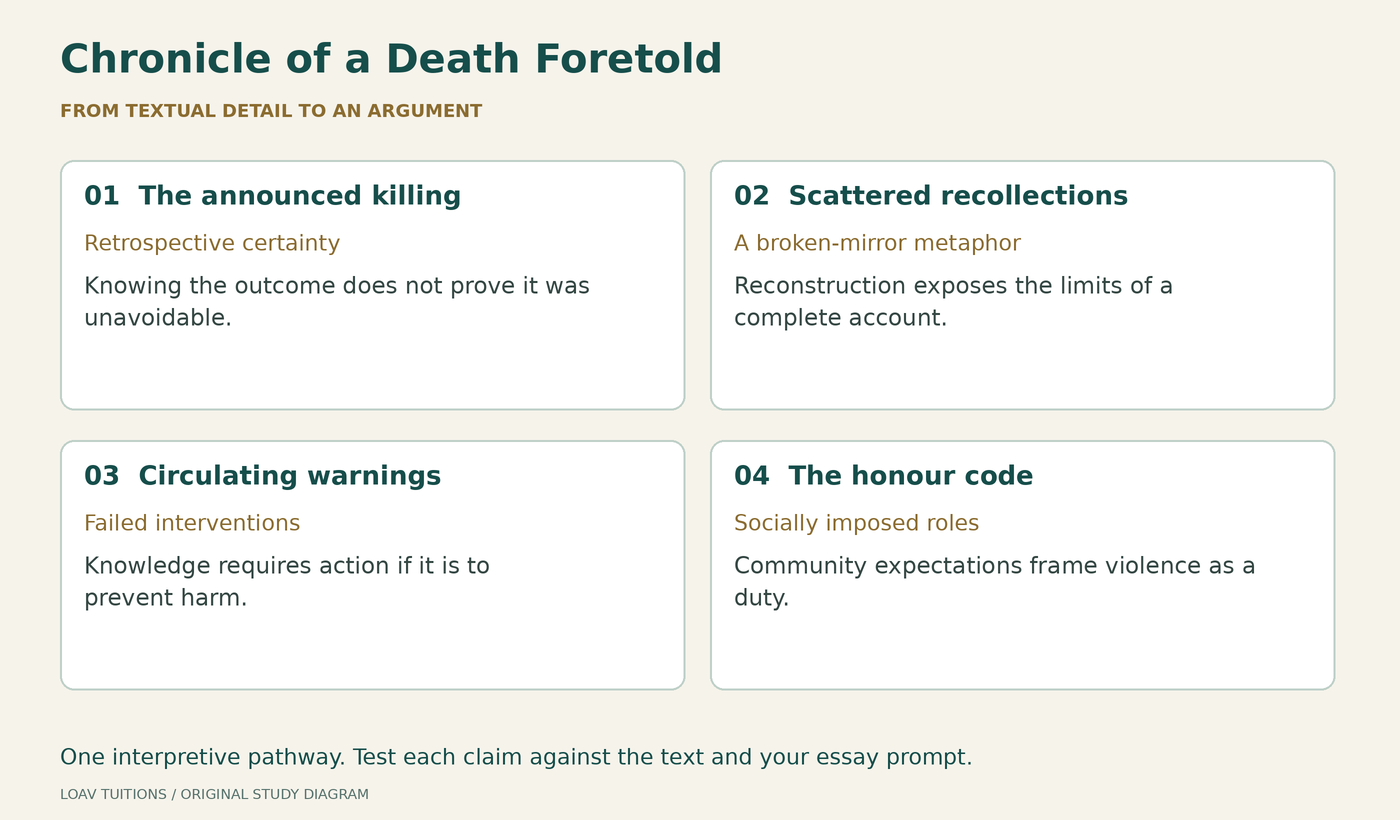
Honour can replace ethical judgment. The word names a socially approved ideal, but the murder exposes the consequences of applying that ideal through gendered violence. Analyse who is expected to carry shame, who is permitted to act and who can treat the matter as someone else’s obligation.
Collective knowledge is not collective responsibility. A warning can circulate without anyone ensuring that its intended recipient is safe. The novella distinguishes awareness, intention and effective action. This makes responsibility more demanding than merely possessing information or having a good explanation afterward.
Fatalism can conceal preventable failure. Because the death is announced in advance, each missed intervention feels like another step towards a fixed outcome. Yet the existence of these missed opportunities also suggests contingency. Strong analysis holds both effects together instead of treating prophecy as a verified supernatural cause.
Reconstruction cannot restore everything. The narrator accumulates detail without producing complete certainty. That limitation does not make inquiry pointless. It changes its ethical purpose: the investigation can expose failures even where it cannot recover a single authoritative version of every event.
Form: a chronicle that resists certainty
The title evokes an orderly record, while the narrative’s returns and contradictions resist a simple chronology. Retrospective testimony gives ordinary remarks an ominous force because the reader already knows the outcome. Report-like precision sits beside uncertainty, showing that detail and reliability are different things. Shifts between past events and later recollection reveal the continuing life of the crime. The text’s graphic bodily detail also challenges the distancing language of social convention: readers must confront what a supposedly honourable act actually does to a person.
Quote Bank by Theme
Grouped by theme for planning, with short contextualised extracts from the text. Chapter or section references are the stable locators. Any printed page numbers apply only to the identified edition, never automatically to a different school edition. Read each passage in context before adapting it.
Truth, memory and uncertain reconstruction
“On the day they were going to kill him”
Voice and location: The narrator. Section 1.
Context: The opening announces Santiago’s death before reconstructing its causes.
Authorial analysis: Prolepsis replaces suspense about the outcome with scrutiny of human agency and missed intervention. Opening display capitals are normalised.
“trying to put the broken mirror of memory back together from so many scattered shards”
Voice and location: The narrator. Section 1.
Context: He describes returning to interview Plácida Linero decades later.
Authorial analysis: The extended metaphor makes recollection fragmented: accumulation cannot automatically restore a complete account.
“not having found a single clue, not even the most improbable”
Voice and location: The narrator describing the magistrate’s findings. Section 5.
Context: The investigation fails to substantiate Santiago’s responsibility for the alleged sexual wrong.
Authorial analysis: The emphatic negative distinguishes an accusation’s social force from evidential support; absence of proof is not omniscient proof of innocence.
Honour, gender and sanctioned violence
“Give me a prejudice and I will move the world.”
Voice and location: The investigating magistrate’s marginal note, quoted by the narrator. Section 5.
Context: The magistrate responds to the weakness of the accusation.
Authorial analysis: The aphoristic allusion to moving the world grants prejudice enormous social leverage, exposing the power of belief without proof.
“The brothers were brought up to be men. The girls had been reared to get married.”
Voice and location: The narrator. Section 2.
Context: He introduces the Vicario children’s upbringing.
Authorial analysis: Parallel sentences expose unequal social destinations: masculine identity is expansive while female identity is organised around marriage.
“Any man will be happy with them because they've been raised to suffer.”
Voice and location: The narrator’s mother. Section 2.
Context: She praises the Vicario daughters’ upbringing.
Authorial analysis: The disturbing causal link between male happiness and female suffering shows gendered coercion reproduced through respectable praise.
Collective responsibility and failed intervention
“There had never been a death more foretold.”
Voice and location: The narrator. Section 3.
Context: He reconstructs the twins’ public preparation of their knives.
Authorial analysis: The superlative makes widespread foreknowledge an indictment of communal failure as well as an apparent sign of fate.
“Now they haven't got anything to kill anybody with”
Voice and location: Colonel Aponte. Section 3.
Context: After confiscating the first knives, the mayor dismisses Clotilde’s concern.
Authorial analysis: Confident declarative language mistakes one limited precaution for a resolved danger; the replacement knives expose that error.
“It's to spare those poor boys from the horrible duty that's fallen on them.”
Voice and location: Clotilde Armenta. Section 3.
Context: She explains why the twins should be detained rather than merely disarmed.
Authorial analysis: The clash between duty and horror identifies honour as coercion, while her attempt to interrupt it shows that alternatives exist.
“consoled themselves with the pretext that affairs of honor are sacred monopolies”
Voice and location: The narrator. Section 5.
Context: He surveys the later explanations of people who could have intervened.
Authorial analysis: Evaluative diction exposes self-exculpation: treating violence as private business protects bystanders from responsibility.
Practice Prompts
- The novella presents inevitability as a story people tell about preventable failure. Discuss.
- How does García Márquez expose the distance between public values and ethical responsibility?
- In Chronicle of a Death Foretold, knowing the truth is less important than acting on what is known. To what extent do you agree?
- How does the narrator’s reconstruction complicate the reader’s judgment of the community?
Full Annotated Essay
Past-exam basis: Adapted from 2025 VCAA Section A, Question 3i, which asks how the novella explores truth and supplies a quotation about conflicting testimony. Official 2025 examination. Adapted practice wording: How does García Márquez investigate the difficulty and importance of establishing truth?
This complete original essay uses BCAS, three TEEAEAL paragraphs and CAS as teaching scaffolds. Its six contextualised quotations range across the opening, the failed interventions and the final investigation. References identify the novella’s five sections; the digital copy’s chapter numerals were added by its scanner, not established as authorial headings.
Introduction
Gabriel García Márquez’s Chronicle of a Death Foretold reconstructs a publicly anticipated killing through a narrator’s later investigation. The novella distinguishes the certainty that violence occurred from the unstable accounts through which people explain it, presenting truth as difficult to establish but ethically necessary to pursue. Its narrative frame separates outcome from explanation, the social authority of interpretation exposes the danger of treating belief as knowledge, and contradictory testimony requires judgment without allowing uncertainty to erase responsibility. García Márquez therefore makes the search for truth a challenge to the community’s consoling versions of its past.
Body 1: fact and explanation
García Márquez first explores truth by separating the certainty of a death from the incomplete accounts of its causes. The narrator’s retrospective investigation collects memories from family members, witnesses and officials. Its announced outcome shifts attention away from a conventional mystery about whether Santiago will die and towards how his death became possible. The novella begins, “On the day they were going to kill him”. The proleptic clause makes the violence certain to the reader, yet its plural subject assigns agency to human actors. Foreknowledge need not mean that a supernatural fate removed every alternative. The narrator later describes “trying to put the broken mirror of memory back together from so many scattered shards”. The extended metaphor presents recollection as partial reflection. His return to Plácida Linero supplies intimate testimony but cannot recover an undamaged totality. The chronicle’s circular form repeatedly sets such fragments beside each other, allowing the reader to see both evidence and its limits. Truth consequently requires more than identifying the outcome: it demands responsible reconstruction without pretending that every surviving fragment fits.
Body 2: confidence without knowledge
Furthermore, the novella exposes the danger of allowing social conviction to do the work of evidence. Angela’s identification of Santiago gains lethal authority within the honour code, whereas the later investigation cannot establish the alleged wrong. The contrast separates an accusation’s power from its demonstrated truth without requiring readers to declare Angela a liar. Reflecting on the investigation, the magistrate is alarmed at “not having found a single clue, not even the most improbable”. The repeated negative intensifies the gap between a socially accepted explanation and substantiation. The brothers’ action cannot be justified by claiming that the narrative conclusively proves the accusation; equally, the missing evidence does not give readers an omniscient guarantee of innocence. The magistrate’s marginal note declares, “Give me a prejudice and I will move the world.” The aphoristic allusion gives prejudice the leverage conventionally associated with a powerful instrument. Set against the narrator’s account of gendered upbringing and the court’s acceptance of honour as a defence, the remark identifies institutions as well as individuals in the production of certainty. The judge’s literary language also reminds readers that even official inquiry is mediated through a particular interpreting voice. García Márquez thus questions the mechanisms that turn belief into authority, showing why ethical judgment must resist the convenience of an untested collective story.
Body 3: disagreement and responsibility
Nevertheless, incomplete knowledge does not absolve a community that possesses enough information to attempt prevention. The warnings circulate through shopkeepers, civil officials and religious authority, but public knowledge does not become coordinated protection. Clotilde’s repeated efforts show that accepting passivity is a choice rather than the only imaginable response. After confiscating the twins’ knives, Colonel Aponte assures Clotilde, “Now they haven’t got anything to kill anybody with”. The confident declaration mistakes one precaution for a settled outcome. The twins’ return with replacement knives exposes the difference between reassuring oneself and verifying another person’s safety. Clotilde, by contrast, recognises that the men must be stopped, not merely relieved of their first weapons. Reflecting on the community’s inaction, the narrator says that bystanders “consoled themselves with the pretext that affairs of honor are sacred monopolies”. The evaluative noun pretext identifies retrospective explanation as self-protection. Sacred language makes violence appear exempt from ordinary intervention, while monopolies casts responsibility as someone else’s exclusive property. The narrative therefore exposes how uncertainty and convention can become excuses, without assigning identical blame to the bystander, the failed official and the killer. The inquiry matters because acknowledging evidential limits should sharpen proportionate responsibility, not permit preventable harm to disappear into a consoling account of fate.
Conclusion
The novella ultimately makes truth both an incomplete achievement and an ethical demand. Its known outcome, prejudicial judgments and failures to act distinguish what happened from what people believe or prefer to explain. García Márquez leaves readers unable to reconstruct every detail, but better equipped to question the certainty with which a society justifies violence and excuses its failures.
Analysis annotations
Structure map: The introduction follows BCAS: background establishes the text’s central tension, the contention gives a qualified answer, the arguments forecast the three body paragraphs, and the summary draws those claims into an authorial perspective. Each body follows TEEAEAL: an idea-led topic sentence and elaboration establish the claim; two evidence-and-analysis movements develop it; the link returns to the prompt. The conclusion follows CAS: it restates the qualified contention, synthesises the arguments and resolves their wider significance. These functions remain within the continuous prose; the labels are teaching tools, not VCAA requirements.
Transitions should name a logical movement, not merely announce another paragraph. Nominalisations such as refusal, possession and reconstruction help track concepts, but keep the author and textual action clear.
- Scope: The argument distinguishes facts, interpretation and ethical judgment instead of making the vague claim that all truth is subjective.
- Evidence: The investigation’s lack of corroboration is distinguished from proof of innocence, and Clotilde’s action is distinguished from Aponte’s reassurance.
- Progression: The first body establishes uncertainty, the second examines the authority of prejudice and the limits of legal evidence, and the third explains why uncertainty cannot erase responsibility.
- Authorial construction: Metaphor, retrospective framing and dramatic irony are connected to reader judgment without claiming access to private authorial intentions.
- Nominalisation: Reconstruction, interpretation and responsibility name the essay’s linked concepts; concrete examples prevent them becoming abstract filler.
Sources and quotation checks
- VCAA 2026 text list: inclusion and nominated edition.
- Publisher’s authorised Rabassa excerpt: supplementary opening comparison. Translation credit: Gregory Rabassa. The exact publication edition used for the quotation bank is not established; no publisher or print pagination is inferred for it.
- Publisher’s teacher guide: plot and interpretive cross-check.
- VCAA 2025 assessment report: official guidance on responding to the precise topic; all models above are original.
For help applying this analysis to your own writing, explore Loav’s VCE tutoring or enquire about a trial class.
