
Loav reading room · VCE English · 2026
Trevor Noah’s memoir turns the apparent absurdity of everyday experience into an examination of how power works. The jokes do not remove the danger; they often reveal the assumptions that allow it to persist.
2026 scope and essential context
The prescribed edition is Trevor Noah’s Born a Crime, John Murray Press, 2017, ISBN 9781473635302. Study the adult memoir, not its young-readers adaptation, and do not substitute Noah’s stand-up routines or television appearances for textual evidence. The 2025 VCAA assessment report explicitly warns against using his comedy sketches as evidence for this text.
Noah recounts childhood and young adulthood during apartheid and its aftermath in South Africa. His parents’ relationship crosses the racial boundaries enforced by apartheid law, making the title an accusation against a system that turns ordinary human intimacy into an offence. Be precise: the child’s existence exposes a criminalised relationship; an essay need not imply that a newborn was personally prosecuted.
The end of apartheid does not instantly remove poverty, segregation or the habits of racial classification. The memoir explores the gap between formal change and lived opportunity. It also centres Patricia, whose practical intelligence, faith and determination shape her son’s possibilities. Accounts of racism and domestic violence require careful discussion that does not confuse explaining danger with blaming those who endure it.
Theme Analysis
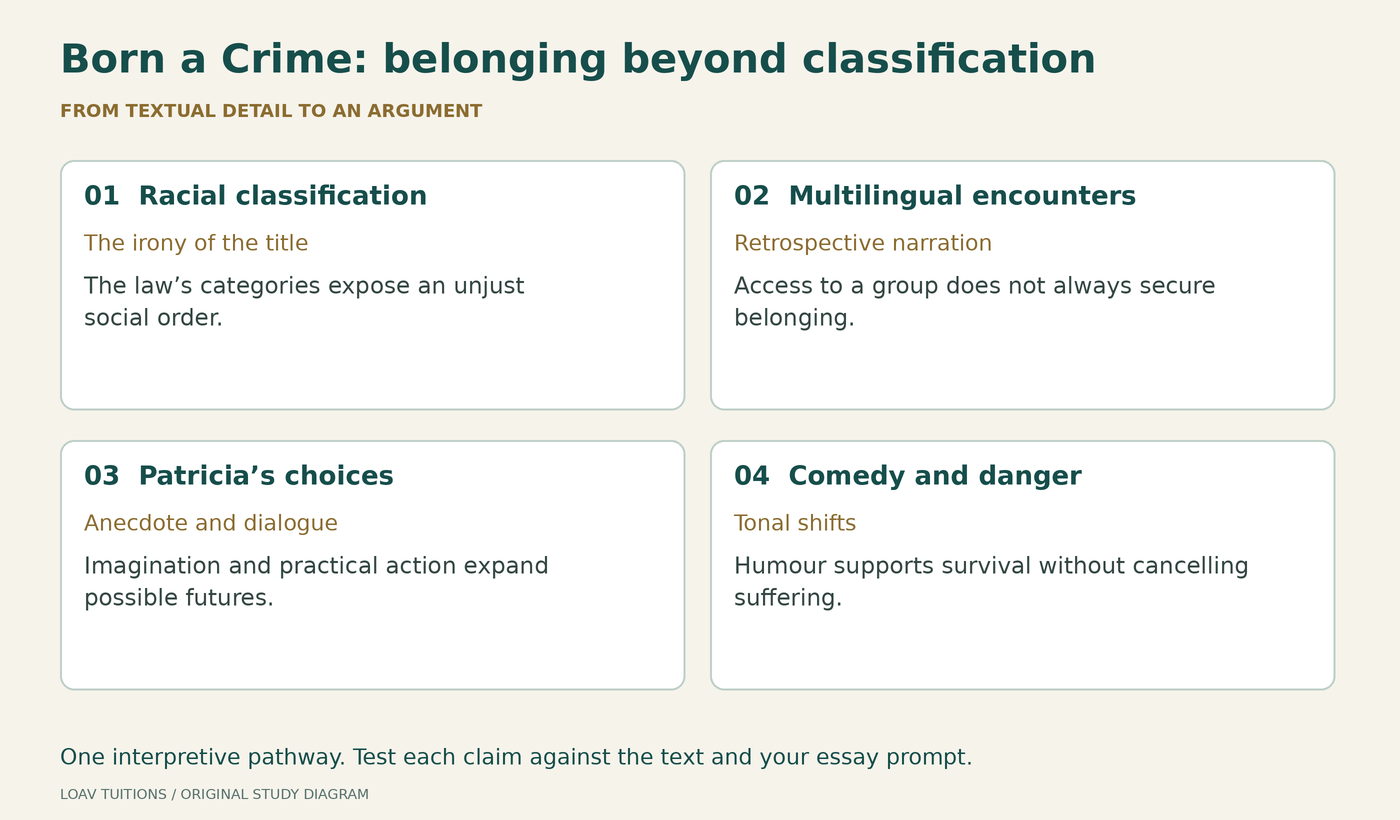
Classification is powerful and unstable. Noah’s position exposes the difficulty of fitting lived identities into supposedly natural racial categories. Social responses to him can shift when people hear his language or infer his background. This instability does not make racism harmless. Instead, it reveals the work required to maintain divisions and the consequences for people who do not fit them neatly.
Language offers access, not unlimited freedom. Multilingualism helps Noah negotiate danger and communicate across social boundaries. Yet access to a group is not identical to secure belonging. A strong essay can argue that adaptability is valuable while also revealing the costs of continually explaining or adjusting oneself. Avoid claiming that language alone abolishes structural inequality.
Patricia expands what is imaginable. Her parenting combines affection, discipline and deliberate exposure to possibilities beyond the limits imposed on their circumstances. Discuss her agency through particular decisions rather than treating her as a generic symbol of strength. Her resourcefulness does not prove that everyone can escape poverty through determination, nor does her faith make her responsible for the violence directed at her.
Opportunity requires material conditions. Noah’s entrepreneurial activity complicates simplistic celebrations of initiative. Skills, equipment, networks and access all affect what effort can produce. Ask how the memoir juxtaposes ingenuity with the constraints of its environment. A story about making money can reveal economic limits as well as personal cleverness.
Humour is a way of thinking. Comic reversals expose contradictions that official explanations try to normalise. The narrator can bring a reader close through familiar embarrassment before revealing a larger inequality. However, not every funny incident performs the same function. Distinguish self-mockery, exaggeration, irony and satirical dialogue, then explain the particular judgement each enables.
Memoir form and narrative technique
Retrospective perspective. The adult narrator can explain conditions the younger self did not fully understand. This creates a productive distance between experience and interpretation. When a childhood judgement is revised, analyse what the reader learns from that revision. Do not assume the child and the retrospective narrator possess identical knowledge.
Episodic structure. Chapters develop linked concerns rather than simply recording every year in order. An anecdote can be selected for its capacity to expose a mechanism of power, a mistaken assumption or a relationship. For whole-text preparation, connect episodes through a developing argument. Listing one story after another is not the same as explaining how the memoir constructs an idea.
Context and anecdote. Broader explanations help an unfamiliar reader understand the political and cultural significance of an apparently private event. The movement between those scales prevents the memoir from becoming either an abstract history lesson or a detached success story. Analyse how an explanation alters the meaning of the episode beside it.
Dialogue and timing. Conversations can stage competing ways of interpreting the same situation. Short responses, delayed explanations and reversals change what the audience expects. Rather than praising a passage as relatable, identify the assumption the joke makes the reader recognise and the contradiction it exposes.
Tonal shifts. The movement from comedy into danger can make the latter more confronting because ordinary affection or mischief has already made the people familiar. Equally, humour after an alarming event can demonstrate a relationship’s resilience. Neither function means the injury has disappeared. Pay attention to what remains unresolved when the joke ends.
Quote Bank
These twelve brief passages come from eight chapters of the adult memoir. They are grouped by ideas, with the speaker or narrative perspective, scene and a possible analytical use. Six are also embedded in the full essay. Read each passage in context; the commentary offers a defensible interpretation rather than a sentence to memorise.
Edition note: Wording has been checked against Born a Crime: Stories from a South African Childhood (Spiegel & Grau, 2016), ebook ISBN 9780399588181. This is the full adult memoir, not the young-readers adaptation. The prescribed John Murray Press print edition is a different edition; chapter and scene references are supplied rather than transferring ebook pagination to that print text. Check page references in your own copy.
Classification, language and belonging
“My grandmother treated me like I was white.”
Voice: Adult narrator, recalling his grandmother’s treatment of him as a child. Location: Chapter 4, “Chameleon”. Scene: His grandmother explains why she will discipline his cousins but is afraid to hit him.
Retrospective irony and comparison: The gap between the narrator’s identity and the way his grandmother treats him exposes racial classification as a social practice. Her unequal discipline shows apartheid’s hierarchy entering family life; it does not establish that Noah is white or that all women think alike. See this quotation in the essay.
“language, even more than color, defines who you are to people”
Voice: Adult narrator, interpreting an encounter from his youth. Location: Chapter 4, “Chameleon”. Scene: After hearing men plan to rob him as a white person, Noah replies in Zulu and is accepted as one of their group.
Comparative emphasis and retrospective generalisation: The comparison prioritises speech over appearance in this encounter. Noah’s escape makes racial perception appear changeable, while the threatened robbery shows that those perceptions still have violent consequences. It is a situated insight, not proof that multilingualism ends racism.
“I was everywhere with everybody, and at the same time I was all by myself.”
Voice: Adult narrator, recalling his high-school self. Location: Chapter 11, “Outsider”. Scene: His tuck-shop business and jokes allow him to circulate among school groups without securing lasting membership.
Antithesis and closing reversal: The expansive pairing of everywhere and everybody collapses into solitude. The chapter’s closing contrast qualifies comic sociability: performing a useful role wins temporary access but does not necessarily make the whole person feel accepted.
Care, education and chosen attachment
“If my mother had one goal, it was to free my mind.”
Voice: Adult narrator, evaluating Patricia’s parenting. Location: Chapter 5, “The Second Girl”. Scene: Noah recalls books, arguments about religious stories and Patricia’s questions about the meaning and application of Bible passages.
Liberation metaphor and retrospective evaluation: The metaphor makes mental independence a form of freedom within a restrictive political order. This is the adult narrator’s interpretation of Patricia’s purpose, not a declaration spoken by the young child. Her questioning matters because it teaches interpretation rather than simple obedience. See this quotation in the essay.
“My job is to feed your body, feed your spirit, and feed your mind.”
Voice: Patricia, in dialogue recalled by the narrator. Location: Chapter 5, “The Second Girl”. Scene: She protects spending on food, books and religious life while economising on clothes, furniture and other possessions.
Parallel three-part syntax and extended metaphor: The repeated verb gives physical, spiritual and intellectual nourishment equal grammatical weight. Her claim is supported by concrete household choices, making care a sustained allocation of scarce resources rather than an abstract virtue. See this quotation in the essay.
“Being chosen is the greatest gift you can give to another human being.”
Voice: Adult narrator, reflecting on his reunion with his father at twenty-four. Location: Chapter 8, “Robert”. Scene: Robert’s continuing interest in his son, including his scrapbook, reassures Noah that years of separation did not mean rejection.
Aphorism and gift metaphor: The general statement converts a particular reunion into an account of attachment as deliberate recognition. It gives Robert a significant emotional influence and complicates an exclusively maternal reading. The narrator is reflecting on adult experience here, not reporting a child’s fully formed insight.
Imagination, resources and unequal opportunity
“We tell people to follow their dreams, but you can only dream of what you can imagine”
Voice: Adult narrator, reflecting on the limits of aspiration. Location: Chapter 5, “The Second Girl”. Scene: After describing Patricia’s outings beyond their usual surroundings, Noah contrasts restricted township expectations with a larger field of possibility.
Adversative turn and qualification of a familiar slogan: The turn after but challenges advice that treats aspiration as freely available to everyone. The surrounding account explains why Patricia’s exposure to unfamiliar places matters: she enlarges what her son can conceive without pretending that imagination itself supplies money or access.
“Talent alone would have gotten me nowhere without Andrew giving me the CD writer.”
Voice: Adult narrator, assessing his early business opportunities. Location: Chapter 15, “Go Hitler!”. Scene: His schoolmate and business partner Andrew, not his younger brother of the same name, passes on the equipment needed to copy CDs.
Counterfactual reflection and emphatic limitation: The imagined absence of assistance dismantles a self-made success story. Specifying the CD writer makes opportunity material: skill needs equipment and knowledge. The admission credits a male peer while connecting an individual benefit to the unequal distribution of resources after apartheid. See this quotation in the essay.
“He has been given more potential, but he has not been given more opportunity.”
Voice: Adult narrator, describing the representative township “cheese boy”. Location: Chapter 16, “The Cheese Boys”. Scene: Noah explains why young men with some education and awareness of a wider world can remain without the means to enter it.
Parallel syntax and antithesis: The repeated passive construction separates what a person has been prepared to do from what society permits him to do. The pronoun refers to a generalised social portrait, not simply to Noah. Read beside chapter 15, the distinction challenges claims that education or effort automatically secures mobility.
Care, coercion and survival
“Boy, who do you think paid your bail? Hmm? Who do you think paid your lawyer?”
Voice: Patricia, confronting Noah after his release from jail. Location: Chapter 17, “The World Doesn’t Love You”. Scene: Noah assumes he has concealed his arrest; she reveals that she supplied the money through his friend and cousin.
Repeated rhetorical questions and delayed revelation: The questions overturn Noah’s belief that he managed the crisis alone. Withholding her involvement until this conversation lets the reader share his reassessment of apparent severity as concealed support. This episode can be analysed without endorsing every punishment described elsewhere in her parenting.
“That’s when I realized the police were not who I thought they were. They were men first, and police second.”
Voice: Adult narrator, recalling his disillusionment at nine. Location: Chapter 18, “My Mother’s Life”. Scene: Police sympathise with Abel and decline to help Patricia after she reports his violence.
Parallel ranking and institutional irony: The balanced clause exposes a conflict between gender solidarity and public duty. It places responsibility on abusive conduct and institutional complicity, qualifying any suggestion that Patricia’s determination alone could ensure safety. The narration recalls a childhood shock through an adult’s concise interpretation. See this quotation in the essay.
“You’re right. He didn’t. But He blessed me with the son who did.”
Voice: Patricia, replying to Noah after he pays her hospital bill. Location: Chapter 18, “My Mother’s Life”. Scene: In the memoir’s final exchange, Noah teases her that Jesus did not pay for her treatment after Abel shot her.
Dialogic reversal, religious language and circular closure: Patricia absorbs the apparent challenge to her faith into gratitude for her son. Their repartee recalls the opening chapter’s shared laughter after danger, while the paid bill gives the ending a material expression of reciprocal care. Neither the joke nor her recovery cancels Abel’s violence or the failures of justice. See this quotation in the essay.
Practice Prompts
- In Born a Crime, humour deepens rather than diminishes Noah’s criticism of injustice. Discuss.
- How does Noah explore the difference between adaptability and belonging?
- Patricia’s influence is powerful because she teaches Noah to imagine beyond his circumstances. To what extent do you agree?
- How does the memoir challenge the belief that opportunity depends only on individual effort?
These are original practice prompts, not official VCAA examination questions. For prompt one, do not merely identify funny moments. Establish how a comic choice produces criticism, and consider whether the memoir also needs tonal seriousness to communicate what humour cannot resolve.
Full Annotated Essay
Prompt: To what extent does the memoir present women as the strongest influence on Noah’s life?
Paraphrase of the verified 2025 VCAA English examination, Section A, Question 2(i). See the official paper.
This complete original model uses BCAS, three TEEAEAL body paragraphs and CAS. These are optional learning scaffolds, not VCAA rules. The separate annotations explain the construction; the essay itself uses continuous prose.
Introduction
Trevor Noah’s Born a Crime traces childhood and early adulthood through apartheid and its aftermath, connecting intimate family relationships to the unequal distribution of freedom. Women, especially Patricia, exert the memoir’s strongest sustained formative influence, but Noah distinguishes their capacity to nurture independence from an ability to determine every outcome. Women first provide competing ways of interpreting identity; maternal care then enlarges possibility alongside indispensable assistance from men; finally, the confrontation with violence reveals both the limits of personal protection and the enduring force of learned care. The memoir’s tribute to women is therefore qualified rather than diminished by its recognition of other relationships and structural power.
Body 1
Women’s formative importance emerges through competing lessons about how to interpret an unequal world. Rather than treating femininity as an automatically liberating quality, Noah contrasts inherited racial assumptions with Patricia’s deliberate cultivation of intellectual independence. The retrospective narrator can recognise both the affection within his family and the hierarchy that shapes its behaviour. Recalling the different treatment he and his cousins receive, he observes, “My grandmother treated me like I was white.” The comparison locates racial meaning in treatment rather than biological certainty. His grandmother’s fear of harming him, while other children are punished, brings apartheid’s valuation of whiteness into the home. Noah’s comic account exposes the contradiction without presenting his grandmother as its sole creator. The child benefits from the distinction; the adult narrator makes its injustice legible. Against this inherited hierarchy, the retrospective assessment of Patricia declares, “If my mother had one goal, it was to free my mind.” The liberation metaphor casts interpretation as a freedom that political institutions restrict. Her questions about Bible passages and their application require reasoning rather than repetition, while their disagreements demonstrate that her influence can produce dissent. The adult’s evaluation thus gives purpose to practices the child did not always welcome. These contrasting women are influential because they furnish assumptions to examine as well as habits with which to examine them. The memoir largely supports women’s formative primacy, while locating its most emancipatory influence in Patricia’s particular parenting rather than in gender alone.
Body 2
Personal influence becomes enabling when it supplies imaginative and material resources, and this makes maternal guidance central without making male assistance incidental. Noah resists a simple account of success through individual determination. Patricia builds a foundation for independence, but later opportunities require resources beyond those she can provide. Patricia explains, “My job is to feed your body, feed your spirit, and feed your mind.” Her statement defines care as more than physical survival. The repeated verb and three-part structure give intellectual and spiritual nourishment the same grammatical status as food. Accounts of her thrift make that metaphor practical: books and meals take priority over possessions, while outings expand what her son can imagine. Her influence lies in sustained decisions about scarce resources, not merely in encouraging optimism. Nevertheless, reflecting on his schoolmate Andrew’s contribution to his CD business, the narrator admits, “Talent alone would have gotten me nowhere without Andrew giving me the CD writer.” The counterfactual statement rejects self-sufficiency, and the specific piece of equipment makes opportunity tangible. His schoolmate’s access to resources exposes advantages distributed unequally by apartheid, giving a male peer a decisive place within Noah’s account of opportunity. Similarly, the reunion with Robert establishes the emotional significance of paternal recognition, although Patricia encourages her son to seek it. Their contributions reveal how maternal preparation and wider support interact, extending rather than displacing Patricia’s formative role. Women, particularly Patricia, provide the most continuous foundation, while the memoir grants men consequential roles in turning that preparation into opportunity and belonging.
Body 3
The encounter with violence finally separates the lasting influence of care from the power to guarantee another person’s safety. Patricia’s resourcefulness does not neutralise Abel’s abuse or institutional complicity. By exposing those limits, Noah avoids making a woman’s protective strength a measure of her responsibility for violence committed against her. After recalling police officers’ refusal to help Patricia, the narrator concludes, “That’s when I realized the police were not who I thought they were. They were men first, and police second.” The parallel ranking exposes gender solidarity overriding public duty. What the nine-year-old experiences as the collapse of trust becomes, in the adult telling, a compact criticism of institutional power. Male influence here is damaging and decisive, qualifying any claim that women alone shape Noah’s circumstances. Yet the memoir also shows care outlasting these failures: the delayed revelation that Patricia financed his lawyer and bail revises his belief that he has survived independently. In the memoir’s final exchange, after Noah has paid her hospital bill and challenged her claim of divine support, Patricia replies, “You’re right. He didn’t. But He blessed me with the son who did.” Her dialogic reversal transforms their familiar disagreement into recognition of reciprocal care. The shared humour recalls mother and son laughing after danger in the opening chapter, giving their relationship a circular narrative presence. However, the ending’s tenderness does not cancel the account of Abel’s violence and inadequate punishment. Patricia’s deepest influence is visible in the son’s response to her vulnerability, not in an impossible immunity from harm. Noah therefore affirms women’s strongest enduring formative role while acknowledging that men and institutions can exert powers their care cannot simply overcome.
Conclusion
Ultimately, Born a Crime largely presents women, above all Patricia, as Noah’s most sustained formative influence, while resisting an exclusive or all-powerful account of that role. Their contrasting examples shape interpretation; maternal provision establishes a foundation developed through other people’s support; and learned care survives dangers that personal resolve cannot prevent. The memoir’s celebration is most persuasive because it honours the work of nurturing freedom without disguising the unequal circumstances in which that work must occur.
Use the model without memorising it
Plan a response to one of the original practice prompts before rereading the essay. Decide which of its arguments remain relevant and which need to change. A strong response is shaped by the question, not by a prepared sequence of quotations. For each selected example, record its context, a formal choice and the inference that connects it to your contention.
The 2025 VCAA report stresses the need to address relationships and qualifiers in the topic. Keep more than one part of the text in view, use evidence analytically, and make the conclusion resolve the argument. Check quotation wording against your prescribed text or licensed film. These models illustrate a defensible reading rather than an official assessment, a guaranteed mark or the only acceptable interpretation.
Sources and evidence notes
- John Murray publisher record: adult memoir identification; the prescribed print ISBN is stated above.
- Trevor Noah, Born a Crime: Stories from a South African Childhood (Spiegel & Grau, 2016), ebook ISBN 9780399588181: primary text used to verify the twelve passages and their scenes. Citations use chapters 4, 5, 8, 11, 15, 16, 17 and 18; ebook pagination is not presented as pagination for the prescribed John Murray Press print edition.
- Penguin Random House published excerpt: supplementary access to the opening chapter, “Run”; it is not the source for the later-chapter quotations above.
- 2025 VCAA English assessment report: avoid beyond-text evidence and analyse the specific topic.
For help applying this analysis to your own writing, explore Loav’s VCE tutoring or enquire about a trial class.
