
Loav reading room · VCE English · 2026
2026 List 1 short stories: Tessa Hadley, Bad Dreams and Other Stories, Vintage, 2018, ISBN 9781784704049. All ten stories are set for study. This guide contains spoilers. Its interpretations, practice topics and model writing are original.
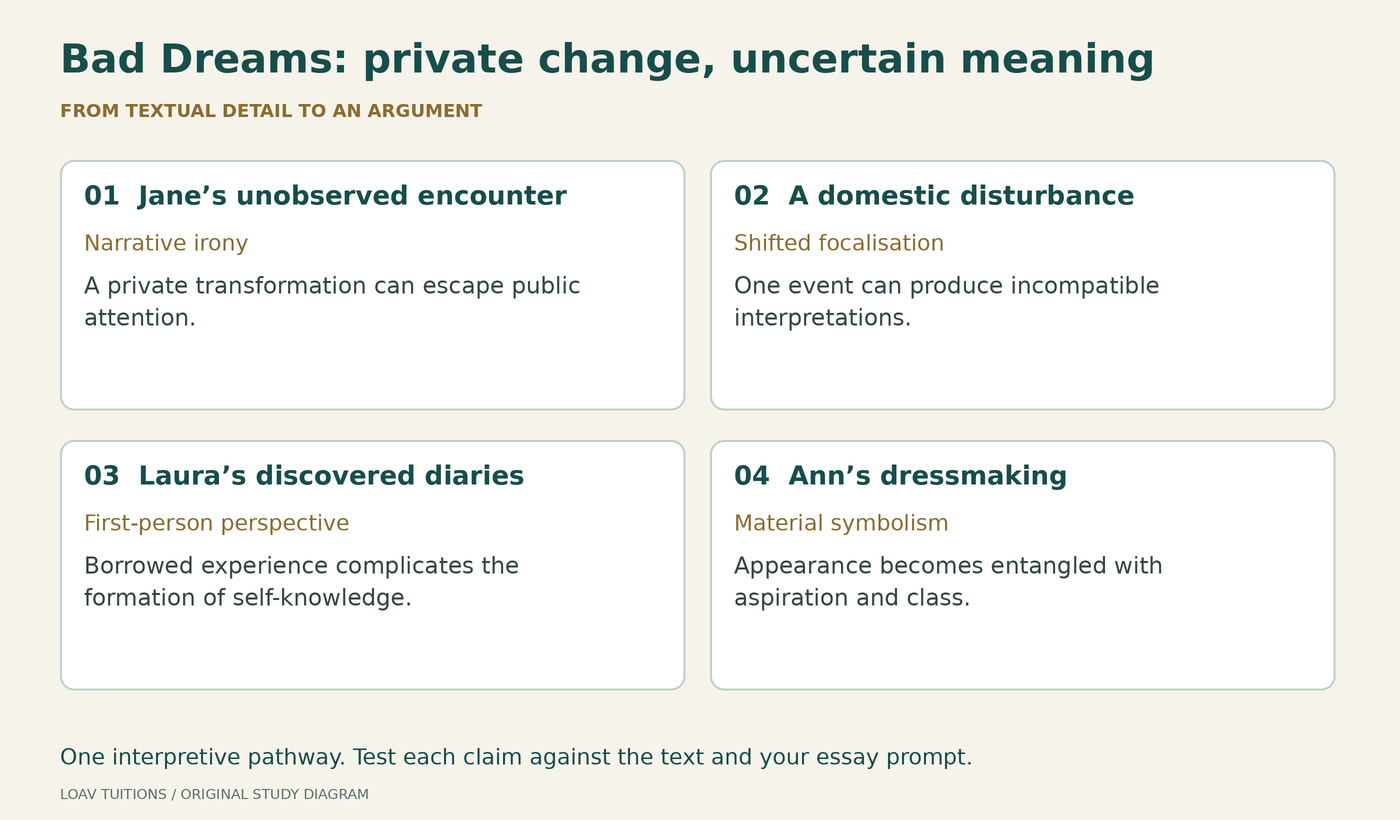
Start with the collection, not only its title story
Hadley investigates changes that people may barely recognise while they are happening. A conversation, an unexpected visitor, a private discovery or a return home can unsettle the story someone tells about their life. The collection does not offer one uniform lesson about maturity. Some discoveries enlarge understanding; others expose a person to disappointment, shame or a new version of self-deception.
The short-story form matters because it concentrates attention without providing a complete biography. Readers enter lives at particular pressure points and must judge what the ending resolves, what it changes retrospectively and what remains uncertain. Across the collection, proximity does not guarantee knowledge: relatives and lovers can misunderstand each other, while a temporary encounter can disturb a settled identity.
All ten stories: a revision map
The following are starting questions, not substitutes for reading. Use your copy to attach a precise event and authorial choice to each one.
- An Abduction: Jane’s encounter with older youths raises questions about unequal knowledge, adolescent longing and the distance between an experience and its public recognition.
- The Stain: Marina’s work caring for an older man brings private attachment into conflict with disturbing knowledge. How should sympathy respond to a troubling past?
- Deeds Not Words: Edith’s story invites comparison between private desire, public ideals and the costs imposed on women. Test whether declared principles survive personal pressure.
- One Saturday Morning: Carrie’s perspective makes adult conduct an object of partial understanding. What can a young observer notice without yet being able to explain?
- Experience: Laura’s housesitting and discovery of another woman’s diaries complicate the relationship between reading, imagining and living. What does borrowed knowledge actually teach?
- Bad Dreams: A child’s secret disturbance of domestic order generates consequences beyond her understanding. Ask how the change of viewpoint redistributes knowledge.
- Flight: Claire’s return to her sister Susan exposes unresolved family conflict. How far can personal reinvention escape the obligations and judgements of home?
- Under the Sign of the Moon: Greta’s journey and encounter with Mitchell place uncertainty beside the desire for contact. When does openness become vulnerability?
- Her Share of Sorrow: Ruby’s relationship with reading and writing invites questions about imaginative independence, family expectations and the difference between encouragement and recognition.
- Silk Brocade: Ann’s dressmaking and response to Nola connect clothing with social aspiration. How do material appearances shape judgements of other people?
Theme Analysis
Knowledge is uneven. Ask who possesses information, who misunderstands its significance and whether the narrator gives readers an advantage. Knowledge need not produce wisdom. A person can acquire a fact and still interpret it through desire, resentment or habit. This distinction helps avoid a simplistic coming-of-age argument in which every new experience equals progress.
Class is lived through detail. Houses, clothes, work and manners can disclose aspiration and exclusion without an explicit speech about social hierarchy. Analyse how a character evaluates such details and whether the narrative invites readers to trust that judgement. A preference may look personal while expressing a learned ranking of people.
Private feeling has public consequences. Hadley’s characters often inhabit emotional worlds unavailable to others. Yet those worlds influence action. An essay can trace the movement from fantasy or fear to behaviour, then to an effect that another person interprets differently. This is more precise than claiming that dreams and reality are simply opposed.
Transformation is not necessarily liberation. A change may produce exhilaration without security or knowledge without control. When a prompt asks about freedom, define whether it means choice, independence, social mobility, emotional release or imaginative possibility. Different stories can then qualify each other rather than merely repeat a theme.
Reading Hadley’s methods
Focalisation: distinguish who narrates from whose perceptions organise a scene. Close third-person writing can carry a character’s assumptions without endorsing them. Where a viewpoint shifts, ask what the newly available knowledge makes readers reconsider. This is especially important when a reader’s earlier judgement becomes less secure.
Irony: a gap between self-understanding and observable behaviour can be comic, painful or both. Do not use ironic as a synonym for unexpected. Identify the two positions that fail to match, then explain whose confidence is being tested. Hadley’s attention to frailty can coexist with criticism.
Objects and sensory detail: material things acquire meaning through use, desire and recollection. Rather than assigning a fixed symbolic definition, trace who values an object, why that value changes and whether another person reads it differently. The same object can connect lives while exposing incompatible expectations.
Compression and endings: a short story may move rapidly across time or stop before a consequence is fully visible. Analyse what that selection makes significant. An ending need not announce a moral to alter the whole story’s meaning. Ask whether it confirms a pattern, unsettles an apparent triumph or leaves responsibility unresolved.
Quote Bank
Use these short passages as starting points for analysis, not as fixed answers. References identify the story and scene in the collection; no print-edition page equivalence is claimed. Each quotation is continuous, with no silent omissions.
Recognition, judgement and unequal knowledge
- “she had overheard the dotty grandmother asking too loudly who the ‘plain’ one was.” Narrator through Jane; “An Abduction”. Jane remembers an adult’s judgement while feeling excluded by younger children. Authorial analysis: The recalled label shows social evaluation becoming internal self-surveillance; the narrative also exposes the cruelty of supposedly casual judgement.
- “Jane Allsop was abducted when she was fifteen, and nobody noticed.” Narrator; “An Abduction”. The collection’s opening frames Jane’s adolescent experience before recounting it. Authorial analysis: The abrupt coordination juxtaposes an alarming event with public inattention, separating felt significance from recognition.
- “For a moment, Greta seemed to see what Ian saw, as if she were looking down at herself.” Narrator through Greta; “Under the Sign of the Moon”. Greta recalls Ian’s contempt during their wedding-night conflict. Authorial analysis: The doubled perspective dramatises the danger of adopting an intimate partner’s hostile account as self-knowledge.
Secrecy, intimacy and misinterpretation
- “They would never know, and that was funny, too.” Narrator through the child; “Bad Dreams”. The child privately enjoys having overturned the furniture. Authorial analysis: Restricted focalisation grants readers causal knowledge that the mother later lacks, preparing the story’s dramatic irony.
- “only one explanation for the crazy scene in the front room:” Narrator through the mother; “Bad Dreams”. The mother wrongly attributes the disorder to her husband. Authorial analysis: The restrictive wording exposes unwarranted certainty: intimate resentment supplies an explanation where evidence is missing.
- “Very carefully then, so no one could tell that anything had been disturbed, she replaced everything else on top of it,” Narrator through Claire; “Flight”. Claire conceals her gift of a scarf at the bottom of Susan’s work bag. Authorial analysis: The careful concealment makes material care an indirect approach to a damaged relationship, without resolving the sisters’ conflict.
Class, performance and imagined transformation
- “they’d never get off the ground with the right people.” Narrator reporting Kit’s view; “Silk Brocade”. Ann recalls Kit’s warning about accepting indiscriminate dressmaking clients. Authorial analysis: The evaluative category embeds social exclusion in business ambition; the desired clientele defines success.
- “if only you could find the right clothes you could become whatever you wanted, you could transform yourself.” Narrator through Ann; “Silk Brocade”. Ann arranges fabric around Nola before the mirror. Authorial analysis: The conditional fantasy links identity to outward presentation; focalisation presents Ann’s conviction without guaranteeing its truth.
- “In reality, inside it was dingy and half furnished and needed a coat of paint.” Narrator through Marina; “The Stain”. The house Marina once associated with grandeur is revealed through her cleaning work. Authorial analysis: The corrective transition punctures the glamorous exterior; material detail makes class fantasy answerable to lived conditions.
Experience, gender and imaginative independence
- “I wanted to cross the threshold and be initiated into real life.” Laura; “Experience”. Laura imagines sexual experience as entry into a more authentic existence. Authorial analysis: The threshold metaphor turns experience into a desired initiation, revealing the assumption that one is not yet fully living.
- “In their shame, they could hardly bear to look at each other.” Narrator through Edith; “Deeds Not Words”. Edith encounters Laura after her imprisonment and force-feeding. Authorial analysis: The paired pronoun connects different injuries through Edith’s perception without making them identical; shame obstructs possible solidarity.
- “She staggered up dazedly from the world of her story, as if the one she returned to were the insubstantial fiction.” Narrator through Ruby; “Her Share of Sorrow”. Ruby emerges from immersive reading in the attic. Authorial analysis: The inverted comparison gives imaginative experience felt authority over everyday life while preserving the distinction between absorption and practical knowledge.
Practice Prompts
- In Bad Dreams and Other Stories, important changes often escape the understanding of those closest to them. Discuss.
- How does Hadley explore the relationship between self-knowledge and disappointment?
- Hadley’s characters can change their circumstances more easily than their assumptions. To what extent do you agree?
- How does Hadley use ordinary objects and settings to reveal unequal power?
Full Annotated Essay: relationships and self-discovery
Past VCAA topic, 2025, Question 1(ii): Discuss the role of relationships in prompting self-discovery across Hadley’s collection. This is a paraphrase of the official proposition. Read the official paper.
This complete original essay uses BCAS, three TEEAEAL paragraphs and CAS as optional teaching scaffolds. They are not VCAA requirements. The chosen stories form a connected argument; all ten stories remain prescribed.
Introduction
Tessa Hadley’s Bad Dreams and Other Stories explores moments when encounters with other people unsettle familiar accounts of the self. Relationships can prompt self-discovery, but the collection resists equating every disturbance with reliable insight. Other people’s judgements shape the identities characters seek to change, intimate uncertainty can generate self-protective misinterpretation, and social relationships expose the assumptions underlying personal ambition. Hadley consequently presents self-discovery as a contingent process: relationships create occasions for revision, but desire and habit determine whether those occasions produce understanding.
Body 1
Hadley initially suggests that self-discovery emerges within judgements supplied by other people, rather than through an entirely independent inward search. A character’s wish to become different can already reflect expectations absorbed from family and social life. An encounter may unsettle that identity without making its replacement securely autonomous. In “An Abduction”, Jane remembers that “she had overheard the dotty grandmother asking too loudly who the ‘plain’ one was”. By embedding an adult’s reductive judgement within adolescent recollection, Hadley shows how a social category becomes an apparently personal deficiency. Readers are prompted to question the standards behind the desire for recognition, rather than simply celebrating the discovery of a new identity. Yet the opening announces, “Jane Allsop was abducted when she was fifteen, and nobody noticed”. Hadley’s opening irony separates private upheaval from public recognition. A related separation shapes “Silk Brocade”, where the ambition to become socially different remains dependent on an imagined audience’s approval. Across these contrasts, apparent transformation does not necessarily escape the values that generated dissatisfaction. Hadley thus invites readers to distinguish a changed self-image from a critical understanding of the standards used to judge the self. Relationships can catalyse change because they help produce dissatisfaction, but Hadley leaves readers to distinguish that destabilisation from an achieved understanding of the self.
Body 2
Conversely, Hadley demonstrates that intimacy can intensify misinterpretation when an unfamiliar event is absorbed into an already familiar grievance. Living closely with someone supplies a persuasive framework for explanation, but confidence in that framework can prevent the recognition of alternative causes. The resulting certainty may feel like discovery while remaining mistaken. In “Bad Dreams”, the child anticipates her parents’ ignorance: “They would never know, and that was funny, too”. Hadley gives readers access to the cause of the disturbance before withholding that knowledge from the mother. This deliberate asymmetry makes intimacy an unreliable basis for certainty: emotional closeness cannot supply missing evidence. The mother later perceives “only one explanation for the crazy scene in the front room”. The restrictive phrasing turns confidence into evidence of interpretive limitation. Whereas the shifting focalisation exposes error directly here, “Silk Brocade” makes readers scrutinise Ann’s socially selective assessment of Nola through the gap between judgement and encounter. These different narrative arrangements refuse to endorse a character’s conclusions merely because readers inhabit their perspective. Hadley thereby presents self-discovery as requiring the correction of one’s interpretive habits, not simply a strongly felt response to another person. Relationships may provoke an apparent revelation about one’s life, but the narrative warns that a revelation can reproduce existing assumptions instead of overcoming them.
Body 3
Furthermore, Hadley uses social aspiration to reveal how relationships can expose the limits of a supposedly self-created identity. The wish to transform oneself often depends on being recognised by a preferred audience; independence can therefore conceal a continuing reliance on other people’s approval. In “Silk Brocade”, Kit fears that with the wrong clients “they’d never get off the ground with the right people”. Through the evaluative adjective, Hadley exposes the hierarchy concealed within apparently practical business judgement. Readers are invited to recognise that the imagined audience does not merely witness reinvention; its approval helps determine what reinvention is supposed to achieve. Ann believes that “if only you could find the right clothes you could become whatever you wanted, you could transform yourself”. Hadley’s material symbolism makes self-creation depend on being read differently by others. This outward performance contrasts with the child’s concealed agency in “Bad Dreams”: one form of independence seeks an audience, while the other protects itself from recognition. By juxtaposing such incompatible strategies across the collection, Hadley denies that self-discovery has a single public measure. Relationships reveal the competing values behind a desired identity, but understanding depends on questioning those values rather than merely gaining approval. Hadley presents social contact as an opportunity to recognise the dependencies beneath ambition, while leaving that recognition contingent on a willingness to question one’s own standards.
Conclusion
Relationships in Hadley’s collection generate occasions for self-discovery without ensuring that understanding follows. External judgements motivate change, intimate misinterpretation can resist correction, and social encounters expose the assumptions supporting reinvention. Ultimately, Hadley locates the difficulty of knowing oneself in the tension between needing other people and reading them selectively. Self-discovery requires more than an influential encounter: it demands the revision of the expectations brought to it.
Why this argument works
Structure map: The introduction follows BCAS: background establishes the text’s central tension, the contention gives a qualified answer, the arguments forecast the three body paragraphs, and the summary draws those claims into an authorial perspective. Each body follows TEEAEAL: an idea-led topic sentence and elaboration establish the claim; two evidence-and-analysis movements develop it; the link returns to the prompt. The conclusion follows CAS: it restates the qualified contention, synthesises the arguments and resolves their wider significance. These functions remain within the continuous prose; the labels are teaching tools, not VCAA requirements.
- Contention: the essay qualifies the topic’s proposition rather than accepting or rejecting it mechanically.
- Progression: the sequence examines identity’s formation, the risk of false discovery and the possibility of revising social assumptions.
- Method: each paragraph analyses a different construction of meaning: social judgement, shifting focalisation and material aspiration.
- Range: three stories supply the six contextual essay passages and support distinct conceptual claims. The thematic bank expands comparison to nine stories; all ten remain prescribed. A collection essay should select evidence by relevance rather than catalogue every title.
- Transitions and nominalisation: “Conversely” introduces a limitation; “Furthermore” develops the account. Recognition, misinterpretation and reinvention make the conceptual distinctions explicit.
Evidence and sources
The twelve bank passages and six essay quotations use the HarperCollins first US ebook edition, May 2017, ebook ISBN 9780062476685. This differs from the prescribed Vintage 2018 collection. References identify the story and scene rather than assuming equivalent page numbers across editions. The bank draws on nine stories, and the model essay develops three rather than substituting a title-story-only reading. The magazine versions linked below are supplementary. This original essay has not been assessed by VCAA.
- Vintage: listed edition and collection overview.
- Tessa Hadley, “An Abduction”: primary publication.
- Tessa Hadley, “Bad Dreams”: primary publication.
- Tessa Hadley, “Silk Brocade”: primary publication.
- English Tutor Lessons: collection and narrative overview.
- VCAA English assessment reports. The 2024 report warns against replacing the actual topic with a preferred theme and against disconnected story-by-story demonstration. No assessment essay is copied here.
For help applying this analysis to your own writing, explore Loav’s VCE tutoring or enquire about a trial class.
