
A decision can help a business reach its objective while creating a serious problem for someone it depends on. In revision, practise explaining that tension rather than giving each stakeholder a disconnected paragraph. Your task is to show who benefits, who bears the cost, and why a proposed response is defensible despite its limitations.
The current VCAA Business Management study design includes stakeholder interests and potential conflicts in Unit 3, and the effects of change on stakeholder groups in Unit 4. The routine below is an original Loav practice exercise, not a VCAA answer template or marking scheme. Adapt it to the command term and scope of the question you actually receive.
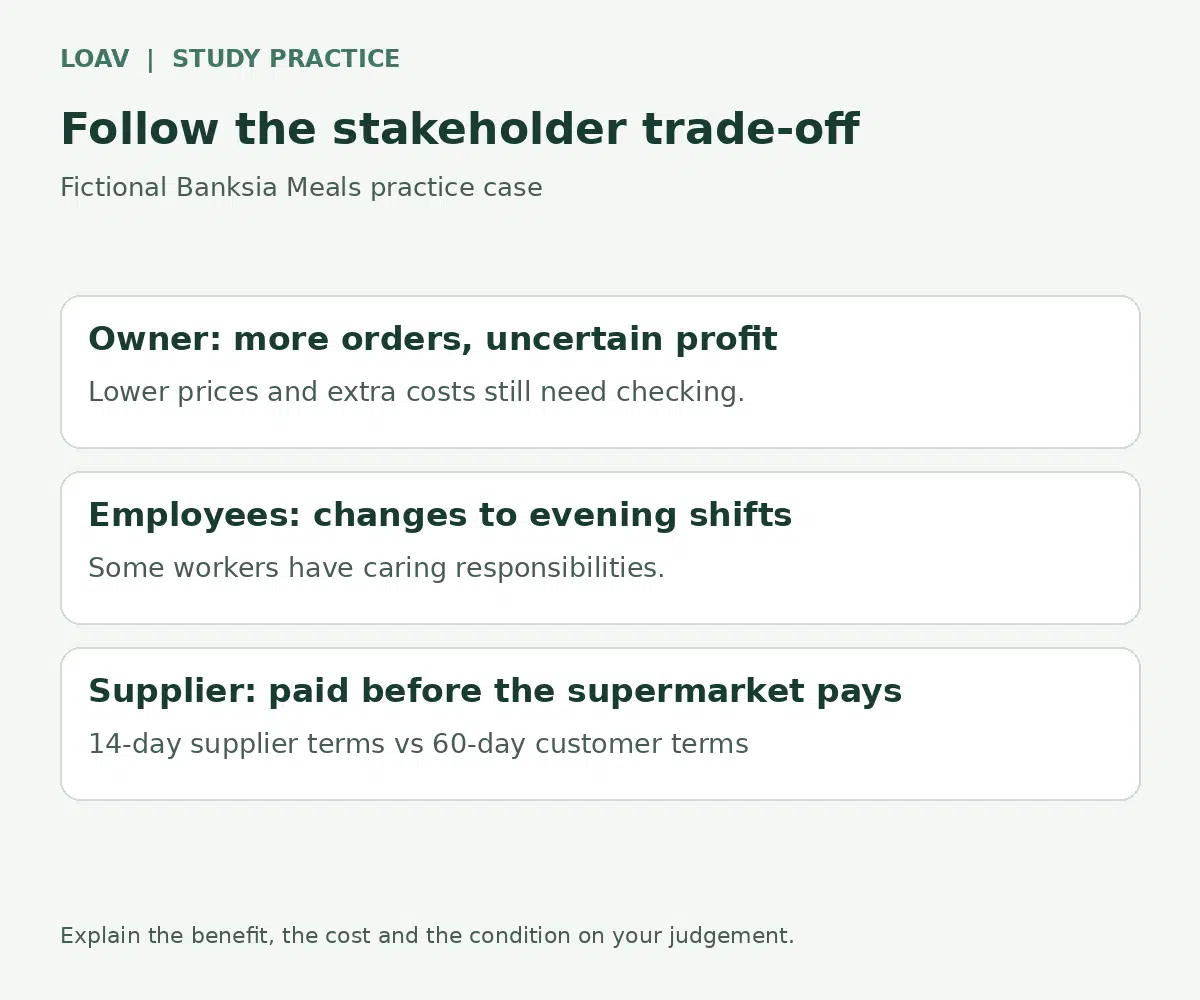
The case: a bigger order with an awkward condition
Fictional practice case: Banksia Meals makes refrigerated lunches for local shops. Its owner wants to increase profit. A supermarket offers a six-month supply contract that would increase weekly orders, but requires a lower price per meal and pays invoices after 60 days. Banksia currently pays its vegetable supplier within 14 days.
To produce the extra meals, the manager proposes buying packing equipment and moving some employees from packing to evening preparation shifts. Training would be needed. Several employees have said that evening work would conflict with caring responsibilities. The supplier is a small grower that depends on prompt payments. Existing shop customers value reliable deliveries and do not want their orders pushed aside.
These details are invented for practice. They are not evidence about a real business and should not replace a researched contemporary case study when a question requires one.
Minutes 0–5: identify the decision and its constraint
Write the decision in one line: Should Banksia accept the contract on the proposed terms? Underneath, write the owner's objective and the most important constraint.
The objective is increased profit, not simply more orders. The lower selling price, equipment purchase and training costs mean that extra sales would not automatically increase profit. The payment gap also creates a cash-flow concern: Banksia must pay the grower before receiving the supermarket's money.
Do not invent a profit margin, cash balance or equipment saving to settle the question. Write “unknown” beside missing information. That gives your eventual recommendation a sensible condition rather than false certainty.
Minutes 5–12: make the conflict explicit
Choose two stakeholder pairs. For each, write an interest, a consequence and the connection between them. Try these starting points:
- Owner and employees: the owner may welcome greater production capacity, while employees with caring responsibilities may find evening shifts difficult to accept. The same production change could support growth while reducing roster suitability for some workers.
- Owner and supplier: delaying payment to the grower could help Banksia manage the 60-day wait, but would transfer that pressure to a supplier that relies on prompt payment. Protecting Banksia's cash position this way could damage an important supply relationship.
Now add a shared interest. Both owner and supplier benefit from a dependable trading relationship. Both owner and employees have an interest in a viable business. Shared interests make the response more realistic, but do not erase disagreement about who should carry the immediate cost.
Minutes 12–18: propose a response that leaves a cost visible
Choose one response and explain what it would involve. For example, Banksia could seek a smaller initial contract with earlier supermarket payment, while consulting employees about workable preparation rosters before committing.
Explain the mechanism. A smaller initial volume could reduce pressure on existing deliveries and the immediate staffing change. Earlier payment could narrow the gap between money received and supplier payments. Consultation could reveal whether a workable roster exists; it does not guarantee that every employee's needs can be met.
Then name the remaining disadvantage. The supermarket might reject revised terms, and a smaller contract would limit the sales opportunity. A recommendation that pretends everyone wins has skipped the difficult part.
Minutes 18–23: write a conditional judgement
Use the case to defend a choice, rather than ending with “there are advantages and disadvantages”. For this drill, a defensible judgement might be:
Banksia should seek revised terms before accepting. The larger order may increase sales, but the lower price and additional costs leave the profit outcome uncertain. Earlier payment and a smaller initial volume would reduce pressure on the supplier relationship and existing deliveries. Acceptance should depend on a costed profit estimate, a workable roster and sufficient cash to maintain agreed supplier payments. This sacrifices some potential sales, but addresses the constraints identified in the case.
This is an illustrative judgement, not an official model response. A different choice can be argued if its reasoning fits the evidence.
Minutes 23–25: check the reasoning, then move on
- Have I connected two interests to the same decision?
- Have I explained consequences instead of only naming stakeholders?
- Have I separated case facts, possible outcomes and unknowns?
- Does my response explain how it helps and what it still costs?
- Does my judgement answer the question actually asked?
Your next step is one relevant question from the official VCAA past examinations. Answer it before checking its report. The 2025 assessment report, particularly Questions 1b and 2c, distinguishes meaningful case application and justified action from merely repeating details or asserting benefits. Use that distinction to find one sentence to improve, then rewrite it.
