
A reading passage may contain several voices: a student being quoted, a person whose opinion is reported, and a writer who comments on both. If you attach a claim to the wrong person, an answer can sound sensible while misreading the passage.
For a short practice session, focus on one question: who is responsible for this view? A small speaker map can help you keep the voices separate before you judge their meaning.
ACER's current SEHS preparation guidance describes reading as retrieving information and interpreting and evaluating ideas in texts. It also says that special practice or revision is not necessary, while sample questions can help students become familiar with the style. This article offers optional general reading practice. The passage and questions are original, not official questions or a prediction of a future examination.
Try this original passage
The school newsletter reported a proposal to keep the library open for twenty minutes after the final bell. It quoted Mira, a student who waited for a later bus: “A later closing time would give students like me somewhere quiet to wait.”
Arun, another bus traveller, was less enthusiastic. His bus left immediately after school, so he would not be able to use the extra time. He suggested surveying students before changing the opening hours.
The principal did not reject the proposal. She said that the school first needed to establish how many students would use the library and whether staff could supervise it. A trial might then be considered.
The newsletter concluded that the two students' different journeys mattered. Before treating bus travellers as one group with identical needs, the school should collect information about when they left. A survey would provide a firmer basis for a decision than either student's experience alone.
Read the whole passage once. Then cover it and say, in one sentence, what the discussion is about. Reopen it before answering detailed questions; this is reading practice, not a test of how much wording you can memorise.
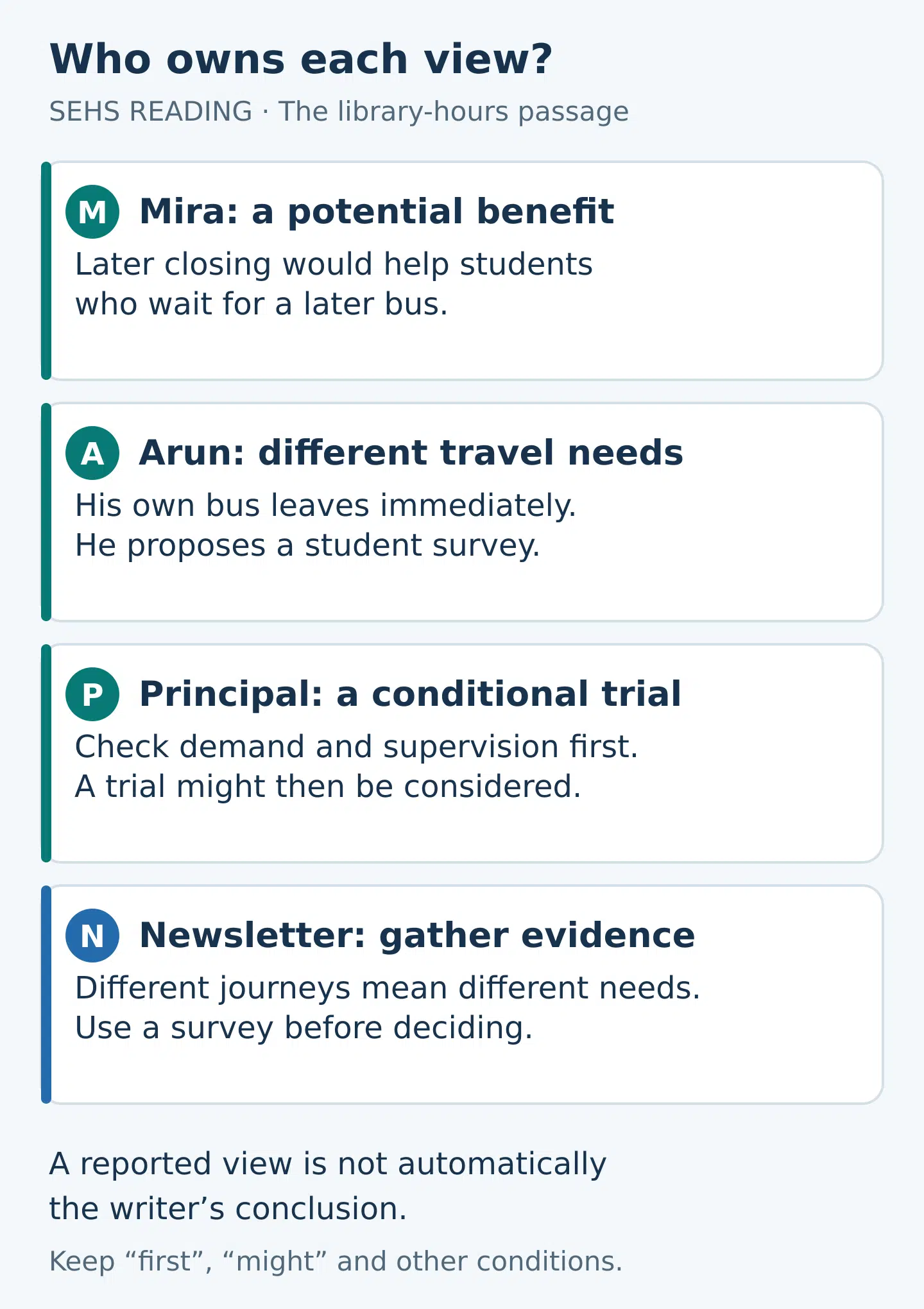
Make a four-row speaker map
Write one short line for each source. Use your own wording, but keep conditions such as “first”, “might” and “students like me”. Those small words limit the claim.
- Mira: supports later closing because it would help students waiting for a later bus.
- Arun: would not personally benefit and suggests a survey before a change.
- The principal: wants information about demand and supervision before considering a trial.
- The newsletter: argues that different travel arrangements should be investigated before deciding.
Notice that the principal's caution is not the same as rejection. Arun's lack of personal benefit is not proof that nobody would benefit. The newsletter reports Mira's view but does not conclude that later closing must be introduced.
Answer three questions, then inspect the source of each claim
1. Which person explicitly proposes surveying students before changing the hours? Arun. The principal asks for information, but the passage specifically attributes the survey suggestion to Arun. A similar intention does not make the wording interchangeable.
2. What is the principal's position? A trial could be considered after the school investigates demand and supervision. “She has approved later opening” is too strong. “She refuses to consider it” contradicts the passage.
3. Which statement best matches the newsletter's conclusion? The school should gather information about students' different departure times before deciding. It does not argue that all students need the library open later, or that bus travellers should receive priority over everyone else.
For each answer, point to the sentence that supports it and name its source. If your explanation begins “Mira thinks…”, check whether the question asks about Mira or about the newsletter. This is a useful place to catch a source mix-up.
Track reported speech as carefully as quotation marks
Quotation marks make Mira's words easy to spot. Arun's and the principal's views are reported without a full direct quotation. They still belong to those people. The writer's act of including a statement does not automatically mean the writer endorses it.
Watch reporting verbs and surrounding commentary. “Said”, “claimed”, “questioned” and “conceded” can frame a view differently, but do not assign a tone from one verb alone. Read the surrounding sentences. A writer may quote an argument in order to challenge it.
Pronouns also need a named owner. In the third paragraph, “She” refers to the principal. If a pronoun has more than one plausible referent in a different passage, reread the preceding sentences instead of choosing the nearest name automatically.
Keep different kinds of voice distinct
In an informative or opinion piece, distinguish the writer's position from the people and organisations it quotes. In fiction, a narrator and a character may have different knowledge or attitudes; neither should automatically be treated as the author's personal view. A first-person narrator can misunderstand events, so check what the passage reveals beyond that narrator's claims.
You do not need to label every sentence in a long text. Mark only the voices relevant to the question, then follow the point where the passage changes speaker or returns to its own commentary. The map is a temporary support, not an extra essay to write.
Run a short voice-check session
- Choose a short, age-appropriate passage with two or three viewpoints.
- List each speaker or source and one accurately limited claim.
- Write two questions: one about a quoted or reported view, and one about the passage's overall position.
- Answer with a sentence reference. Then create one wrong answer by deliberately swapping the speakers.
- Explain exactly why the swap changes the meaning. Finish by reading the passage again without the map.
Keep this untimed while you are learning the distinction. Later, try using only a few initials beside the relevant lines. Do not turn a map into an inflexible exam procedure; follow the instructions and use the approach only when it helps.
Research on self-explanation reading training by McNamara (2004) examined prompting readers to explain meaning rather than only read aloud. Benefits depended on the text and readers' prior knowledge; the study did not test speaker maps or selective-entry results. It supports exploring meaning actively, but this particular voice-check routine is an original practice suggestion.
For broader context, see Loav's SEHS reading, verbal reasoning and writing guide. Use this session to practise voice attribution alone, rather than trying to improve every reading skill at once.
Your next step: take one passage you have already read and find a view you may have attached to the wrong source. Correct the speaker, preserve the claim's conditions and answer the question again. Aim for a more precise reading, not a longer explanation.
