
You can do the arithmetic correctly and still answer the wrong question. In a word problem, the first challenge is deciding what the numbers mean and how they relate. Before practising faster calculations, practise building a clear mathematical representation of the situation.
For Victorian selective entry preparation, this is useful general learning rather than a special exam trick. ACER describes quantitative reasoning as reasoning with numbers, patterns and shapes in abstract and real-world settings. Its current guidance says additional exam practice or revision is not necessary; official samples are for becoming familiar with the format. The optional routine below develops an everyday mathematical skill, not a required preparation program. Read ACER’s preparation guidance.
Use a four-line setup
Take an unfamiliar question and pause before calculating. Write these four lines on scrap paper:
- Find: Name the unknown, including its unit.
- Know: Record only the quantities that help answer that question.
- Relate: Draw a bar, make a small table or write an equation connecting the quantities.
- Check: Predict a sensible range or relationship for the answer.
Keep the representation simple. A bar split into equal parts can show a ratio. A two-column table can pair litres with minutes. A labelled equation can show a starting amount plus repeated changes. Drawing decorative details is not the goal: every mark should explain a quantity or relationship.
Example 1: distinguish a total from a difference
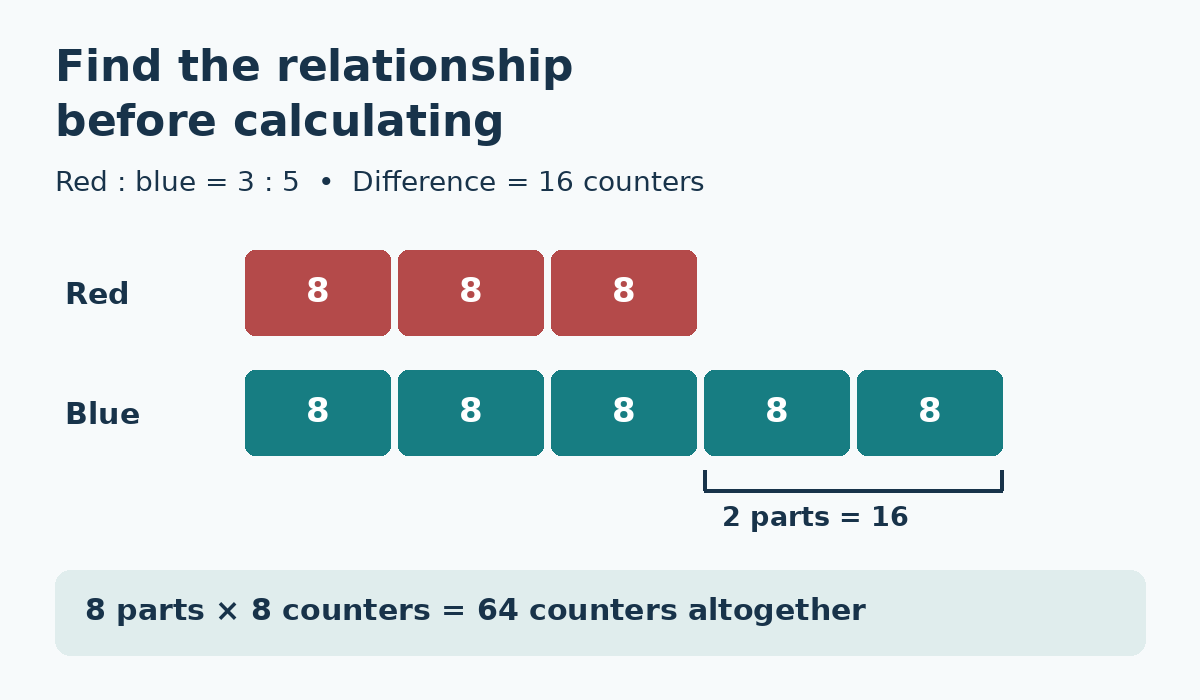
Original practice question: A club has red and blue counters in the ratio 3:5. There are 16 more blue counters than red counters. How many counters are there altogether?
The unknown is the total number of counters. Represent red with three equal boxes and blue with five equal boxes. The extra two boxes represent the difference of 16, not the total.
- Two parts = 16 counters, so one part = 8 counters.
- Red: 3 × 8 = 24. Blue: 5 × 8 = 40.
- Total: 24 + 40 = 64 counters.
Now check both conditions: 24:40 simplifies to 3:5, and 40 − 24 = 16. Dividing 16 by eight would treat the difference as the total. The bar model helps you see why that operation answers a different question.
Change just one sentence: suppose there are 64 counters altogether instead. The same eight-part diagram now has a different label. This time, 64 ÷ 8 gives the size of one part. Comparing these two versions makes the important distinction visible.
Example 2: give every rate a unit
Original practice question: A tap delivers water at a constant rate of 12 litres every 3 minutes. An empty tank needs 50 litres. How long will filling take?
Write the unknown as “time in minutes”, not just “x”. A rate table can pair 3 minutes with 12 litres and 1 minute with 4 litres. Therefore, time = 50 litres ÷ 4 litres per minute = 12.5 minutes, or 12 minutes 30 seconds.
Check the scale: 12 minutes supplies 48 litres, so the answer should be a little above 12 minutes. Also check the wording: the constant-rate condition is what allows proportional reasoning. Do not assume every real tap or every rate problem behaves that way unless the question supports it.
Practise the setup separately from the solution
Try a short session with three suitable word problems from your schoolwork. Spend the first few minutes writing only the four-line setups. Then solve them and compare your representations with the solutions or your teacher’s explanation.
For each mismatch, identify its location: misunderstood unknown, missing relationship, inconsistent units or arithmetic. Rewrite only the faulty line, then try a different problem with the same underlying relationship. Start untimed; the purpose is to notice the reasoning that rushing can hide.
Research offers a reason to take structure seriously, without promising an entrance-exam result. A randomised study of seventh-grade students found benefits from a multiweek program combining mathematical structure, diagrams and problem-solving monitoring. Benefits did not extend to its transfer test, so the findings do not establish that one diagram or this short routine improves every unfamiliar task. Read the original study by Jitendra and colleagues.
Your next-session checklist
- Have I named exactly what I need to find?
- Does each number have a meaning and unit?
- Does my representation show the relationship, not merely copy the story?
- Have I checked the result against every condition?
Next time a question feels difficult, try explaining its relationships before reaching for a calculation. If you cannot explain your diagram, ask your teacher to help you fix the setup. That is a more precise request than simply saying you do not understand the whole question.
