
You close your books after a reasonable study session. The next afternoon, you open them again and spend the first ten minutes asking: which question was I doing, what had I checked, and why did I stop?
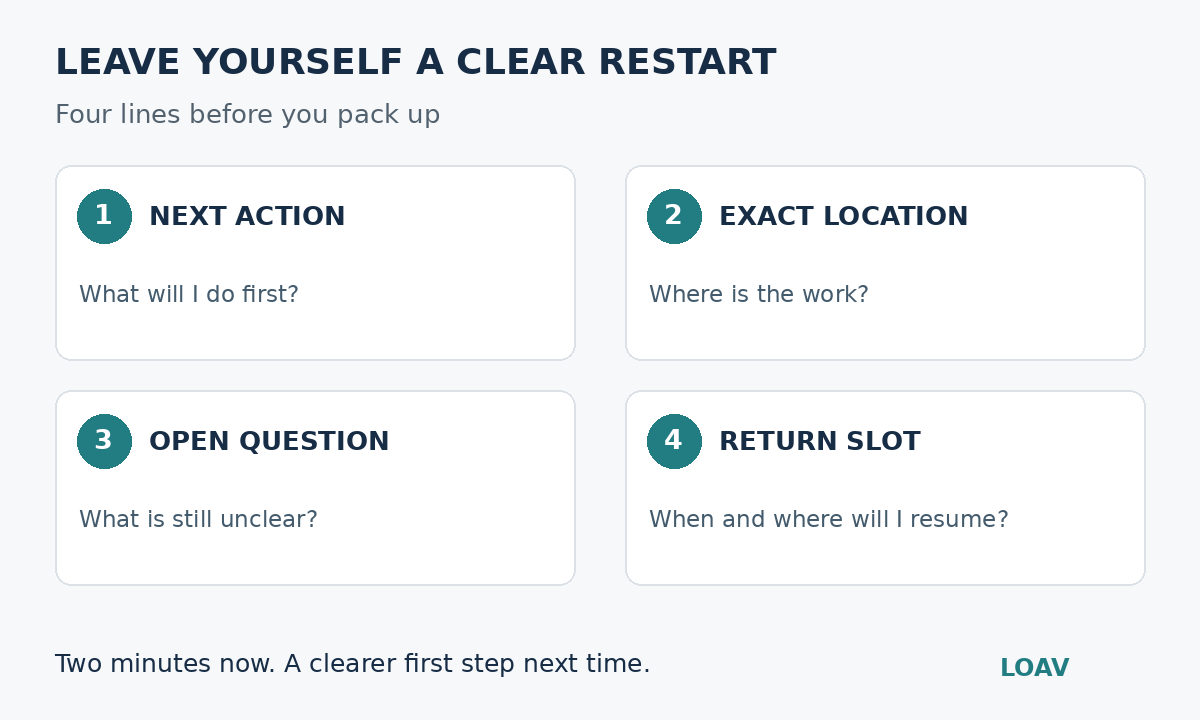
A restart note is a short message to your future self. It records the exact point you reached and the first useful action for your return. It is not another weekly timetable, a polished summary or a long list of everything you still need to learn. Try writing one before you pack up today.
Why leave a note when you already know the task?
In experiments reported by Masicampo and Baumeister in 2011, making specific plans for unfinished goals reduced some intrusive thoughts and interference during other tasks. That does not prove a restart note will improve VCE results or remove stress. It offers a reason to test a clear plan rather than carrying a vague unfinished task around in your head. Read the original research paper.
The routine below is Loav’s practical suggestion, not an official examination requirement. Its purpose is simple: make your next start less dependent on remembering today’s train of thought.
Write four lines before you stop
- Next action: name one thing you will do, using a verb such as solve, sketch, explain, compare or check.
- Exact location: identify the question, page, file and any saved working you need.
- Open question: record the point you have not resolved, rather than pretending the work is finished.
- Return slot: choose a realistic time and place to pick it up.
Keep the note where the work lives: inside the exercise book, beside the question, or at the top of the relevant document. A note hidden in a separate planning app is not helpful if you forget to open that app.
Replace a vague instruction with a usable handoff
“Do more Methods” gives tomorrow’s version of you too many decisions. A clearer note might read:
- Next action: solve the quadratic again without looking at my previous working.
- Location: my revision book, page 18, the example marked with a star.
- Open question: did I check whether both roots fit the stated domain?
- Return slot: Tuesday at 4:30 pm, at my desk, before starting the next exercise.
For example, if your original practice question gives x² − 5x + 6 = 0 with x > 2, the algebra produces roots 2 and 3, but only 3 satisfies the condition. The restart task is not copying “3”. It is solving again and explaining why one root is excluded. This is an original illustration, not a past examination question.
Use the unresolved question to ask for better help
Sometimes the next action is not another attempt. You may need a teacher to check an assumption, clarify a term or explain a step. Record what you tried and the precise uncertainty.
A SEHS preparation note could say: “I drew equal-sized boxes for the ratio problem, but I do not know whether the stated total includes both groups. Ask about that sentence before completing the calculation.” Keep the problem statement and your diagram together. That gives someone enough context to help without having to reconstruct your whole session.
If you cannot get help immediately, write a separate task you can complete independently. Do not spend the entire next session circling the same unresolved point. Equally, do not label an uncertain answer correct simply to clear the task.
Make the return small, but meaningful
Your first action should be small enough to start promptly and substantial enough to produce evidence of learning. “Open the folder” is preparation; “attempt the first part without the solution” is study. “Finish the whole chapter” may be too large for a useful starting instruction.
When you return, attempt that action before rereading everything. Then check your work and decide whether to continue, practise a related question or seek help. The note is a starting point, not a contract: change it if a deadline, teacher instruction or new difficulty makes another task more important.
Keep the material appropriate
If your note points to a past VCE question, record the subject and year as well as its number. Use the VCAA student resources page to reach official past papers and study designs. Check that older material fits your current course, with your teacher’s guidance where needed. A precise note cannot make an outdated question relevant.
Tonight’s two-minute checklist
- Can I identify exactly where to restart?
- Does my first action require me to think, not just organise?
- Have I separated checked work from unresolved work?
- Is the return slot realistic, with the materials easy to find?
Try this for your next three sessions. Notice whether you begin the intended task sooner and whether the note preserves the question you were trying to answer. Keep the parts that help. The goal is a clearer return to learning, not a more elaborate planning system.
