
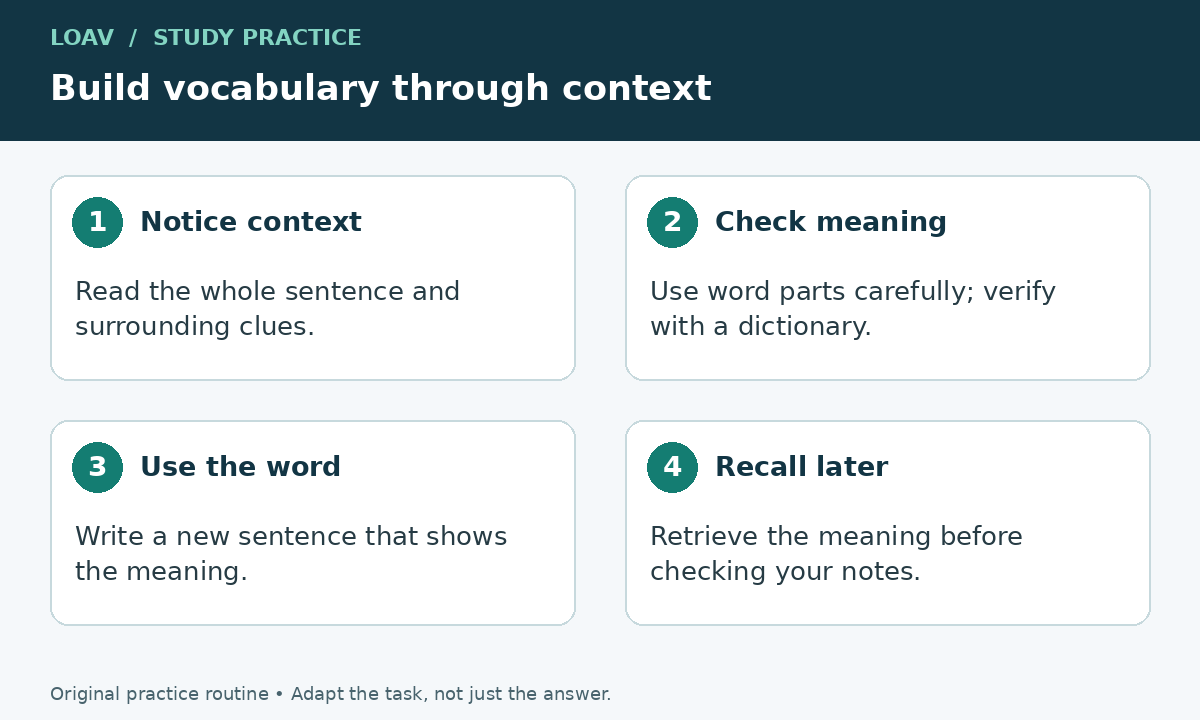
A vocabulary notebook can grow quickly while the words inside it remain hard to use. If you are thinking about Victoria's selective entry high schools (SEHS), a manageable alternative is to investigate a few useful words, meet them in sentences and recall them after a gap. The aim is better understanding, not the longest possible list.
First, keep the official position clear. ACER says students do not need to practise or revise for the entrance exam and encourages broad, age-appropriate learning. The Victorian Department of Education describes an assessment of reasoning and higher-order thinking. This optional Loav routine is everyday vocabulary advice, not an official preparation programme or a promise of admission.
Choose words worth investigating
Start with three words from something you already read: a novel, a science explanation or a thoughtful article. Choose words that stop you understanding a sentence, recur across subjects or express a useful distinction. Skip obscure words selected only because they look impressive.
For each word, keep its source sentence, a plain-English meaning, one original example and a next-review date. A dictionary definition alone cannot show which meaning the writer intended. Check the relevant sense and part of speech, rather than copying every entry.
Use a 15-minute session
- Minutes 0 to 3: recall. Cover the meanings of older words. Explain each aloud, then check. In your first session, use this time to choose your three words.
- Minutes 3 to 7: investigate context. Reread the sentences around each new word. Underline the clue that supports your best guess. Mark uncertainty instead of treating a guess as a fact.
- Minutes 7 to 11: verify and connect. Check a dictionary. Look for meaningful word parts or a related word. Correct your original guess in a different colour.
- Minutes 11 to 15: use and schedule. Write a new sentence for each word. Hide the notes and explain one meaning again. Add the next review date, then stop.
If three words take longer, choose two next time. Keep enough time to check understanding rather than racing through entries.
Worked example: let context narrow the meaning
Mira's agreement was tentative: she would decide after seeing the costs.
The second clause tells us that Mira has not committed. A sensible first guess for tentative is “not yet definite”. Check that sense in a dictionary, then test a fresh sentence: “We made a tentative booking while we checked the train times.”
Now compare it with a non-example: “The signed agreement could no longer be changed.” Explain why tentative would not fit that situation. This exposes shallow understanding that repeating a synonym can hide. These sentences are original learning examples, not sample entrance-exam questions.
Use word parts as clues, then check
Consider unpredictable. The prefix un- signals “not”; predict concerns saying what will happen; -able suggests something can be done. Together they suggest something whose behaviour or outcome cannot be reliably predicted.
Try: “The wind was unpredictable, changing direction several times.” Then connect predict, prediction and predictable. Do not split every unfamiliar word wherever the letters look convenient. Word parts are clues, and context plus a dictionary must confirm the meaning.
A middle-school vocabulary study by Lesaux and colleagues found gains in taught-word knowledge and morphological awareness from a multifaceted programme. That supports exploring words in several ways, but does not establish that this short routine improves SEHS results.
Give the words a weekly return date
Learn the small set on Monday. On Tuesday, recall meanings before opening the notebook. On Thursday, mix them with older words and write different examples. On Sunday, ask someone to give you the words in a shuffled order. Revisit them the following Sunday, even if this week's review felt easy.
Keep review sessions within 15 minutes. Use spare time for reading rather than immediately repeating the same three answers. This timetable is a practical starting point, not a scientifically fixed interval.
Karpicke and Roediger's vocabulary experiment found that repeated retrieval improved delayed recall. Kornell's flashcard experiments also favoured spaced study over cramming. Those studies involved university learners, so treat them as support for the learning principles, not a forecast of your results.
Check understanding before adding more
- Can I explain the meaning without looking?
- Can I point to the context clue?
- Can I use the word accurately in a different sentence?
- Can I still do this after several days?
If a word fails a check, correct it and bring its next review forward. Your next step is small: choose today's reading, investigate three useful words and put the first return date in your notebook.
Browse Loav’s study articles and guide collections for more practical learning advice.
